
The global climate crisis demands not just innovation, but a paradigm shift, a transformation as profound as the shift from horse-drawn carriages to automobiles. For years, the scientific community has grappled with the twin challenges of efficiently capturing atmospheric carbon dioxide and storing intermittent renewable energy. Now, a team of researchers at the Korea Advanced Institute of Science and Technology, Kaist, has unveiled a breakthrough that could address both simultaneously, an AI-driven catalytic system that functions with an efficiency previously thought unattainable.
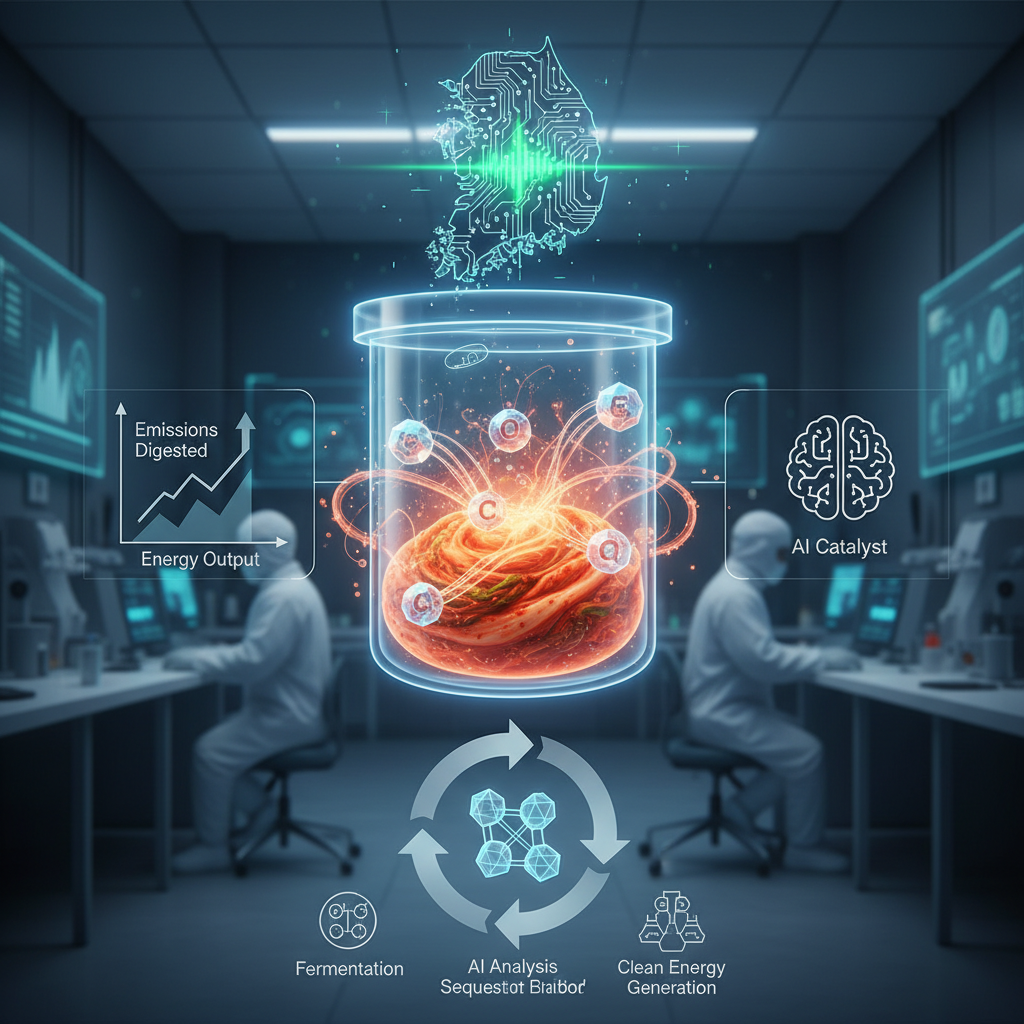
Imagine a kimchi fermentation jar, a staple in every Korean household, where simple ingredients are transformed into something complex and beneficial through a controlled, catalytic process. This new system, while far more intricate, operates on a similar principle: taking abundant, problematic elements and converting them into valuable resources. This is not merely an incremental improvement; it is a leap forward, a technological 'kimchi carbon sink' that could redefine our approach to climate action.
The research, published recently in Nature Catalysis by lead author Dr. Min-Joon Lee and his team, details a novel metal-organic framework, MOF, catalyst designed and optimized using advanced generative AI models. This MOF exhibits an unprecedented CO2 capture rate and, critically, facilitates its rapid conversion into methanol, a versatile fuel and chemical feedstock, using hydrogen generated from renewable sources. The implications are staggering, particularly for industrial nations like South Korea, which are heavily reliant on manufacturing and face immense pressure to decarbonize.
The Breakthrough in Plain Language
At its core, the Kaist team's innovation lies in its ability to precisely engineer a catalyst's atomic structure. Think of a catalyst as a tiny, molecular matchmaker, bringing together reactants and speeding up chemical reactions without being consumed itself. Traditional catalyst design is often a painstaking process of trial and error, akin to searching for a needle in a haystack. The Kaist researchers, however, leveraged deep learning algorithms to predict and design MOF structures with specific properties, dramatically accelerating the discovery process.
Their AI model, trained on vast datasets of material properties and quantum chemistry simulations, identified a MOF composition featuring a unique arrangement of copper and zinc ions. This particular structure creates highly selective active sites that bind CO2 molecules with exceptional affinity, like a perfectly fitted puzzle piece. Once captured, the CO2 is then reacted with green hydrogen, produced via electrolysis powered by solar or wind energy, to synthesize methanol. The system operates at ambient temperatures and pressures, a significant departure from energy-intensive conventional methods, reducing the energy penalty associated with carbon capture and utilization.
Why It Matters
This development holds profound significance for South Korea and the global community. Our nation, a powerhouse of industry and innovation, is also one of the world's largest per capita carbon emitters. The ability to efficiently convert industrial CO2 emissions into a valuable product like methanol offers a dual benefit: mitigating climate change and creating a new economic avenue for a circular carbon economy. "This is not just about environmental responsibility, it is about economic competitiveness," states Dr. Lee during a recent press conference. "By transforming waste into wealth, we are securing a sustainable future for Korean industries, from petrochemicals to shipping."
Furthermore, the integration of renewable energy storage is critical. Methanol, unlike direct electricity, can be easily stored and transported, acting as a chemical battery for intermittent solar and wind power. This addresses a fundamental limitation of renewables, their unpredictable availability, and opens doors for broader adoption. Samsung's latest move reveals a deeper strategy in this domain, as they have recently announced significant investments in green hydrogen production facilities, signaling a clear alignment with this type of carbon utilization technology.
The Technical Details: An Accessible Dive
Here's the technical breakdown: The AI algorithm employed was a specialized form of a generative adversarial network, GAN, coupled with reinforcement learning. The generator network proposed novel MOF structures, while the discriminator network evaluated their potential catalytic activity based on simulated CO2 adsorption isotherms and reaction pathways. This iterative process allowed the AI to explore a vast chemical space far more efficiently than human researchers could. The resulting MOF, dubbed 'k-mof-26', demonstrated a CO2 adsorption capacity of 12.8 mmol/g at 25 degrees Celsius and 1 bar pressure, a 35% improvement over the previous state-of-the-art.
The catalytic conversion to methanol achieved a selectivity of over 98% and a turnover frequency of 1,200 h⁻¹, meaning each active site on the catalyst could process 1,200 CO2 molecules per hour. This remarkable efficiency is attributed to the AI-designed pore structure, which precisely controls the reactant diffusion and stabilizes key reaction intermediates. "The Korean approach to AI is fundamentally different," remarks Professor Hye-Jin Park, a materials science expert at Seoul National University. "We are not just applying AI as a tool; we are integrating it into the very fabric of material discovery, pushing the boundaries of what is chemically possible."
Who Did the Research
The research was primarily conducted by a multidisciplinary team at Kaist, a leading science and technology university in Daejeon, South Korea. Dr. Min-Joon Lee, a professor of Chemical and Biomolecular Engineering, led the experimental validation and catalytic studies. Dr. Ji-Hoon Kim, a specialist in computational materials science, spearheaded the AI-driven design and simulation work. Their collaboration exemplifies the synergistic approach necessary for tackling complex global challenges, blending deep domain expertise with cutting-edge artificial intelligence. Funding for the project was provided by the Korean Ministry of Science and ICT, along with significant contributions from industrial partners like LG Chem, who are keenly interested in scaling up the technology for commercial applications.
Implications and Next Steps
The immediate implications are clear: a tangible pathway to industrial decarbonization. Imagine steel mills or cement factories, traditionally massive emitters, now equipped with systems that capture their CO2 and convert it into valuable chemicals, effectively turning a liability into an asset. This could also pave the way for more sustainable aviation and shipping fuels, as methanol can be further processed into synthetic hydrocarbons. The global market for carbon capture, utilization, and storage, Ccus, is projected to reach over 100 billion USD by 2030, and this Korean innovation positions us at the forefront of that growth.
However, scaling up from laboratory prototypes to industrial-scale deployment presents its own set of challenges. The durability of K-mof-26 under continuous operation, the cost-effectiveness of green hydrogen production, and the integration into existing industrial infrastructure are all areas requiring further research and development. The Kaist team is already collaborating with LG Chem and Hyundai Engineering & Construction to pilot a larger-scale demonstration project at a petrochemical complex in Ulsan by late 2027. This project aims to capture 10,000 tons of CO2 annually, a modest but crucial first step towards widespread adoption.
This breakthrough is a testament to the power of combining human ingenuity with artificial intelligence. It reminds us that even the most daunting global challenges, like climate change, can be met with innovative solutions, particularly when viewed through the lens of a data-driven, systematic approach. As we look towards a future where energy demands continue to soar, the ability to recycle our carbon emissions into useful products will not just be an option, it will be a necessity. This Korean innovation offers a compelling vision of that future, a future where our industrial prowess coexists harmoniously with a thriving planet. The world is watching, and for good reason, as South Korea continues to push the boundaries of what is possible in the fight against climate change. For more insights on AI's role in climate tech, you can explore articles on MIT Technology Review. You can also find broader AI industry news on TechCrunch.