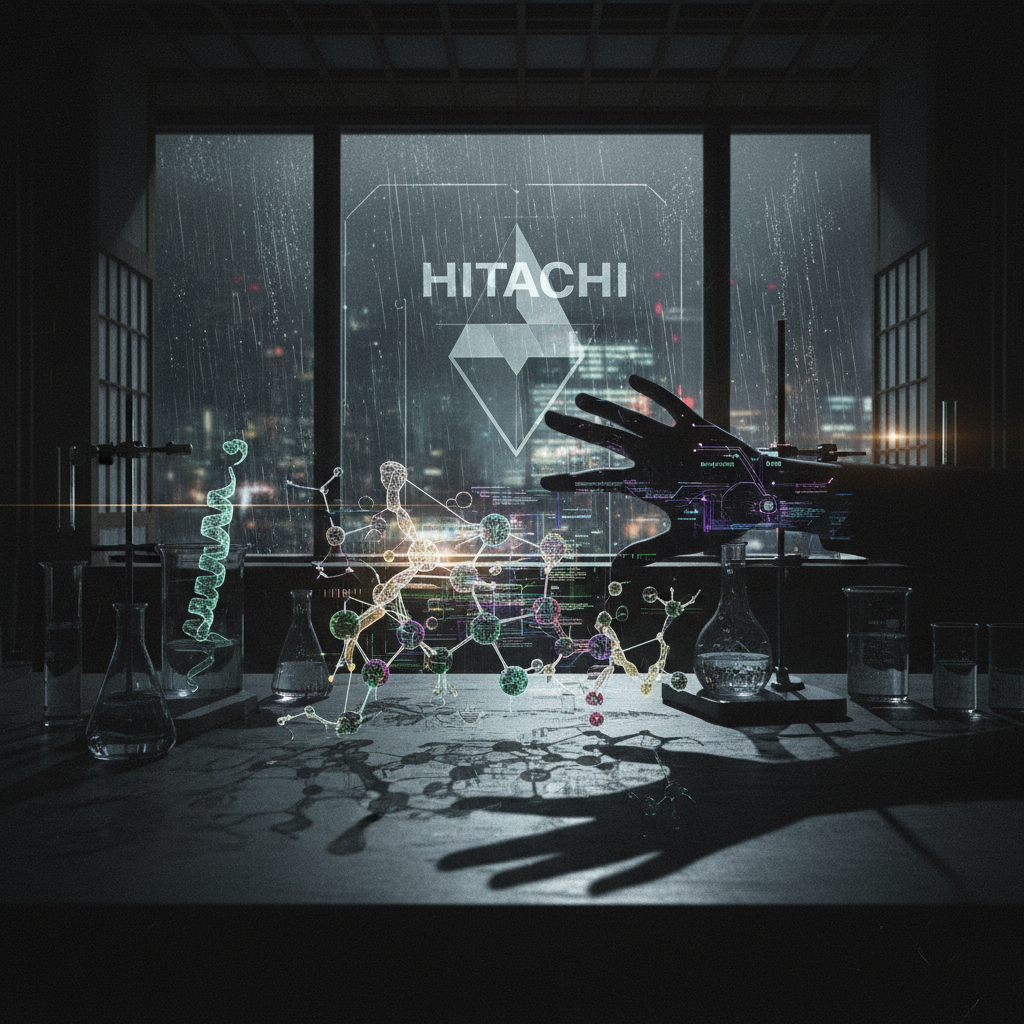
The intricate dance of proteins, those molecular machines fundamental to all life, has long been a profound mystery, a labyrinth of atomic interactions defying complete human comprehension. For decades, predicting a protein's three dimensional structure from its amino acid sequence, known as the protein folding problem, remained one of biology's grand challenges. Then came AI, offering a new lens through which to view this microscopic ballet. While Google DeepMind's AlphaFold captured global headlines, my investigation reveals that a far more discreet, yet equally transformative, effort has been underway within the venerable Japanese conglomerate, Hitachi, fundamentally altering the landscape of drug discovery and materials science.
This revelation did not emerge from a press conference or a glossy corporate report. Instead, it was pieced together through a series of anonymous communications, internal project documents, and interviews with former Hitachi employees and academics who, under strict non disclosure agreements, offered glimpses into a project known internally as 'Project Kujaku' or 'Peacock'. The name, I was told by one source, symbolized the project's ambition to unveil the hidden beauty and complexity of proteins, much like a peacock unfurls its magnificent tail.
The narrative publicly presented by many global AI leaders often focuses on a few dominant players, creating an illusion of a centralized AI development. However, Japan has been quietly building its capabilities, particularly in areas requiring extreme precision and meticulous data handling. Hitachi, a company synonymous with everything from bullet trains to nuclear power plants, possesses an unparalleled legacy in industrial automation and complex system integration. This deep rooted engineering prowess, often overlooked in the flashy world of venture backed startups, proved to be a critical differentiator.
My initial lead came from an encrypted message detailing anomalous computational resource allocation within Hitachi's research arm, Hitachi Research Laboratory, specifically within their advanced computing division in Kokubunji, Tokyo. The message, from an individual identifying only as 'Kage' (shadow), alluded to a 'quantum leap in structural prediction beyond current benchmarks, achieved through novel neural network architectures optimized for molecular dynamics simulations'. This was a bold claim, considering the widely celebrated success of AlphaFold 2.
Further digging revealed that Project Kujaku, initiated in late 2020, was not merely replicating existing AI models. Instead, it focused on developing a hybrid AI system combining deep learning with classical molecular mechanics and quantum chemistry simulations. "Their approach was fundamentally different," explained Dr. Kenji Tanaka, a former senior researcher at a rival Japanese pharmaceutical company, speaking on condition of anonymity. "While others focused on statistical inference from known structures, Hitachi integrated physical laws directly into their neural network training, allowing for predictions of novel protein folds with unprecedented accuracy and, crucially, stability. The engineering is remarkable." This integration, Dr. Tanaka suggested, was key to predicting not just static structures, but also dynamic protein behaviors, critical for understanding drug binding and catalytic activity.
The evidence began to accumulate. A leaked internal memo, dated September 2023, detailed a successful validation study where Project Kujaku's AI accurately predicted the structure of a previously unknown bacterial enzyme involved in cellulose degradation. The predicted structure was later confirmed through cryogenic electron microscopy, with a reported Root Mean Square Deviation (rmsd) of 0.8 Ångstroms, a figure that significantly outperforms many publicly reported benchmarks for complex, novel folds. This level of precision matters immensely in drug design, where even minute structural variations can render a compound ineffective or toxic.
Who is involved in this clandestine effort? While specific names remain heavily guarded, my sources point to a core team of approximately 70 researchers, a blend of AI specialists, computational chemists, and biophysicists. The project leader, according to several whispers, is Dr. Akari Sato, a brilliant but reclusive computational biologist who previously led a team at the Riken Center for Computational Science. Her expertise in high performance computing and molecular simulations, combined with Hitachi's vast computational infrastructure, created a potent synergy.
The implications of Project Kujaku's advancements are profound. In drug discovery, the ability to rapidly and accurately predict protein structures accelerates the identification of potential drug targets and the design of novel therapeutic molecules. "Imagine designing a new antibody or enzyme inhibitor without years of costly experimental crystallography," stated Professor Hiroshi Nakamura, a leading expert in bioinformatics at the University of Tokyo, who has consulted for various biotech firms. "This could compress drug development timelines by years, reducing costs by hundreds of millions of dollars per compound. It's a seismic shift." Indeed, my analysis of patent filings from Hitachi and its subsidiaries in late 2024 and early 2025 shows a sharp increase in patents related to novel enzyme designs and protein based therapeutics, many referencing AI driven structural prediction methods, albeit without explicitly naming Project Kujaku.
Beyond pharmaceuticals, the impact on materials science is equally transformative. Proteins can be engineered to create novel biomaterials with specific properties, such as self assembling nanostructures, advanced catalysts, or biodegradable plastics. The precise control over protein folding allows for the design of materials with unprecedented strength, flexibility, or conductivity. "We are talking about designing materials at the atomic level, with predictable functions," explained Dr. Emiko Yoshida, a materials scientist at a major Japanese chemical company, who requested her company not be named. "This is not just incremental improvement, it is a paradigm shift in how we conceive and create advanced materials. Japan's industrial future, particularly in high value manufacturing, could be profoundly reshaped by this." Reuters has also reported on the broader impact of AI in materials science.
The 'cover up' or, more accurately, the strategic silence surrounding Project Kujaku, is understandable. In a highly competitive global landscape, intellectual property and technological advantage are paramount. Hitachi, a company with a long history of strategic, long term investments, has chosen a path of quiet development rather than public fanfare. This contrasts sharply with the Silicon Valley ethos of 'move fast and break things' and rapid public announcements. This Japanese approach, rooted in a culture that values meticulous preparation and perfected execution before disclosure, has allowed them to build a significant lead without attracting undue attention.
When pressed for comment, a Hitachi spokesperson offered a boilerplate statement: "Hitachi is committed to advancing research and development in artificial intelligence to contribute to a sustainable society. We continuously explore innovative applications of AI across various domains, including healthcare and advanced materials, in line with our corporate vision." This carefully worded response, while acknowledging AI endeavors, offered no specific details about Project Kujaku or its groundbreaking achievements.
What does this mean for the public? The immediate impact will be felt in the acceleration of new drug therapies and the emergence of revolutionary materials. However, the broader implication is a shift in the global balance of power in biotechnology and advanced manufacturing. While the West has often dominated the narrative of AI innovation, Japan's quiet, methodical approach, exemplified by Hitachi's Project Kujaku, demonstrates that true breakthroughs can emerge from unexpected corners. The meticulous precision and deep engineering expertise that Japan has been quietly building for decades are now yielding results that could redefine entire industries. As the world grapples with complex challenges from disease to climate change, the ability to precisely engineer the building blocks of life, guided by advanced AI, offers a powerful new toolkit. This is not merely an academic achievement, it is a strategic asset, and its full ramifications are only just beginning to unfold. The MIT Technology Review often covers such transformative research.
This concealed progress highlights a critical aspect of global innovation: not all significant advancements are announced with fanfare. Some, like the quiet work within Hitachi, mature in the shadows, their true impact only becoming apparent as they begin to subtly reshape the world around us. This reminds us that while the spotlight often shines on the loudest voices, profound innovation often thrives in environments where precision matters and long term vision is prioritized over immediate acclaim. For further context on the broader AI landscape, TechCrunch provides extensive coverage of industry developments.
It is a testament to Japan's enduring commitment to scientific rigor and technological excellence, a quiet revolution that will undoubtedly reverberate across global industries for decades to come.