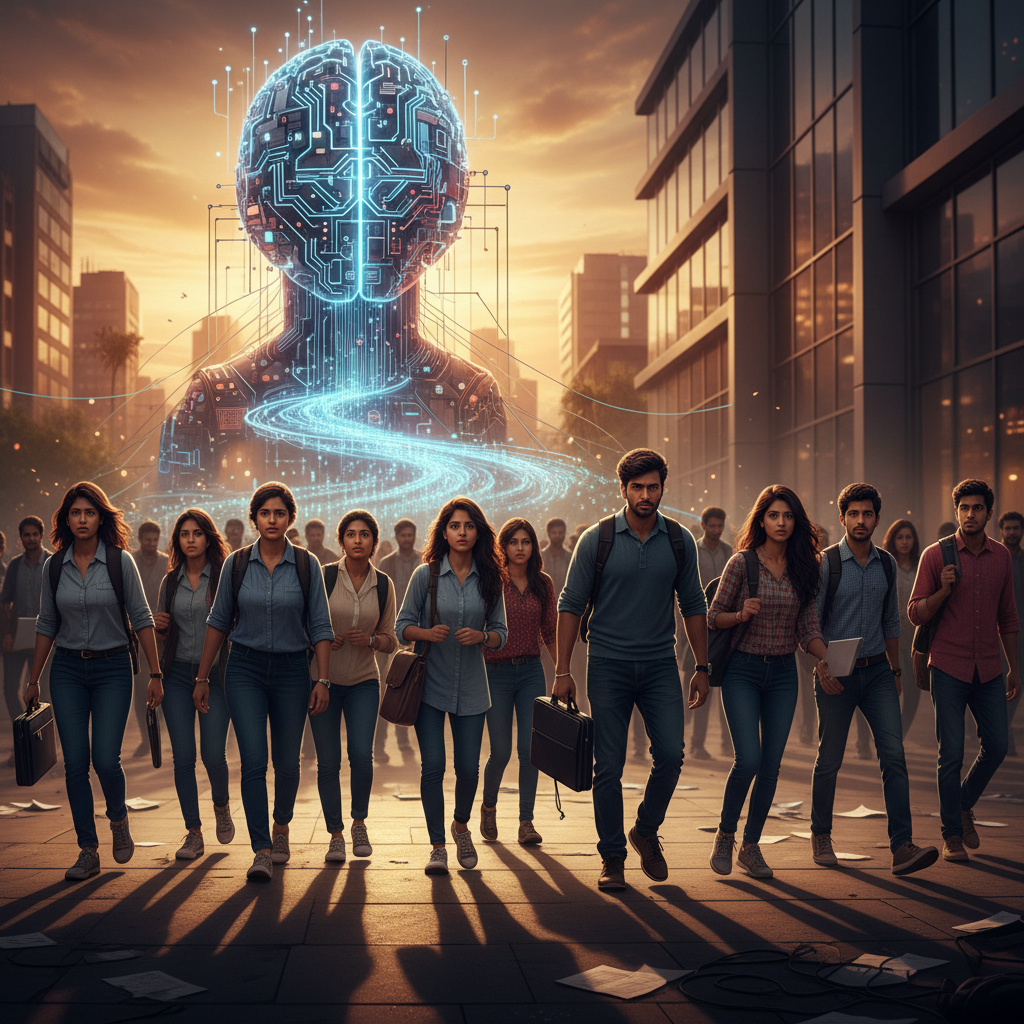

The news hit like a monsoon storm this morning, unexpected and disruptive. Global tech behemoths, the very companies that once promised endless growth and glittering careers, have announced another brutal round of layoffs, and this time, India is feeling the brunt more acutely than ever before. We are talking about tens of thousands of roles, not just in support functions, but in core engineering, quality assurance, and even middle management, all being swept away by the relentless tide of artificial intelligence. This isn't just a blip, friends, this is the inflection point we've been talking about, the moment AI stops being a futuristic concept and becomes a very real, very present force reshaping our economy and our lives.
For years, India has been the world's back office, its innovation engine, its talent factory. Our graduates, sharp and hungry, powered Silicon Valley's dreams from Hyderabad to Bengaluru. But now, the very tools we helped build are turning the tables. Reports indicate that over 60,000 tech jobs globally have been eliminated in the last three months alone, with a staggering 40 percent of those impacting operations and development centers here in India. These aren't just numbers, these are livelihoods, families, and dreams built on the promise of a thriving tech sector.
The official reactions have been, predictably, a mix of concern and cautious optimism. Dr. Ananya Sharma, Joint Secretary for Digital Economy at the Ministry of Electronics and Information Technology, acknowledged the immediate pain. "We understand the anxiety these announcements cause," she stated in a press briefing this afternoon. "However, this is not a sign of weakness in India's tech sector. It is a global phenomenon, a re-evaluation of skill sets in the age of advanced AI. We are working closely with industry leaders to reskill our workforce and pivot towards emerging opportunities." Her words carry the weight of government policy, but the unease in the air is palpable.
But let's be honest, Arjùn Sharmà doesn't deal in platitudes. My take is this: the layoffs are a harsh reality check, a necessary cleansing fire. For too long, many tech roles were about repetitive tasks, about being a cog in a giant machine. AI, particularly generative AI, is simply better at those tasks. It's faster, cheaper, and doesn't need coffee breaks. This isn't about AI replacing humans entirely, it's about AI replacing the mundane parts of human jobs, freeing us up, or rather, forcing us, to do more complex, creative, and strategic work.
Expert analysis from the ground up supports this view. "We've seen this coming for years," said Professor Rajesh Kumar, head of AI research at IIT Delhi, speaking to me over a quick chai. "The demand for basic coding and routine IT support is diminishing. What's exploding is the need for AI architects, prompt engineers, data ethicists, and specialists who can integrate AI into complex systems. The problem is, our education system and much of our existing workforce aren't quite there yet. This is a wake up call for retraining on a massive scale." He pointed out that while the global tech giants are cutting, many Indian AI startups, particularly in deep tech and defense AI, are actually hiring aggressively, albeit for very different skill sets. "Forget Silicon Valley, look at Hyderabad" he quipped, echoing a sentiment I've held for years. The real innovation, the real growth, is happening right here, if you know where to look.
What happens next is crucial. The government, through initiatives like the National AI Strategy, is already pushing for massive investment in AI research and development, aiming to create a million AI-ready professionals by 2030. Companies like TCS and Infosys are pouring billions into internal reskilling programs, recognizing that their existing workforce is their greatest asset, provided they can adapt. There's a palpable sense of urgency, a feeling that India cannot afford to miss this wave. The focus will shift from sheer volume of IT services to high-value AI solutions, from being a service provider to an intellectual property powerhouse.
I spoke with Priya Singh, a 32-year-old software engineer from Bengaluru who was laid off from a major US tech firm last week. "It was a shock, no doubt," she told me, her voice steady but with an underlying current of determination. "But I've already enrolled in an advanced machine learning course. I see this as an opportunity to upgrade, to move into something more cutting edge. The old way of doing things is over. We have to evolve." Her resilience, her immediate pivot, is a microcosm of the spirit that will define India's response.
This isn't just about job numbers, it's about national destiny. India has the demographic advantage, the intellectual horsepower, and the entrepreneurial spirit to not just survive this AI-driven restructuring, but to thrive in it. We have the potential to lead. The global tech landscape is being redrawn, and the lines are being etched by algorithms. We cannot afford to be passive observers. We must be active participants, shaping the future, not just reacting to it.
My friends, India will own the next decade of AI, but it won't be without its growing pains. This current wave of layoffs is a stark reminder that the future belongs to those who are agile, adaptable, and willing to continuously learn. It's a challenging time, yes, but also an incredibly exciting one. The churn is uncomfortable, but it's clearing the path for something far more robust, far more innovative, and ultimately, far more Indian. The world is watching, and we have an opportunity to show them how a nation of over a billion people can not only embrace the AI revolution but lead it. For more on how AI is shaping global economies, you can always check out Reuters Technology or MIT Technology Review. The conversation is just beginning, and we at DataGlobal Hub will be here, connecting the dots, every step of the way. The future is now, and it's demanding our full attention. For a deeper dive into the ethical considerations of AI, you might find this article interesting: When the Algorithm Learns Quechua: Unpacking Generative AI's Promise for Peru's Newsrooms [blocked]. And for those tracking the broader tech industry shifts, TechCrunch remains an essential read.