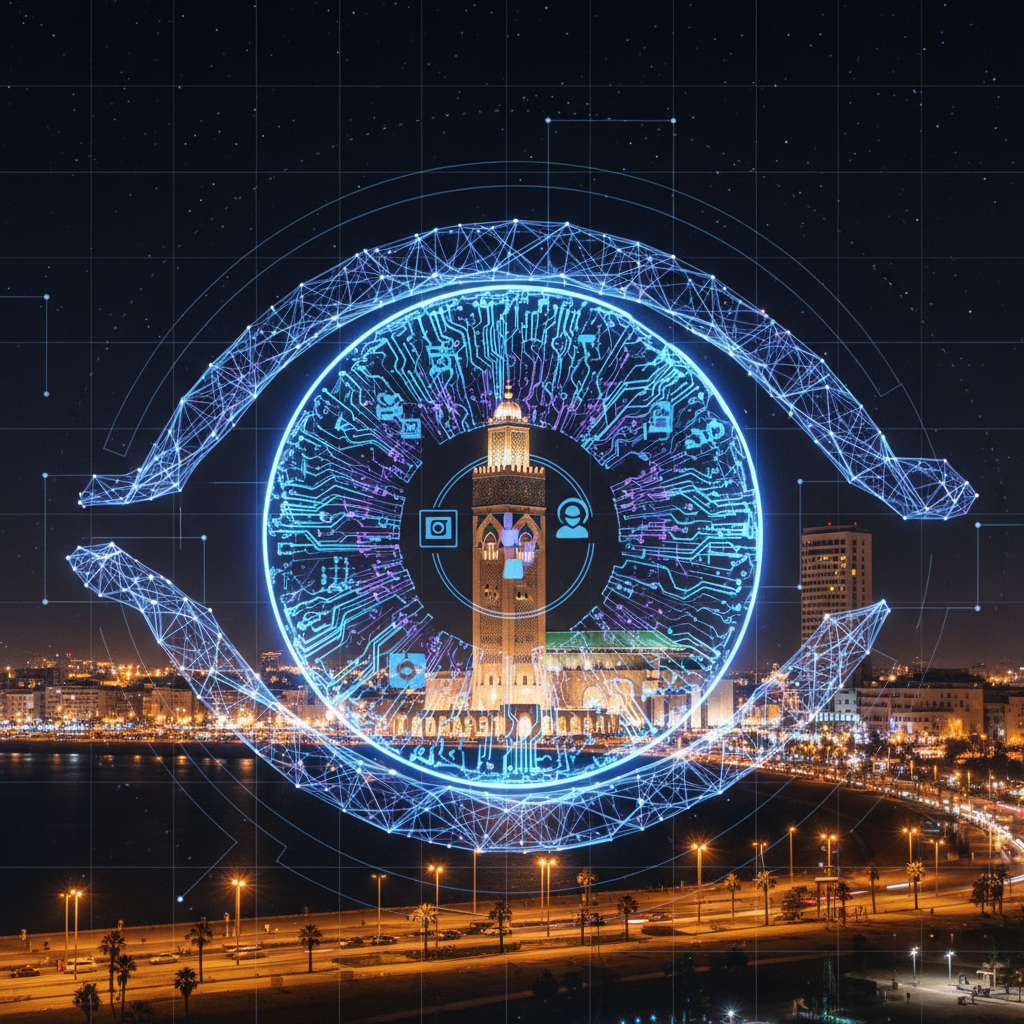
Walk through the medina of Fes or the modern avenues of Rabat today, and you might not see them, but the digital eyes are watching. Not in a sinister, dystopian way necessarily, but in a quiet, pervasive hum that is increasingly becoming part of our urban fabric. We are talking about AI powered surveillance systems, technologies that promise to make our cities safer, more efficient, and more responsive. But how do these intricate machines actually work, and what are the trade offs we make for this enhanced security? It is a question that resonates deeply in Morocco, a nation that has always valued community and personal space, yet understands the imperative of national security. Morocco sits at the crossroads of Africa, Europe, and the Arab world and that's our AI superpower, a unique vantage point from which to observe and adapt these global trends.
The big picture here is simple: AI surveillance aims to automate and enhance the monitoring of public spaces, critical infrastructure, and even private properties. It moves beyond passive cameras that merely record events, transforming them into active, intelligent sensors that can detect, analyze, and even predict. Think of it as upgrading from a simple guard watching a dozen screens to a highly sophisticated, tireless analyst capable of processing thousands of data streams simultaneously. The goal is to identify anomalies, prevent crimes, manage crowds, and respond to emergencies with unprecedented speed. In a country like ours, where urban centers are growing rapidly and public safety is paramount, the appeal is undeniable. Data from the Ministry of Interior in 2024 showed a 15% reduction in petty crime in areas where pilot AI surveillance projects were deployed in Marrakech and Tangier, a compelling statistic for policymakers.
Now, let us break down the building blocks of such a system. Imagine a typical AI surveillance setup in a Moroccan city, perhaps monitoring a busy intersection near the Hassan II Mosque. It is not just cameras, though they are certainly the most visible component. At its core, you have:
- Sensors and Data Collection: These are primarily high resolution cameras, often equipped with infrared capabilities for night vision, but they can also include microphones for sound detection, thermal sensors, and even radar. These devices are strategically placed to capture visual, auditory, and environmental data from the area. In Casablanca, for example, the city has been steadily increasing its network of Cctv cameras, with an estimated 8,000 public cameras by the end of 2025, a significant leap from just 2,500 five years prior.
- Edge Devices and Preprocessing: This is where some of the first intelligent work happens, often right at the camera itself. Many modern surveillance cameras are 'smart cameras' with embedded AI chips, like those from NVIDIA's Jetson series. These chips perform initial processing, such as motion detection, object recognition (distinguishing a human from a vehicle), and even basic facial detection, before sending the data to a central server. This reduces the amount of data that needs to be transmitted, saving bandwidth and improving real time response. It is like having a local faqih who can quickly discern the essence of a situation before escalating it to the qadi.
- Central Processing Unit (CPU) and AI Algorithms: This is the brain of the operation. Powerful servers, often housed in secure data centers, receive the preprocessed data. Here, advanced AI algorithms, primarily deep learning models, get to work. These algorithms are trained on massive datasets of images and videos to perform complex tasks: facial recognition against watchlists, license plate recognition, anomaly detection (a bag left unattended, a person falling), crowd analysis (density, movement patterns), and even behavioral analysis (aggressive movements, loitering). Companies like Google's DeepMind and OpenAI are constantly pushing the boundaries of these foundational models, making them more accurate and versatile, and their innovations trickle down into these applications.
- Data Storage and Management: All this data, often petabytes of it, needs to be stored securely and efficiently. Cloud based solutions, often leveraging local data centers in Morocco to comply with data sovereignty laws, are increasingly common. The data is indexed and tagged by the AI, making it searchable and retrievable for human operators.
- User Interface and Alert Systems: This is how human operators interact with the system. A control room, perhaps like the one in the Prefecture of Police in Casablanca, displays live feeds, AI generated alerts, and analytical dashboards. When an anomaly is detected, the system can automatically flag it, highlight the relevant footage, and even dispatch alerts to patrol officers via their mobile devices. This human in the loop element is crucial, ensuring that AI acts as an assistant, not a replacement for human judgment.
Let us walk through a worked example. Imagine a busy Friday afternoon near the Bab Mansour gate in Meknes. A tourist accidentally leaves their backpack on a bench while admiring the architecture. Here is how the AI system might respond:
- Step 1: Detection. A smart camera, part of the city's network, identifies the backpack as an 'unattended object' after a predefined period, say five minutes. The edge AI on the camera performs initial object classification.
- Step 2: Analysis. The data is sent to the central AI system. The algorithm analyzes the object's context: Is it near a person? Has it moved? Is there any suspicious activity around it? It might cross reference with other cameras to see if the owner simply stepped away for a moment.
- Step 3: Anomaly Flagging. The AI determines the backpack is indeed unattended and potentially a security risk. It generates an alert, categorizing it as 'Level 2: Unattended Item'.
- Step 4: Human Verification. The alert pops up on an operator's screen in the control room, showing the live feed and a highlighted area around the backpack. The operator quickly assesses the situation, perhaps zooming in or checking adjacent camera feeds.
- Step 5: Response. The operator confirms the anomaly and dispatches a nearby security patrol via radio or a dedicated app. Within minutes, the patrol arrives, secures the area, and investigates the backpack. This entire process, from detection to dispatch, can take mere minutes, a stark contrast to traditional methods.
Of course, these systems are not infallible. They sometimes fail, or rather, they encounter limitations and edge cases that challenge their capabilities. One major issue is bias in training data. If the AI is trained predominantly on data from one demographic, it might perform poorly or even inaccurately on others. For example, facial recognition systems have historically struggled with non Caucasian faces, a critical concern in our diverse Moroccan society. "The quality and diversity of our training datasets are paramount," explains Dr. Fatima Zahra El Alaoui, head of AI ethics at Mohammed VI Polytechnic University. "Without careful curation, these systems can perpetuate and even amplify existing societal biases, undermining the very trust they seek to build." This is a challenge that Moroccan researchers are actively addressing, focusing on creating more representative datasets that reflect our unique population.
Another common failure point is environmental variability. Heavy fog, extreme dust storms common in the Sahara, or even sudden changes in lighting can degrade camera performance and confuse AI algorithms. A system trained in a sunny European city might struggle in the unique atmospheric conditions of Ouarzazate. Furthermore, privacy concerns are a constant shadow. The more data these systems collect, the greater the risk of misuse, surveillance creep, or data breaches. Balancing the security benefits with the fundamental right to privacy is a tightrope walk. "We must always ask: who watches the watchers?" says Omar Benjelloun, a prominent human rights lawyer in Rabat. "Robust legal frameworks and independent oversight are not luxuries, they are necessities for any widespread AI surveillance deployment."
So, where is this heading? The trajectory is clear: more pervasive, more intelligent, and more integrated systems. We are seeing a move towards predictive policing, where AI analyzes patterns of crime, social media data, and even weather patterns to predict where and when crimes are most likely to occur. This is a contentious area, raising serious ethical questions about profiling and pre emptive action. We are also witnessing the integration of AI surveillance with other smart city technologies, from traffic management to waste collection, creating a truly interconnected urban nervous system. The Sahara is vast, but the data flowing across it is vaster, and its potential to reshape our lives is immense.
In Morocco, the conversation is vibrant. Casablanca is becoming the AI capital nobody expected, with startups and research initiatives exploring ethical AI development. The Moroccan government, through institutions like the Digital Development Agency (ADD), is actively engaging with these technologies, seeking to harness their benefits while mitigating risks. The future will likely involve more sophisticated privacy preserving AI, where techniques like federated learning and differential privacy allow systems to learn from data without directly exposing individual identities. This could offer a crucial pathway to balancing security with freedom.
Ultimately, the digital eye is not just a technological marvel, it is a societal mirror. It reflects our aspirations for safety, our fears of intrusion, and our ongoing struggle to define the boundaries of freedom in an increasingly data driven world. As these systems become more sophisticated, our responsibility to understand them, to question them, and to shape their deployment in a way that aligns with our values, only grows. For more on the global debate around AI ethics, you might find this article on Wired insightful. The challenge, as always, is not in the technology itself, but in how we, as humans, choose to wield its immense power.