Let me tell you something, the chatter from Silicon Valley about artists versus AI, it often misses the point entirely. It is a Western-centric narrative, focused on lawsuits and existential dread. Here in India, particularly in places like Hyderabad and Bengaluru, we see a different picture emerging, a far more dynamic and, dare I say, Indian response to the AI tsunami. Our creators are not merely fighting back; they are adapting, innovating, and in many cases, leading the charge in defining what a truly symbiotic relationship between human creativity and artificial intelligence can look like.
For too long, the global conversation has been dominated by the fear that AI will simply replace human artists, musicians, and writers. We have seen the headlines, the protests, the calls for outright bans. And yes, the concerns are valid. The rapid advancements in generative AI, from crafting photorealistic images to composing symphonies and writing entire novels, have indeed sent shivers down the spines of many. But what I observe from my vantage point, immersed in India's buzzing tech and creative hubs, is a resilience and ingenuity that transforms this challenge into an unparalleled opportunity. This is not just about survival; it is about shaping the next epoch of human expression.
Consider the music industry, for instance. The initial shockwaves from AI generated tracks were palpable. Artists worried about their livelihoods, their unique sound being diluted or outright stolen. But then, something shifted. Musicians began to see AI not as a competitor, but as a sophisticated instrument. "We are moving beyond merely using AI for mastering or simple beat generation," explains Dr. Kavita Sharma, a leading ethnomusicologist and AI ethics researcher at IIT Bombay. "Indian classical musicians are experimenting with AI to generate complex ragas, exploring improvisational possibilities that would take years of human practice to even conceive. It is about augmenting, not replacing, the guru's wisdom." She highlights how AI is being used to analyze vast archives of traditional music, identifying patterns and generating new melodic structures that respect the ancient forms while pushing boundaries. This is not just a technological leap; it is a cultural evolution.
And it is not just the established artists. The burgeoning creator economy in India, fueled by platforms like YouTube, Instagram, and regional streaming services, is finding its own rhythm with AI. A young artist from Chennai might use a generative AI tool to quickly mock up dozens of design variations for a client, then infuse their unique human touch to perfect the final piece. A writer in Kolkata might leverage an AI assistant to brainstorm plot points or translate their work into multiple Indian languages, dramatically expanding their reach. The fear of being replaced is giving way to the excitement of amplified potential. "AI has become my co-pilot, not my adversary," says Rahul Khanna, a graphic novelist whose recent work, a mythological retelling, incorporated AI generated concept art. "It handles the grunt work, freeing me to focus on the narrative and the emotional depth. My output has quadrupled, and the quality, I believe, is even higher." This sentiment is echoed across the board.
The legal and ethical frameworks around AI and copyright are still very much in flux globally. We saw the recent debates and legislative proposals in Europe and the US, grappling with how to protect intellectual property in an age where machines can learn from and reproduce human creations. Here in India, the conversation is perhaps less about outright prohibition and more about establishing fair use, transparency, and equitable compensation models. The Indian government, through bodies like Niti Aayog, has been proactive in fostering discussions that balance innovation with protection. There is a growing consensus that simply blocking AI from learning from existing works is a futile exercise, akin to trying to stop the monsoon. Instead, the focus is on ensuring that creators are acknowledged and compensated when their work contributes to AI training data, and that consumers are aware when content is AI generated.
This proactive stance is critical. We are not waiting for Silicon Valley to dictate the terms. India will own the next decade of AI, not just in terms of technological development, but in how we integrate it ethically and creatively into society. Our diverse cultural landscape, with its rich tapestry of art forms, languages, and storytelling traditions, provides a unique testing ground for AI's creative potential. The sheer volume of data, both structured and unstructured, available in India for training culturally relevant AI models is immense. Forget Silicon Valley, look at Hyderabad, look at Bengaluru, look at the vibrant startup ecosystem that is not just building AI tools, but building culturally intelligent AI tools. TechCrunch's AI section often covers the global race, but the nuances of India's approach are truly distinct.
Of course, challenges remain. The digital divide, ensuring equitable access to these powerful AI tools, is a significant hurdle. Education and reskilling programs are vital to ensure that artists from all backgrounds can leverage AI, rather than being left behind. The government, along with private sector players like TCS and Infosys, is investing heavily in AI literacy initiatives. "We are seeing a surge in demand for workshops that teach creative professionals how to use AI tools responsibly and effectively," notes Anjali Singh, CEO of 'Kala AI', a Mumbai based startup developing AI powered creative assistants. "It is about empowering them, giving them new brushes for their digital canvas." This kind of grassroots enablement is what truly differentiates our approach.
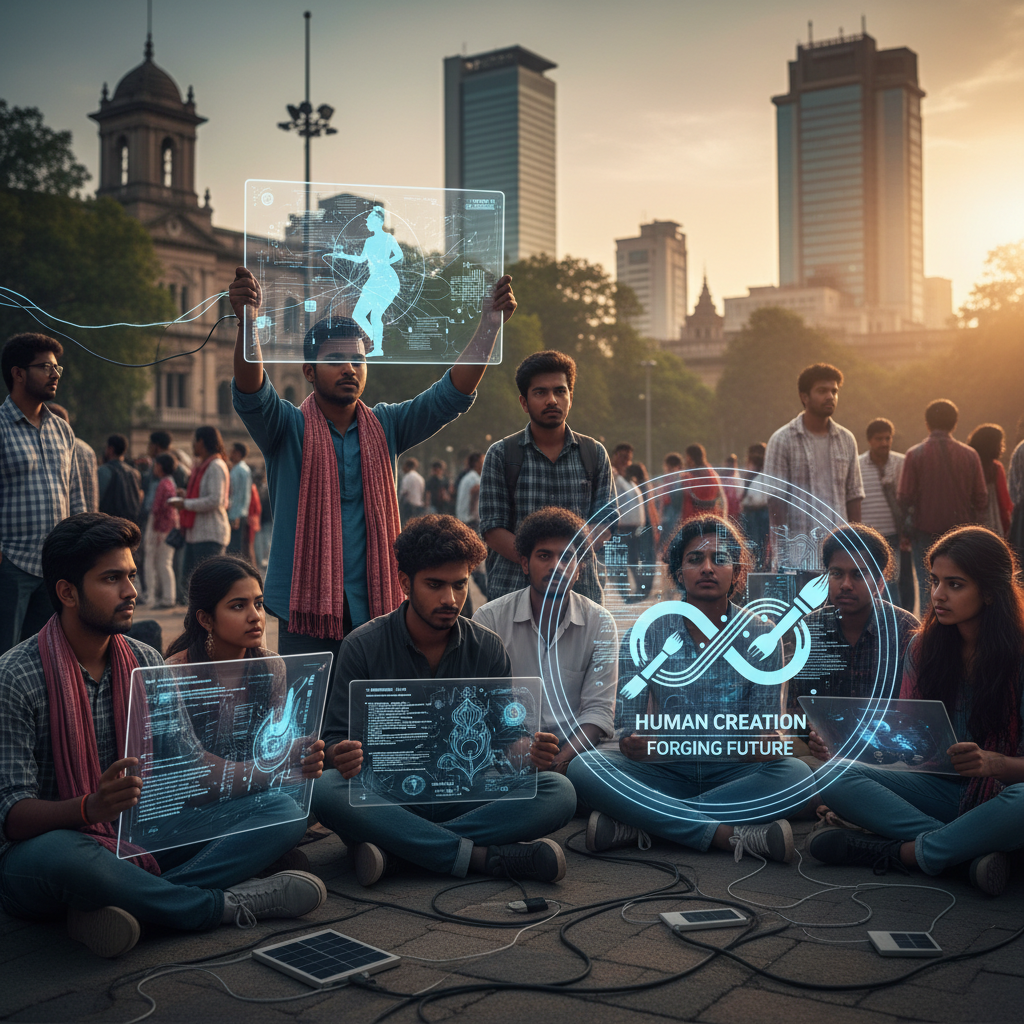
The fight against AI, if you can even call it that, is evolving. It is less about a Luddite rejection and more about a strategic embrace, a digital dharna where creators are not just protesting, but actively shaping the future. They are demanding a seat at the table, influencing policy, and most importantly, demonstrating that human creativity, far from being diminished, can be profoundly enhanced by intelligent machines. This is the inflection point. The next generation of masterpieces, whether they are films, songs, or novels, will likely be born from this beautiful, messy, and utterly Indian collaboration between human genius and artificial intelligence. The world is watching, and I believe, learning. For more on the broader implications of AI on society, Wired's AI coverage offers interesting perspectives, but for the real pulse of creative integration, keep your eyes on India.