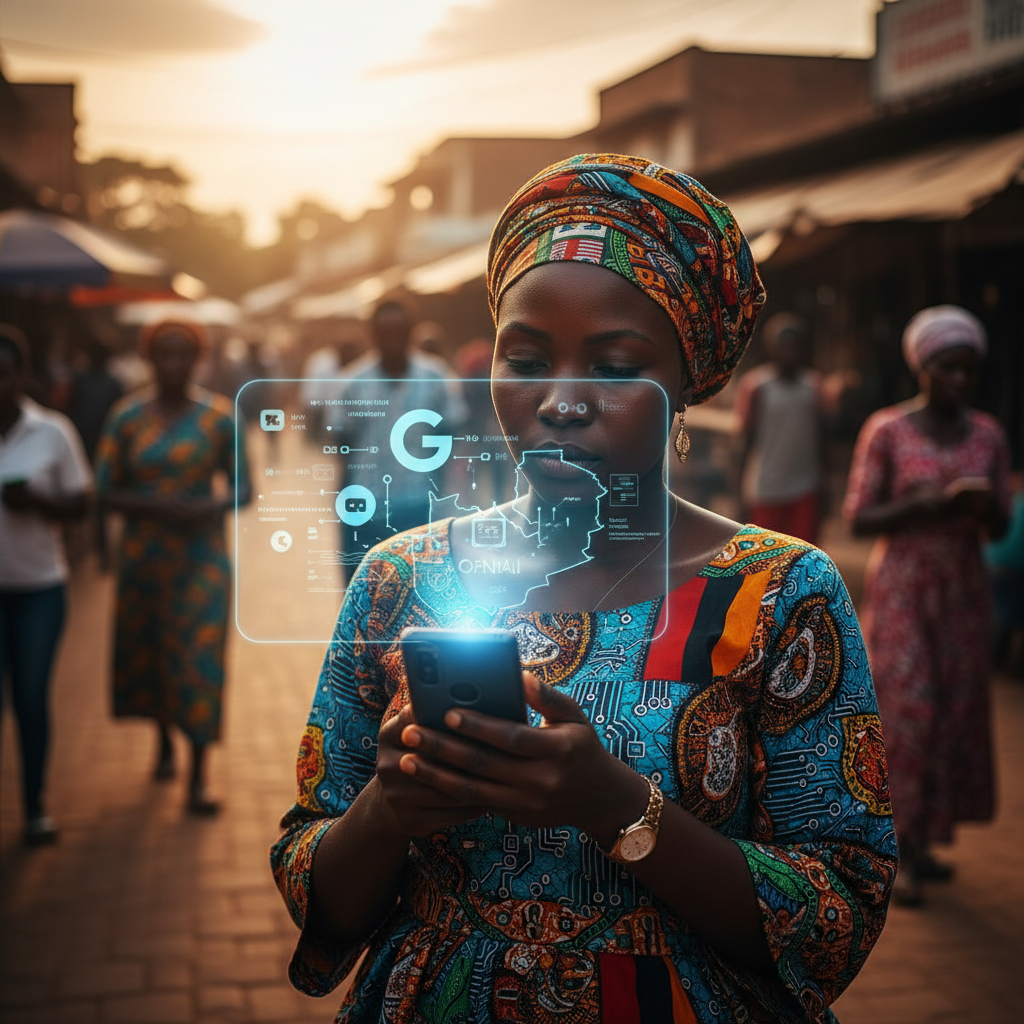

You're going to want to sit down for this, especially if you think data privacy is just a European problem with a fancy acronym like GDPR. Here in Zambia, under the vast, often indifferent, African sky, we are watching the global AI data privacy debate unfold with a mixture of amusement, apprehension, and a healthy dose of 'what about us?'
The world is buzzing about how AI models, like OpenAI's GPT-4 or Google's Gemini, are hoovering up every scrap of digital information they can find. From your auntie's Facebook posts about her prize-winning chickens to the intricate medical records stored in cloud servers, it is all grist for the algorithmic mill. And while the EU is flexing its regulatory muscles with the AI Act and the US tries to catch up with state-level initiatives like Ccpa, the question for us in Zambia, and indeed across Africa, is whether our data is being protected or simply becoming a colonial commodity of a new kind.
I was at the Lusaka Tech Summit last month, sipping on some rather strong local coffee, when Dr. Chanda Nkosi, a brilliant legal scholar from the University of Zambia, put it rather bluntly. "The global North is debating the nuances of 'right to be forgotten' while we are still fighting for the right to know what data these AI giants even have on us," she said, adjusting her spectacles. "Our digital sovereignty is not a theoretical exercise, it is about protecting our people from exploitation, plain and simple. We need to define our own digital chitenge, our own fabric of protection, not just wear what Brussels or California tailors for us." Her words resonated deeply, like the beat of a traditional drum across the plains.
Consider the sheer volume of data. Africa, with its burgeoning youth population and rapidly expanding internet access, is a goldmine. Every new smartphone user, every mobile money transaction, every social media interaction, adds to a data pool that AI companies desperately need to train their models for diverse languages, cultures, and contexts. Microsoft's investment in local data centers, for instance, is not just about providing cloud services, it is also about proximity to this invaluable resource. The irony is almost too perfect: the very data that could power Africa's digital transformation is also the most vulnerable to being scooped up and monetized by external entities without adequate local safeguards.
Zambia, to its credit, is not sitting idly by. We have the Data Protection Act of 2021, a relatively new piece of legislation that aims to bring us closer to international standards. It establishes principles for data collection, processing, and storage, and gives individuals rights over their personal information. But enacting a law and enforcing it effectively against multinational tech behemoths are two very different things, like trying to herd a flock of guinea fowl with a single whistle. The resources, the technical expertise, and the sheer political will required are immense.
"Our Act is a good starting point, but the AI era introduces complexities we could not have fully foreseen even a few years ago," explained Mr. Mwansa Banda, Director General of the Zambia Information and Communications Technology Authority Zicta. I caught him during a brief break from what looked like an endless stream of meetings. "How do you apply 'purpose limitation' when an AI model is designed to find novel patterns across disparate datasets? How do you ensure 'data minimization' when the hunger for more data is insatiable for better model performance? These are the questions keeping us awake at night." He gestured vaguely towards a stack of papers on his desk, probably filled with more acronyms than a bowl of alphabet soup.
The global patchwork of regulations is a mess, frankly. GDPR in Europe sets a high bar, with hefty fines for non-compliance. California's Ccpa and its successor Cpra give consumers significant rights. Brazil has its Lgpd, India is developing its own framework, and even China has enacted stringent data privacy laws. Each one is a unique pattern, a different color in the global digital chitenge. For a company like Google or Meta, operating across all these jurisdictions is a logistical nightmare, requiring localized compliance teams and significant legal overhead. They are caught between a rock and a hard place, trying to innovate at breakneck speed while navigating a labyrinth of rules.
This fragmentation creates opportunities and challenges for countries like Zambia. On one hand, it means we are not alone in our concerns. We can learn from the experiences of others. On the other hand, it means our relatively smaller market might be seen as less of a priority for compliance by global players. It is a classic David and Goliath scenario, but in this version, David needs a supercomputer and a team of AI ethicists.
One of the most pressing issues is the concept of 'data localization.' Should Zambian data, especially sensitive personal data, be processed and stored within Zambia's borders? This is a contentious point. Proponents argue it enhances national security, makes enforcement easier, and fosters local digital economies. Opponents, often backed by global tech firms, argue it stifles innovation, increases costs, and can lead to a balkanization of the internet. "We are not asking for a digital wall around Zambia," clarified Ms. Nandi Phiri, a policy analyst at the Ministry of Technology and Science. "We are asking for respect, for transparency, and for a fair share in the value created from our data. If an AI model is trained on Zambian health records to develop a diagnostic tool, what benefit accrues to the Zambian people? This is not just about privacy, it is about equity." Her point is a valid one, echoing the broader calls for a more equitable global digital order.
The rise of 'synthetic data' is another interesting twist. Companies like NVIDIA are pouring resources into generating artificial datasets that mimic real-world data but contain no actual personal information. This could, theoretically, alleviate some privacy concerns. However, the quality and representativeness of synthetic data remain a challenge, and the underlying models still need real data to learn from initially. It is like trying to learn to cook nshima by only reading recipes, without ever tasting the real thing.
In a twist that surprised absolutely no one, the conversation around data privacy is also deeply intertwined with national security. The ability of foreign governments or entities to access vast troves of personal data through AI systems is a significant concern for intelligence agencies worldwide. This is driving some nations, particularly in the Global South, to explore 'sovereign AI' initiatives, where they develop and control their own AI infrastructure and models, reducing reliance on foreign tech giants. This is a long and expensive road, but one that some see as essential for true digital independence.
So, where does this leave us? Zambia, like many African nations, is caught in the crosscurrents of a global digital revolution. We are embracing AI for its potential to transform healthcare, education, and agriculture, but we are also keenly aware of the risks. Our journey towards robust data privacy in the AI era will be a complex dance, balancing innovation with protection, global standards with local realities. We will need strong leadership, informed citizens, and a willingness to engage critically with the tech giants who often seem to dictate the rules of the game. The digital chitenge we weave today will determine the future of our digital sovereignty, and whether our data truly serves our people, or merely becomes another resource extracted for distant profit. It is a story that is still being written, and we are all holding our breath to see how it ends.
For more insights into how different regions are approaching AI regulation, you can explore articles on MIT Technology Review or Wired. The complexities of global data governance are also frequently discussed on TechCrunch. The intersection of AI and policy is a rapidly evolving field, and keeping abreast of developments is crucial for nations like Zambia looking to chart their own course.