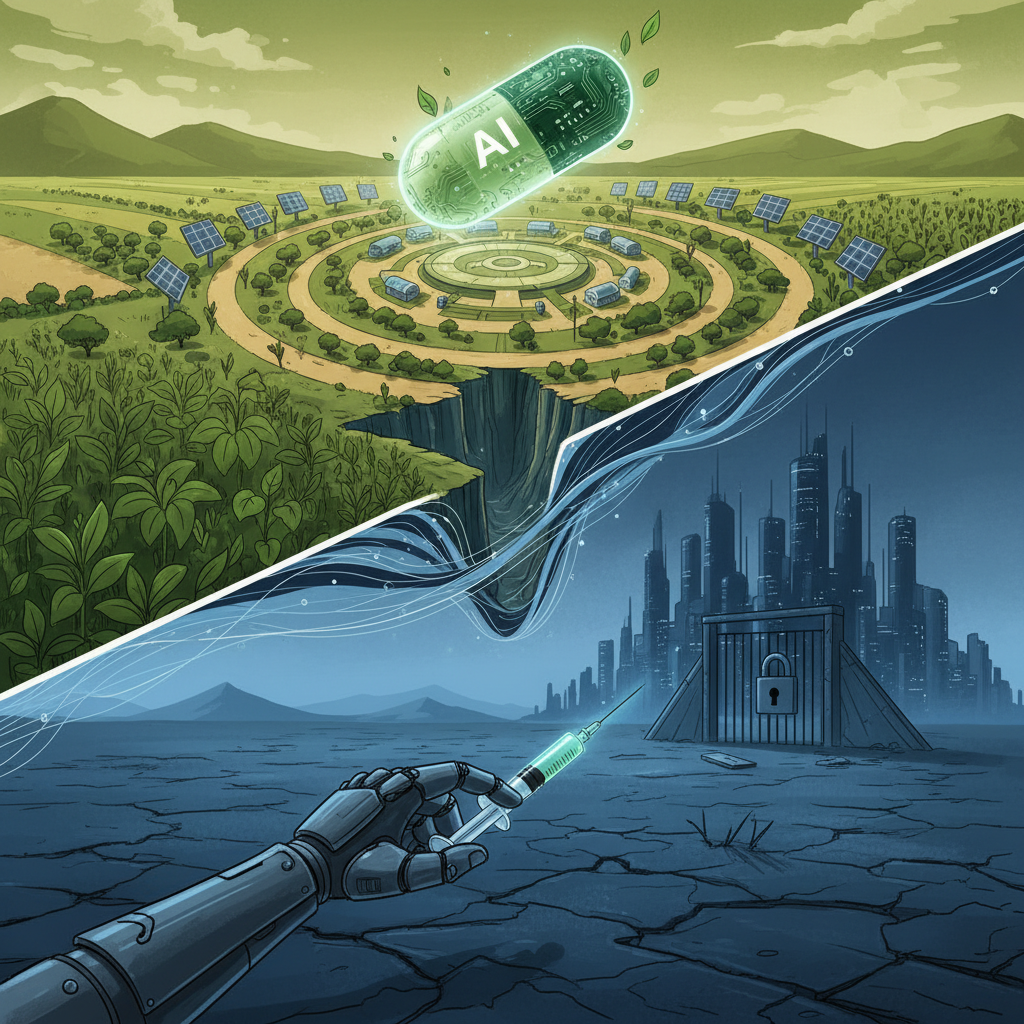

The hum of progress, they call it. The relentless march of artificial intelligence into every corner of our lives, promising to make things faster, smarter, and more efficient. And nowhere is this promise whispered with more urgency than in the hallowed halls of pharmaceutical research, where AI is now the new darling, poised to unlock cures and treatments at a pace unimaginable just a decade ago. But here in Eswatini, a small kingdom with a big heart and even bigger challenges, I find myself asking a question that often gets lost in the dazzling glow of innovation: for whom are these breakthroughs truly being made?
I hear the headlines, I read the reports: AI-powered platforms are sifting through billions of molecular compounds, predicting drug efficacy with startling accuracy, and slashing years off the traditional discovery timeline. Companies like Insilico Medicine and Recursion Pharmaceuticals are making waves, boasting pipelines filled with AI-generated candidates, some already in clinical trials. It is truly remarkable, a testament to human ingenuity amplified by algorithmic power. The global pharmaceutical market, already a behemoth, is projected to see AI contribute an additional 100 billion dollars in value by 2030, according to some industry analysts. This is not small change, and it is certainly not a small impact.
Yet, my heart feels a familiar ache. In Eswatini, we say 'umuntfu ngumuntfu ngebantfu' which means 'a person is a person through other people.' It is a philosophy of ubuntu, of interconnectedness and community. AI should learn this lesson, especially when it comes to something as fundamental as health. When I look at the incredible strides being made in drug discovery, I cannot help but wonder if the algorithms are being trained to prioritize diseases that affect the wealthiest populations, or if they are truly being directed towards the neglected tropical diseases, the endemic conditions, and the chronic illnesses that plague communities like ours across the African continent.
Consider the statistics. Africa bears a disproportionate burden of diseases like malaria, tuberculosis, and Hiv/aids, alongside a rising tide of non-communicable diseases. Yet, pharmaceutical research and development has historically been driven by market forces, focusing on diseases prevalent in high-income countries where purchasing power is highest. Will AI, with its cold, hard logic, simply optimize for these same economic incentives, or can we steer it towards a more equitable path?
“The potential for AI to democratize drug discovery is immense, but it is not automatic,” explains Dr. Nqobile Dlamini, a leading public health expert at the University of Eswatini. “If the data fed into these AI systems primarily reflects populations from the global North, then the drugs they discover will naturally be biased towards those populations. We need diverse datasets, and we need a deliberate strategy to include diseases that are economically less attractive but desperately needed.” Her words echo a sentiment I hear often: technology is a tool, and its impact depends entirely on the hands that wield it and the intentions that guide it.
I have heard the counterarguments, of course. The pharmaceutical industry will tell you that the sheer cost of drug development, often exceeding a billion dollars per successful drug, necessitates a focus on markets that can recoup those investments. They will argue that AI, by making the process more efficient, will ultimately lower costs and make drugs more accessible globally. “We are seeing a significant reduction in early-stage discovery costs, sometimes by as much as 50 percent, thanks to AI,” says Mr. Sipho Maseko, a regional director for a major European pharmaceutical firm operating in South Africa. “This efficiency gain will eventually translate into more affordable medications, benefiting everyone.” He paints a picture of a future where AI’s cost-cutting magic trickles down to every corner of the globe. It is a hopeful vision, but one that feels a little too distant when you are standing in a rural clinic in Eswatini, watching a child suffer from a preventable illness.
My rebuttal is simple: hope is not a strategy. While efficiency gains are welcome, the fundamental economic model of pharmaceutical innovation remains largely unchanged. The focus is still on profit, and without deliberate intervention, AI will simply become a hyper-efficient engine for the existing system. We need more than just cheaper drugs; we need drugs for our diseases, developed with our genetic diversity in mind, and priced for our economies. This tiny kingdom has big ideas about technology, and one of them is that it must serve humanity, not just shareholders.
We need to demand that AI drug discovery initiatives include mandates for neglected diseases. We need global partnerships that fund research into diseases that do not promise blockbuster returns but devastate millions. Imagine if the computational power of Google DeepMind or OpenAI were directed not just at optimizing advertising or generating text, but at finding novel treatments for schistosomiasis or dengue fever, diseases that impact millions but receive a fraction of the research funding. MIT Technology Review often highlights the ethical dilemmas of AI; this is one of the most pressing.
The disruption AI brings to pharmaceuticals must be a disruption of priorities, not just processes. It is not enough to simply accelerate the status quo. We need to actively shape the algorithms, the data, and the funding models to ensure that this revolution benefits everyone, not just those who can afford it. As Dr. Themba Nxumalo, a senior advisor to Eswatini’s Ministry of Health, passionately articulated to me last month, “We cannot afford for AI to be another tool that leaves us behind. We must be at the table, influencing its direction, ensuring our health needs are not just an afterthought, but a core objective.”
The promise of AI in drug discovery is real, and it is profound. It holds the potential to alleviate suffering on an unimaginable scale. But this potential will remain just that, a potential, unless we collectively ensure that its power is harnessed for truly global good. We must demand that the AI pill paradox is resolved, not by ignoring the needs of the many, but by actively designing a future where health breakthroughs are a right, not a privilege, for every person, everywhere. The future of medicine, powered by AI, must be a future for all of us, from the bustling labs of Boston to the quiet clinics of rural Eswatini. Otherwise, what is the point of all this progress, really? Reuters reports daily on the financial implications, but the human cost is what truly matters here. This is not just about science; it is about justice. Sometimes the smallest countries have the biggest vision, and ours is for an AI that heals the world, not just parts of it.