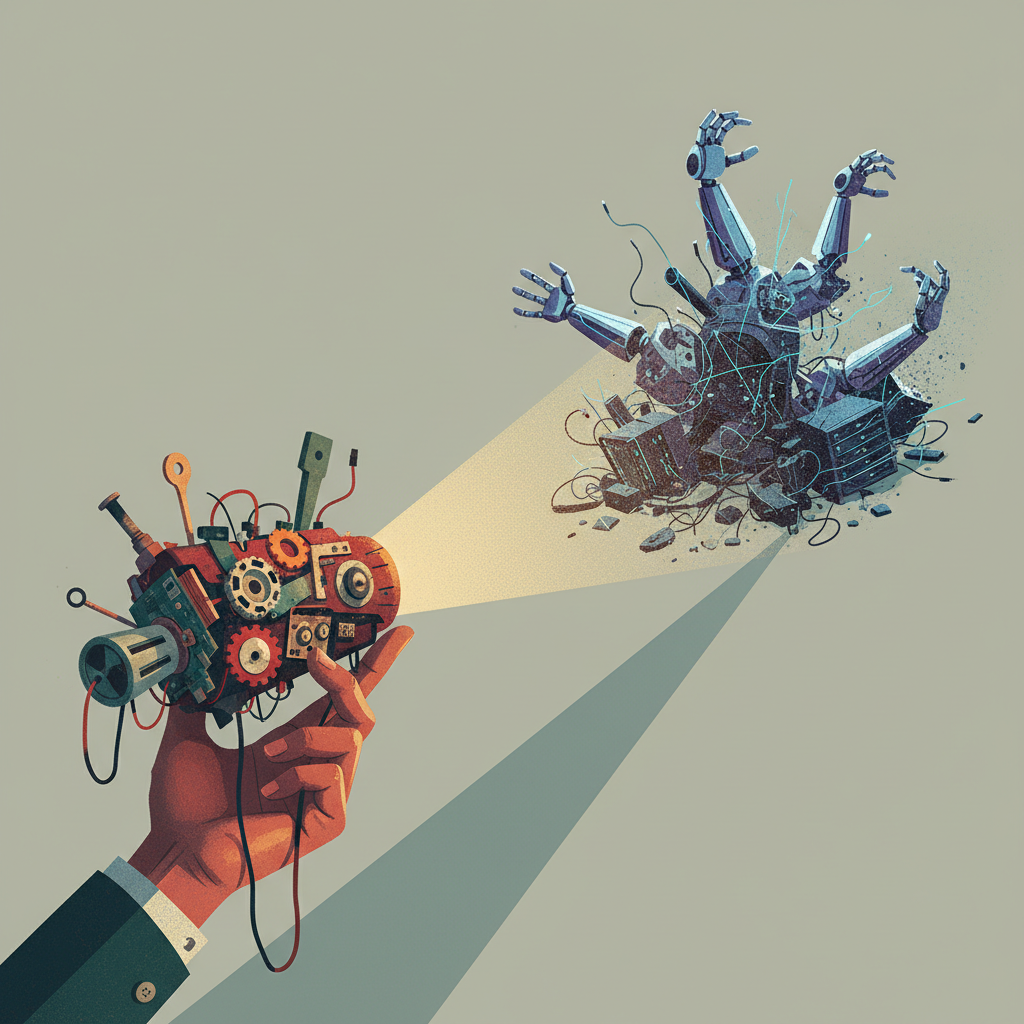

Let's be brutally honest. When you hear about the AI arms race, what comes to mind? Probably images of Google's DeepMind battling Baidu's latest models, or perhaps NVIDIA's Jensen Huang talking about trillion-dollar chips. The narrative is always the same: a few powerful nations, a handful of tech giants, and the rest of us are just spectators, waiting to see who wins the digital crown. From my vantage point here in Caracas, that whole story feels like a carefully constructed illusion, a grand distraction from where the real innovation is happening.
Unpopular opinion from Caracas: This so-called AI arms race, with its talk of national security and economic dominance, is largely missing the point. It's a game played by the rich, for the rich, using rules that ignore the very human element of creativity and necessity. While Washington and Beijing pour billions into foundational models and military applications, the true revolution, the one that will actually change lives, is bubbling up from the margins. It's born out of scarcity, out of challenge, and out of a desperate need to adapt. This is where places like Venezuela, often dismissed in these global power plays, actually hold an unexpected advantage.
Think about it. The US, China, and the European Union are locked in a high-stakes poker game, each trying to outspend and out-compute the other. We hear about the Chips Act in the US, designed to bring semiconductor manufacturing home, or China's national AI strategy aiming for global leadership by 2030. The EU, meanwhile, is trying to legislate its way to ethical AI dominance with its AI Act, a noble but perhaps naive attempt to regulate a beast still being born. These are all top-down approaches, driven by state-level directives and corporate behemoths like Microsoft, OpenAI, and Tencent. They are building bigger, faster, more complex systems, but are they building smarter systems for the global majority?
I argue no. Their focus is often on scale, on general intelligence, on applications that serve their existing economic and strategic interests. They are optimizing for efficiency in already efficient systems. But what happens when the systems are broken? What happens when resources are scarce? That's when true innovation, the kind that reshapes paradigms, emerges. The crisis created something unexpected here in Venezuela, a kind of technological resilience that is often overlooked. Our engineers, our developers, our entrepreneurs, they don't have the luxury of endless compute or venture capital. They have to make do, to hack, to repurpose, to invent with what little they have. And that, my friends, is a powerful forge for ingenuity.
Consider the impact of Venezuela's tech diaspora. These are brilliant minds, many educated in our public universities, who have taken their problem-solving skills honed by adversity to every corner of the globe. They are not just coding for Silicon Valley giants; they are often leading the charge in creating lean, efficient, and highly adaptable AI solutions. Venezuela's tech diaspora is reshaping AI globally. They understand that the most advanced AI isn't always the one with the most parameters, but the one that solves the most pressing problems with the fewest resources. This perspective is invaluable, and it's something the G7 nations often miss in their grand strategic plans.
Take the example of cryptocurrency. When our national currency became volatile, when traditional financial systems faltered, Venezuelans didn't wait for a government solution. They embraced Bitcoin, they innovated with peer-to-peer networks, they built their own digital economies out of sheer necessity. This wasn't a top-down initiative; it was a grassroots movement born from crisis. The same principle applies to AI. While the big players focus on autonomous weapons or hyper-personalized advertising, our people are thinking about how AI can optimize energy grids in unstable conditions, how it can streamline logistics when infrastructure is crumbling, or how it can provide accessible education where traditional institutions are failing.