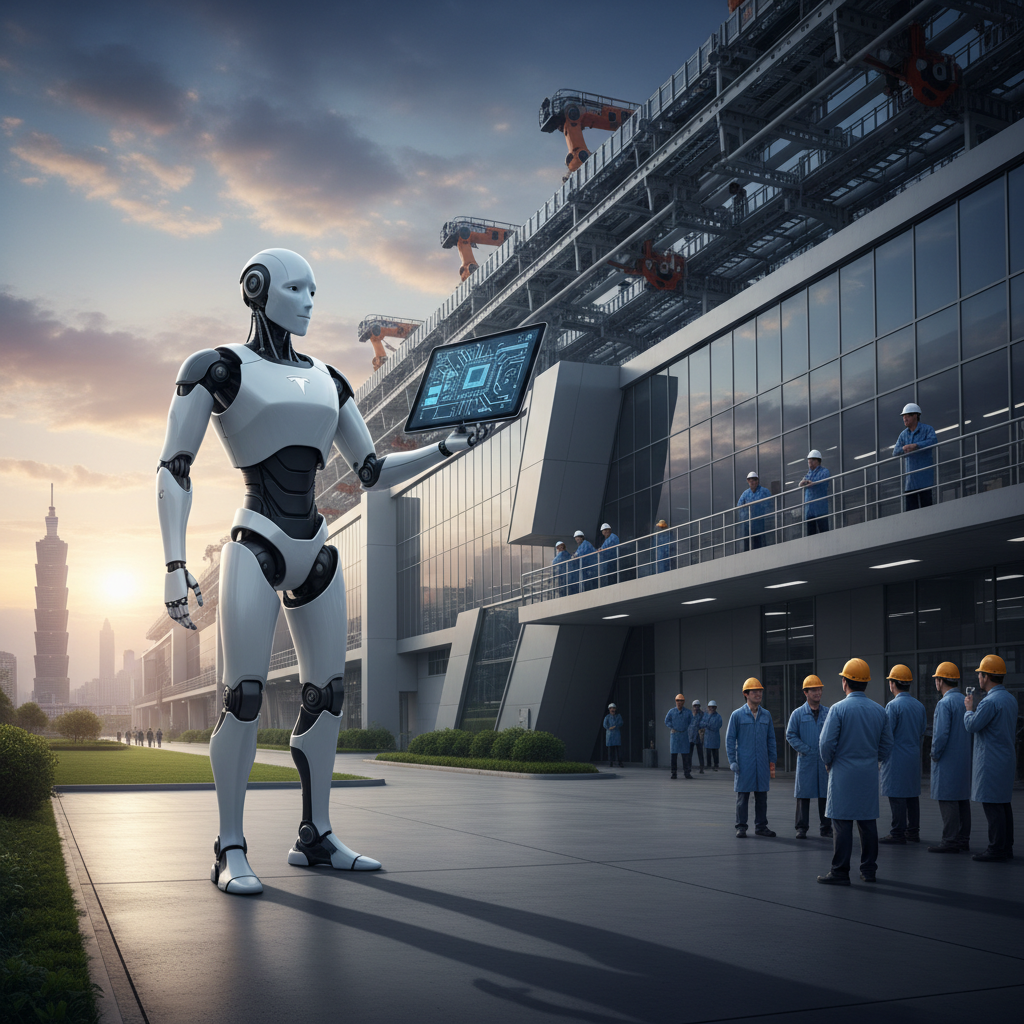

The vision is compelling: sleek, bipedal robots seamlessly integrating into human workspaces, performing tasks from precision assembly in factories to customer service in retail. This narrative, amplified by figures like Elon Musk showcasing Tesla's Optimus and venture capital pouring into startups such as Figure AI, suggests an imminent paradigm shift in global labor. Yet, from my vantage point in Taiwan, a nation synonymous with advanced manufacturing and supply chain resilience, the question is not merely if these humanoids will arrive, but how they will truly transform our industrial landscape, and at what cost.
Let's separate fact from narrative. The enthusiasm surrounding humanoid robots is palpable. Companies like Boston Dynamics have demonstrated incredible agility and dexterity with their Atlas robot, while others like Agility Robotics with Digit are already piloting deployments in logistics. Tesla's Optimus, though still in its nascent stages, aims for mass production and a price point that could make it economically viable for a broad range of tasks. These developments are not trivial; they represent significant engineering achievements. However, the leap from controlled demonstrations to widespread, reliable, and cost-effective deployment in diverse, unstructured environments remains substantial.
Taiwan, with its dense network of high-tech manufacturing, particularly in electronics and semiconductors, is often seen as an ideal proving ground for advanced automation. Our factories, from the sprawling campuses of Foxconn to the specialized foundries of Tsmc, already employ sophisticated robotic systems for tasks requiring precision and repetition. The introduction of humanoids, theoretically, could extend automation to tasks that currently demand human flexibility and problem-solving. Imagine a humanoid robot on a Foxconn assembly line, not just placing components, but also troubleshooting minor defects or reconfiguring its workspace for a new product run, tasks traditionally requiring human intervention. This is the promise.
But the data tells a more nuanced story. While the global robotics market is projected to grow significantly, with some estimates placing the humanoid segment alone at over $13 billion by 2030, the current adoption rates for general-purpose humanoids in complex manufacturing environments are still low. The challenges are manifold: high initial investment, limited battery life, the need for robust AI for navigation and task execution, and perhaps most critically, the difficulty of programming these robots for the sheer variability of human-centric tasks. A human worker can adapt to a slightly misplaced tool or an unexpected obstruction; a robot requires explicit programming or highly advanced perception and decision-making capabilities, which are still evolving.
“The real bottleneck for humanoid robots right now isn't just hardware, it's the software and the ability for these machines to truly generalize across tasks without extensive retraining,” observes Dr. Chen-Fu Chien, a distinguished professor at National Tsing Hua University and an expert in smart manufacturing. “Our factories are dynamic. They are not static environments. The cost of downtime for reprogramming or error correction can quickly negate any perceived labor savings.” His point underscores a critical distinction: our existing industrial robots are highly specialized, optimized for specific, repetitive actions. Humanoids aspire to be generalists, a far more complex undertaking.
Consider the restaurant and retail sectors, another area frequently cited for humanoid deployment. In Taiwan, service industries are characterized by high human interaction, cultural nuances, and often, bespoke customer requests. While simple tasks like delivering food or stocking shelves could be automated, the full scope of a waiter's or sales associate's role involves empathy, nuanced communication, and problem-solving that current AI and robotics are far from replicating. A robotic barista might make a perfect latte, but can it engage in the casual, friendly banter that defines Taiwan's vibrant cafe culture? Doubtful.
“We are exploring automation, certainly, especially for repetitive kitchen tasks,” stated a representative from a major Taiwanese restaurant chain, who preferred to remain unnamed due to ongoing strategic planning. “But for front-of-house, our customers value human interaction. The cost-benefit analysis for a humanoid server, considering its current limitations and the investment, simply doesn't close the gap for us yet.” This sentiment highlights a practical barrier: the return on investment must be clear and compelling, particularly in industries where profit margins can be thin.
Taiwan's position is more complex than headlines suggest. As a crucial node in the global supply chain, our industries are constantly seeking efficiency. The government, through initiatives like the Asia Silicon Valley Development Plan, actively promotes AI and robotics adoption. Companies like Delta Electronics are already leaders in industrial automation, developing advanced robotic arms and smart factory solutions. The expertise is here, the willingness to innovate is strong. However, the focus remains on practical, incremental improvements rather than wholesale, unproven technological shifts.
The semiconductor industry, Taiwan's crown jewel, offers a prime example. TSMC's fabs are among the most automated facilities on Earth, utilizing highly specialized robots for wafer handling and transport in ultra-clean environments. These are not humanoids; they are purpose-built machines designed for extreme precision and reliability. The integration of general-purpose humanoids into such critical, sensitive processes would require an unparalleled level of validation and reliability, a bar that current humanoid technology has yet to meet.
Furthermore, the social implications cannot be ignored. While proponents argue humanoids will take on 'dirty, dull, and dangerous' jobs, the reality is that job displacement, even if temporary, can lead to significant societal disruption. Taiwan, with its aging population, faces unique demographic challenges that might make automation appealing for labor shortages. However, any widespread deployment would necessitate robust retraining programs and social safety nets, a conversation that must begin now, not after the robots arrive.
The narrative of humanoids rapidly conquering the workforce is exciting, a testament to humanity's ingenuity. Yet, for a nation like Taiwan, grounded in pragmatic engineering and economic realities, the path to widespread adoption will be measured, strategic, and deeply analytical. The promise is there, but the practicalities, the costs, and the societal adjustments required are formidable. We will watch, we will analyze, and we will innovate, but we will do so with our eyes wide open, understanding that true progress is built on more than just hype; it is built on verifiable performance and sustainable integration. The future of labor is undoubtedly evolving, but the shape it takes will be determined by far more than just technological capability; it will be shaped by economic viability, cultural acceptance, and the rigorous demands of real-world application, especially in the demanding environment of our industrial heartland. For a deeper dive into the broader implications of AI in manufacturing, one might consider the analyses found on MIT Technology Review. The journey from laboratory marvel to factory floor staple is often longer and more complex than many anticipate. For further insights into the global robotics market, Reuters often provides valuable reports.