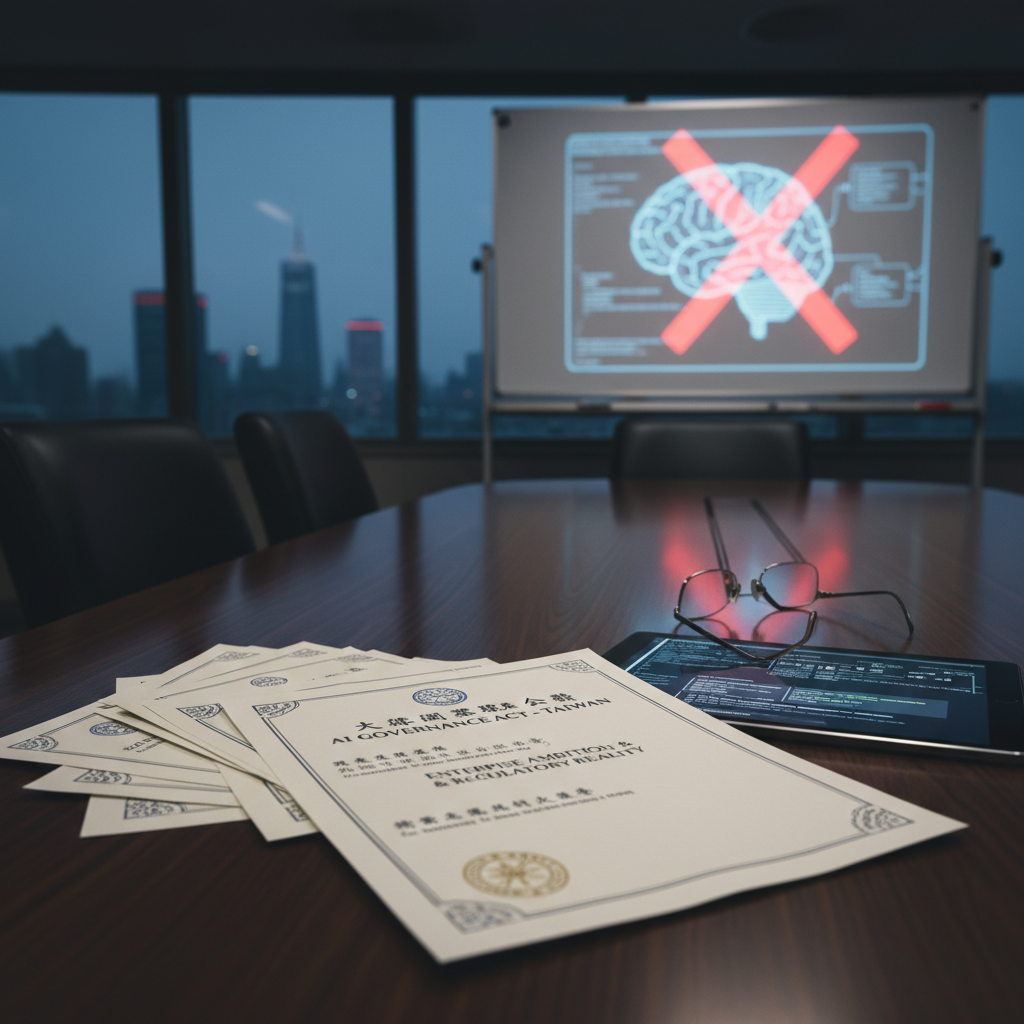

The promise of artificial intelligence has captivated boardrooms across Taiwan, much as it has globally. Executives envision streamlined operations, predictive analytics, and unprecedented efficiency gains. Yet, for many, the reality of implementing AI within their enterprises has been a stark contrast to the glossy presentations. Failures in adoption, often stemming from a misalignment between technological ambition and regulatory preparedness, are quietly accumulating. In response, the Executive Yuan recently announced a new directive aimed at fostering responsible AI development and deployment, particularly within critical sectors. But will this top-down approach truly address the intricate challenges faced by Taiwanese businesses?
The policy move, unveiled in late March 2026, emphasizes a multi-pronged strategy. It includes the establishment of a dedicated AI Ethics and Governance Office under the Ministry of Digital Affairs, a proposed framework for data privacy in AI applications, and incentives for companies to adopt AI solutions that adhere to international ethical guidelines. The stated goal is to position Taiwan not just as a hardware manufacturing powerhouse, but as a leader in trustworthy AI, leveraging our robust semiconductor foundation. "We recognize that AI is not just a technological race, but a race for trust," stated Audrey Tang, Minister of Digital Affairs, during a press briefing. "Our aim is to create an environment where enterprises can innovate with confidence, knowing that ethical and legal boundaries are clearly defined."
Who is behind this initiative, and why now? The impetus appears to be a confluence of factors: increasing pressure from international bodies advocating for AI regulation, a desire to protect Taiwan's reputation as a responsible tech player, and perhaps most critically, a growing awareness of the domestic enterprise AI adoption failures. Anecdotal evidence suggests that many initial AI projects, particularly among traditional manufacturing and service industries, have faltered due to a lack of clear guidelines on data governance, algorithmic bias, and accountability. Companies are hesitant to invest heavily without a predictable regulatory environment, fearing future liabilities or non-compliance. This new directive, therefore, is an attempt to provide that much-needed clarity and de-risk AI investments for local firms.
What does this mean in practice for a Taiwanese enterprise? For a medium-sized manufacturing firm in Taichung, for example, it means navigating a new layer of compliance. If they wish to deploy an AI system for quality control or supply chain optimization, they will likely need to demonstrate adherence to data anonymization protocols, explainability principles for their algorithms, and conduct regular impact assessments. The proposed framework, while still in draft form, hints at mandatory reporting for high-risk AI systems and potential penalties for non-compliance. The Ministry of Economic Affairs is also reportedly exploring certifications for AI solutions, similar to ISO standards, which could become a de facto requirement for government contracts or even B2B partnerships.
The industry reaction has been, predictably, mixed. Larger technology firms, particularly those with international operations, generally welcome the move. "A clear regulatory landscape is essential for scaling AI solutions," commented Dr. Chen-Hao Lin, Chief AI Officer at Delta Electronics, a prominent Taiwanese electronics manufacturer. "We already adhere to many global standards, so a localized framework that aligns with these principles will facilitate, rather than hinder, our innovation." However, for small and medium-sized enterprises (SMEs), which form the backbone of Taiwan's economy, there is palpable concern. "We are already struggling to find talent and secure funding for basic digital transformation, let alone navigate complex AI ethics guidelines," voiced Ms. Mei-Ling Huang, CEO of a textile company in Tainan. "Will the government provide practical support and resources, or just another set of rules to follow? The data tells a more nuanced story; many SMEs simply lack the internal expertise to implement these sophisticated governance frameworks without significant external assistance."
Civil society organizations, long advocating for stronger protections in the digital realm, view the initiative with cautious optimism. The Taiwan Association for Human Rights, for instance, has praised the emphasis on ethical AI but has called for greater public consultation and transparency in the drafting of specific regulations. "The devil is always in the details," remarked Mr. Li-Wei Chang, a legal expert at the association. "While the intent to protect citizens from algorithmic harm is commendable, we must ensure that the framework does not become overly prescriptive, stifling innovation, nor too vague, leaving room for exploitation. We need robust mechanisms for redress and accountability that are accessible to the average citizen, not just large corporations." There is a particular focus on ensuring that biases inherent in training data, especially those reflecting societal inequalities, are actively mitigated, a concern that resonates deeply in a diverse society like Taiwan.
Will it work? The ambition is clear, but the path ahead is fraught with challenges. Taiwan's position is more complex than headlines suggest. While our technological prowess, particularly in semiconductors, is undeniable, translating that into comprehensive and effective AI governance for enterprise adoption requires more than just policy pronouncements. It demands significant investment in education and training, not only for engineers but also for legal professionals and business leaders. It requires a pragmatic approach that balances innovation with protection, avoiding the pitfalls of both under-regulation and over-regulation. The success of this initiative will hinge on the government's ability to engage deeply with industry, provide tangible support to SMEs, and build public trust through transparent processes. Without these critical components, the new directive risks becoming another well-intentioned but ultimately ineffective layer of bureaucracy, failing to bridge the gap between Taiwan's AI aspirations and its enterprise realities. Let's separate fact from narrative; the true test will be in the implementation, not just the announcement.