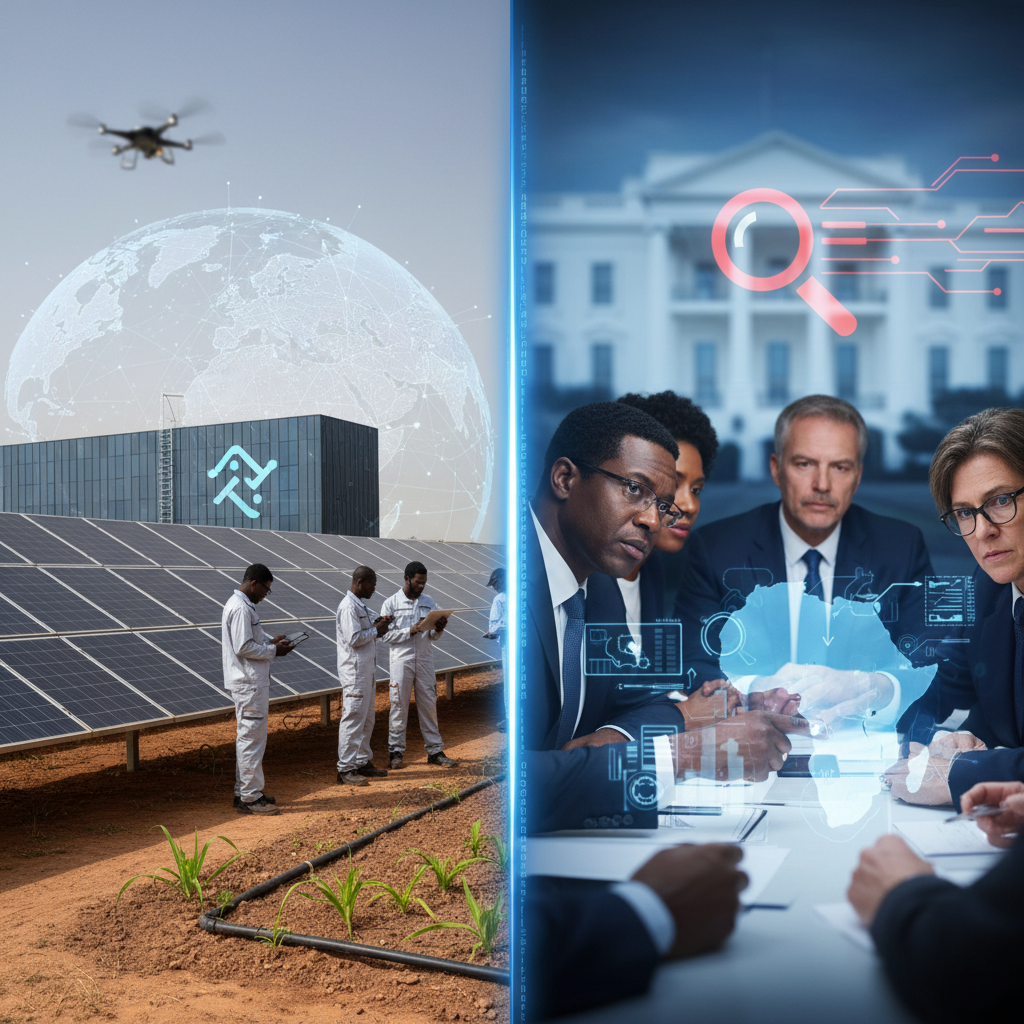
The dusty roads of Dakar, usually bustling with the vibrant chaos of commerce and community, now carry the silent hum of a different kind of ambition: the ambition of global superpowers. For years, Senegal, like many nations across our continent, has been a recipient of significant infrastructure investment from China. Now, this investment has pivoted sharply towards the digital realm, specifically artificial intelligence, drawing the wary gaze of Western powers. This is not merely about building roads or ports anymore; it is about controlling the very nervous system of our future.
My investigations reveal a pattern, a meticulously orchestrated campaign by Beijing to embed its AI technologies deep within Africa's nascent digital ecosystem. Huawei, a name synonymous with Chinese technological prowess, stands at the forefront of this push. Their AI solutions, from smart city surveillance systems to cloud computing infrastructure, are being deployed with a speed and scale that few Western companies can match. In Senegal, for example, Huawei's involvement in the national data center project, a cornerstone of our digital transformation, has been substantial. The implications of this are profound, extending far beyond mere technological adoption.
“We welcome investment from any partner that respects our sovereignty and contributes to our development goals,” stated Madame Aminata Touré, Director of Senegal's National Agency for Digital Economy, during a recent press briefing. “However, we must remain vigilant. The digital infrastructure we build today will define our economic and social landscape for generations. We cannot afford to become a digital dependency.” Her words, while diplomatic, hint at the underlying tension that permeates these high-stakes deals.
The geopolitical chessboard is clear: Washington, increasingly concerned about China's technological ascendancy, views these investments with deep suspicion. The narrative from the United States and its allies often frames Huawei's involvement as a national security risk, citing potential backdoors and data espionage. While concrete evidence of such nefarious activities remains elusive in the public domain, the warnings are persistent. The documents reveal a significant increase in diplomatic pressure from Western embassies in Dakar, urging caution and offering alternative, albeit often more expensive, technological solutions.
Consider the burgeoning market for AI-powered climate solutions, a critical area for a nation like Senegal grappling with desertification and rising sea levels. Chinese firms are offering comprehensive packages that include AI-driven smart agriculture systems, predictive weather modeling, and even AI-enhanced water management. These solutions are often bundled with attractive financing options and rapid deployment capabilities, making them incredibly appealing to governments eager to demonstrate progress. “The speed at which these Chinese AI solutions can be implemented is a game changer for us,” explained Dr. Omar Diop, a leading Senegalese agronomist working with the Ministry of Agriculture. “We need immediate, impactful solutions for our farmers, not protracted negotiations and conditional aid. The proof is in the harvest, not in the rhetoric.”
However, this rapid adoption comes with its own set of questions. Who owns the data generated by these smart systems? What are the long-term implications for data sovereignty? These are not trivial concerns. My sources tell me that clauses within some of these technology transfer agreements grant the foreign providers extensive access to operational data, ostensibly for system maintenance and improvement. While this might seem innocuous, in the context of advanced AI, data is the new gold, and its control represents immense power.
The United States, through initiatives like the 'Partnership for Global Infrastructure and Investment,' is attempting to counter China's influence, but often struggles to match the speed and flexibility of Chinese state-backed enterprises. “We are committed to providing transparent, high-quality alternatives that uphold democratic values and data privacy standards,” asserted Ambassador Sarah Jenkins, the US envoy to Senegal, in a recent interview with a local newspaper. “Our focus is on empowering African nations to build resilient, secure digital futures, free from undue influence.” Yet, the perception on the ground is often one of slower processes and higher upfront costs, making the Chinese offerings appear more pragmatic in the short term.
This technology cold war is not just about hardware and software; it is fundamentally about standards and norms. Chinese companies are exporting their technological ecosystem, which includes not only their products but also their regulatory frameworks and data governance philosophies. If these become the de facto standards in Africa, it could create a digital divide that mirrors ideological fault lines. The implications for interoperability, cybersecurity, and even freedom of expression are immense. For more on the broader geopolitical implications of AI, one might consult analyses from MIT Technology Review.
The scale of Chinese investment in Africa's digital infrastructure is staggering. Reports from various think tanks indicate that Chinese firms have been involved in building over 70% of Africa's 4G networks and are now aggressively pursuing 5G and fiber optic deployments. This foundational infrastructure is what enables the widespread adoption of AI applications. It creates a powerful lock-in effect, making it difficult for African nations to pivot to alternative providers later, even if geopolitical winds shift. This is just the tip of the iceberg.
The burgeoning field of AI ethics and governance is another battleground. While Western nations emphasize principles of fairness, accountability, and transparency in AI development, Chinese approaches often prioritize efficiency and social stability, sometimes at the expense of individual liberties. As Senegal develops its own AI strategy, it must navigate these divergent philosophies. The choices made today will shape not only our technological landscape but also our societal values.
“We are not merely consumers of technology; we are partners in its evolution,” declared Dr. Malick Ndiaye, a prominent Senegalese computer scientist and advocate for local AI development. “Our focus must be on building indigenous capacity, training our youth, and developing AI solutions that address our unique challenges, not just importing foreign models wholesale. We need to understand the algorithms, not just use them.” His words resonate deeply within the local tech community, which often feels sidelined by the larger geopolitical machinations.
The global scramble for critical minerals, essential for advanced AI chips and technologies, further complicates the picture. Africa is rich in these resources, and the competition for access is intensifying. Nations like the Democratic Republic of Congo, with its vast cobalt reserves, are already experiencing the complex interplay of resource extraction, technological demand, and geopolitical maneuvering. While Senegal is not a major producer of these specific minerals, the broader economic and political stability of the continent is inextricably linked to these dynamics.
As Senegal stands at this digital crossroads, the decisions made by our leaders will have far-reaching consequences. The allure of rapid development and affordable technology from one superpower must be weighed against the concerns about data sovereignty, security, and long-term strategic autonomy voiced by another. The challenge is to harness the transformative power of AI for the benefit of our people, without becoming a pawn in a larger, global game. The future of our digital independence, much like our political independence, will depend on our ability to negotiate these complex currents with wisdom and foresight. For ongoing news on AI industry developments, TechCrunch provides regular updates. Meanwhile, the debate on digital sovereignty in Africa continues, as highlighted in previous discussions about Amazon's Alexa Overhaul in Senegal [blocked].