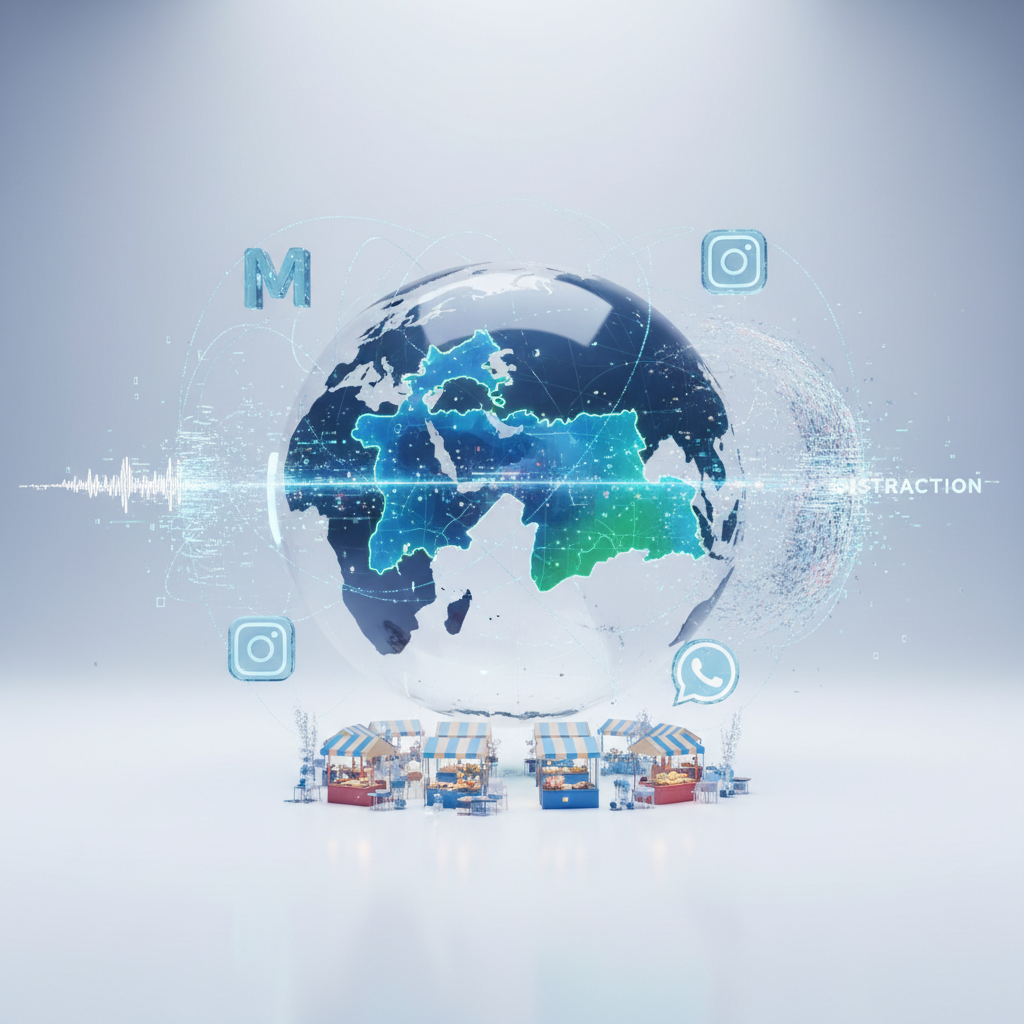
The West has it backwards, again. While the titans of Silicon Valley, led by the likes of OpenAI's Sam Altman, race to build ever more powerful, ever more proprietary, and ever more secretive artificial intelligences, a different vision is emerging. It is a vision that resonates deeply with the spirit of collaboration and community I know from Amman, a vision championed by companies like Together AI. They are not chasing the next closed-source behemoth; they are building the open infrastructure, the digital souq where every vendor, every developer, can set up shop and innovate freely. And frankly, Jordan's approach makes more sense than Silicon Valley's.
For too long, the narrative around AI has been dominated by a few well-funded, Western-centric corporations. They hold the keys to the kingdom, dictating what models we can use, what data they are trained on, and ultimately, what the future of AI looks like. This is not just a technological problem; it is a geopolitical one. When critical infrastructure, especially something as transformative as AI, is concentrated in the hands of a few, it creates dependencies that can be exploited, stifling innovation and limiting sovereignty for nations outside that exclusive club.
Together AI, a company that might not grab the headlines like OpenAI or Google, is quietly constructing the anti-OpenAI. They are focusing on providing the cloud infrastructure and developer tools that allow anyone to run, fine-tune, and deploy large language models, or indeed any AI model, in an open and accessible manner. Think of it as the foundational layer, the bedrock upon which a truly diverse and globally distributed AI ecosystem can flourish. This is not about building the next GPT or Claude; it is about democratizing access to the computational power and frameworks needed to build the next GPT or Claude, but on your own terms.
Why does this matter so profoundly for us in Jordan, and for the wider Global South? Because we cannot afford to be mere consumers of AI, reliant on the benevolence or business models of foreign tech giants. We need to be creators, innovators, and shapers of this technology. The proprietary model, with its exorbitant API costs and opaque training data, creates a digital divide that mirrors existing economic inequalities. Open-source, however, offers a pathway to self-reliance. It empowers our universities, our startups, and our governments to develop AI solutions tailored to our specific needs, whether that is optimizing water management in arid regions, improving healthcare access in rural communities, or preserving our rich Arabic linguistic heritage.
Take, for instance, the words of Dr. Fei-Fei Li, co-director of Stanford's Institute for Human-Centered AI, who has consistently advocated for broader access to AI. She once stated,