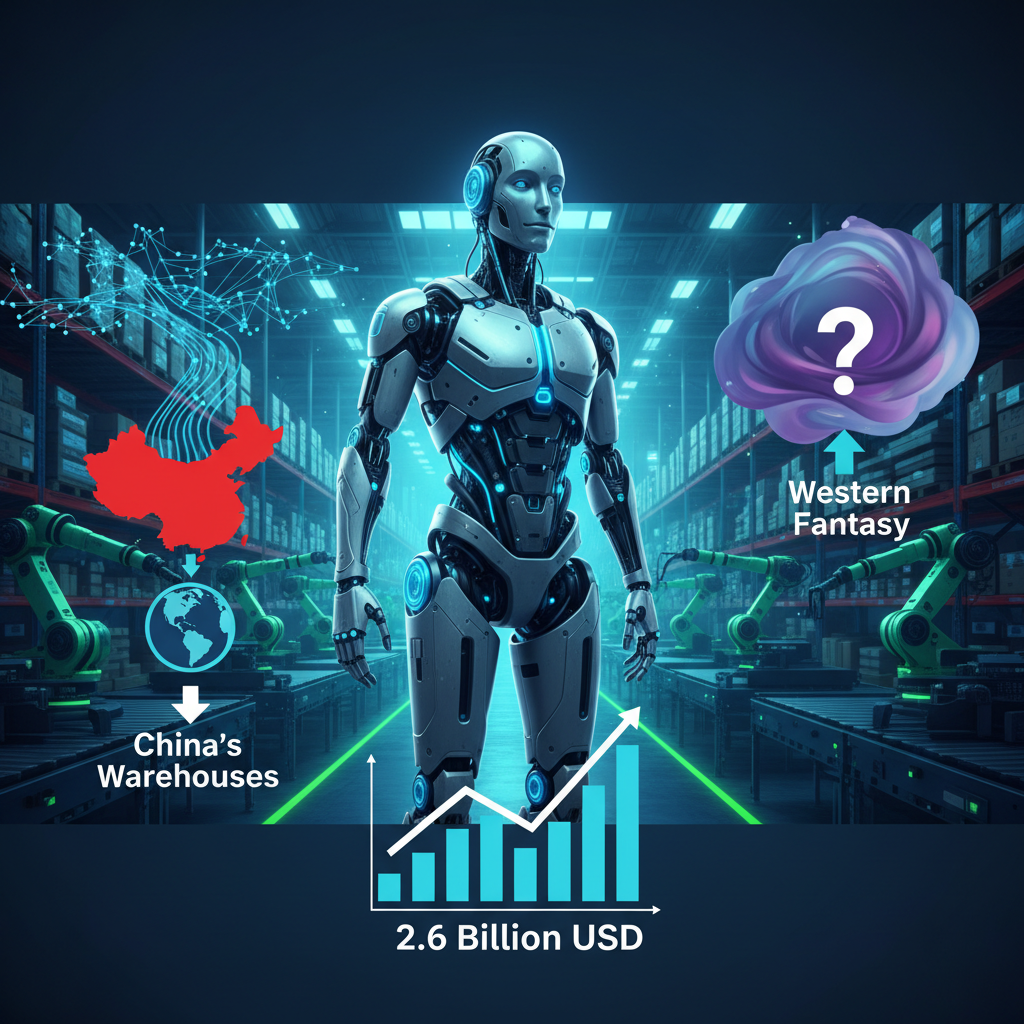

Walk into any major logistics hub in China, from Shenzhen to Shanghai, and you will see an army of people, moving with a practiced rhythm, sorting packages, loading trucks, and fulfilling the insatiable demands of e-commerce. It is a symphony of human effort, often grueling, sometimes repetitive, but undeniably human. Now, imagine that symphony replaced by silent, bipedal machines. This is the vision being sold by companies like Figure AI, which recently secured a staggering $2.6 billion investment from an impressive roster of backers including OpenAI, Microsoft, and NVIDIA. They are betting big that their humanoid robots, like the Figure 01, will soon be the new normal in warehouses, pushing human labor into obsolescence.
But is this a genuine technological leap, poised to sweep across the globe, or merely a very expensive Western fantasy that overlooks the unique economic and social landscapes of places like China? As an investigative journalist, I have learned that the real story is rarely in the glossy press releases; it is in the supply chain, the labor market, and the unspoken policies that shape technological adoption.
For decades, automation in warehouses has been a steady, incremental march. We have seen automated guided vehicles, robotic arms for picking and packing, and sophisticated conveyor systems. These machines have typically been purpose-built, designed for specific, repetitive tasks within a controlled environment. They are efficient, yes, but they lack the dexterity and adaptability of a human worker. The promise of humanoid robots, however, is different. They are designed to operate in human-centric environments, using human tools, and performing a wider array of tasks without extensive re-engineering of existing infrastructure. This is the allure for investors like Sam Altman, who reportedly sees Figure AI as a key step toward general artificial intelligence embodied in the physical world.
In the West, where labor costs are high and demographics are shifting towards an aging workforce, the economic argument for replacing human labor with robots is compelling. Companies like Amazon have been at the forefront, deploying thousands of Kiva robots in their fulfillment centers, albeit not yet humanoid ones. The narrative is often framed as a solution to labor shortages and a path to increased efficiency. For Figure AI, the target is clear: the estimated 10 million unsafe or undesirable jobs in the US alone that could be performed by their robots. This is a significant market, no doubt.
However, when we turn our gaze to China, the picture becomes more nuanced. China is the world's factory, and its logistics networks are immense, driven by a vast and often migrant workforce. While labor costs have risen over the years, they remain significantly lower than in many Western economies. Furthermore, China's manufacturing and logistics sectors have historically absorbed millions of workers, playing a critical role in social stability and economic development. Beijing isn't saying this publicly, but the wholesale displacement of human labor on a massive scale, even if technically feasible, presents complex social and economic challenges that are not easily dismissed.
Consider the sheer scale. China processes billions of packages annually. The Singles' Day shopping festival alone generates volumes that dwarf many Western countries' yearly totals. While Chinese companies like JD.com and Cainiao (Alibaba's logistics arm) have invested heavily in automation, including robotic sorting centers and drone deliveries, their approach has often been a hybrid one, augmenting human labor rather than entirely replacing it. They have focused on efficiency gains through smart logistics, data analytics, and targeted automation for the most arduous or repetitive tasks, leaving more complex or variable tasks to human hands.
Expert opinions on this shift are varied. Dr. Wang Li, a leading robotics researcher at the Chinese Academy of Sciences, recently commented, "The technical prowess of Figure AI's robots is undeniable, and their potential for general-purpose manipulation is exciting. However, the economic calculus for widespread adoption in China's current labor market is different. We must consider the social impact of large-scale displacement. Our focus has been on human-robot collaboration, enhancing worker capabilities, rather than outright substitution." This perspective highlights a key divergence in strategic thinking.
Indeed, the Chinese government's