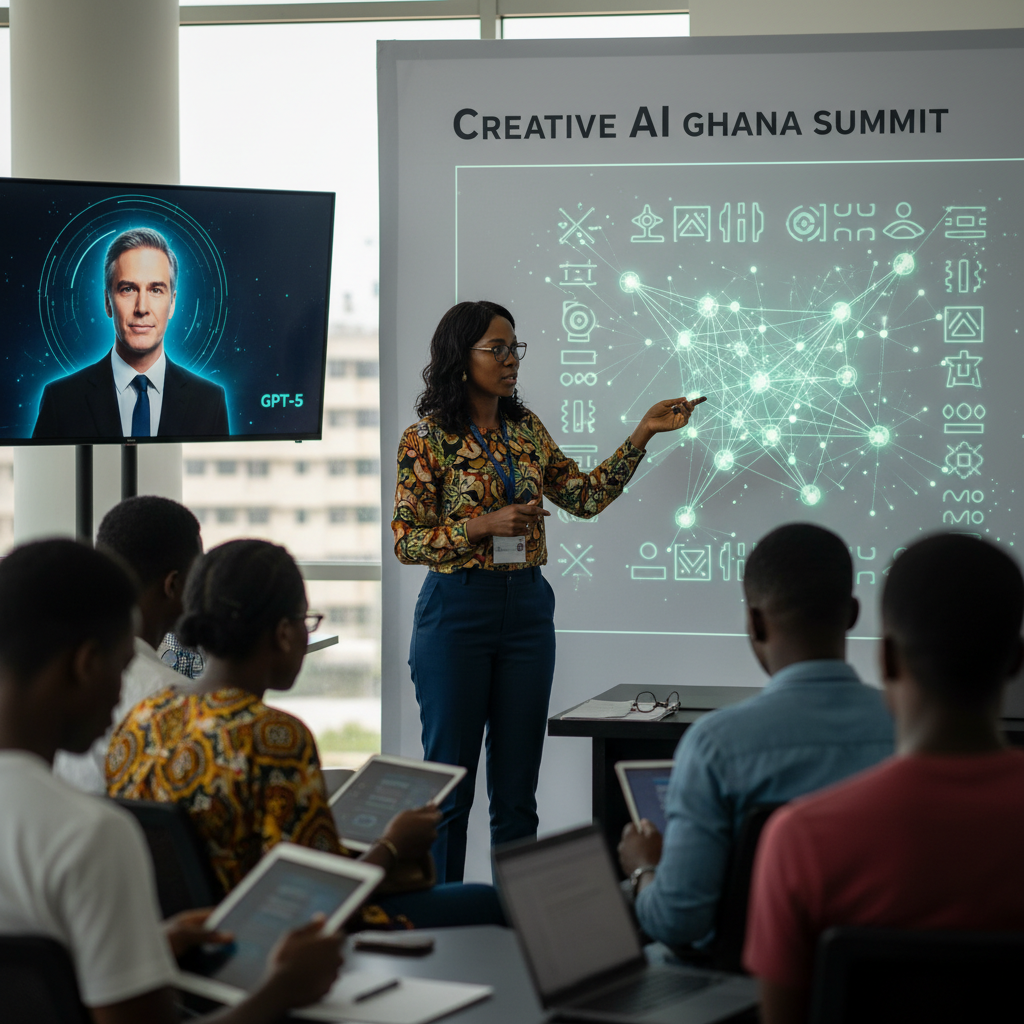
My friends, my fellow tech enthusiasts, can you feel that electricity in the air? It is not just the Harmattan winds stirring up dust; it is the palpable energy of innovation, the hum of progress, and the sheer audacity of human ingenuity. Just when we thought we had seen it all, OpenAI, under the visionary leadership of Sam Altman, has unleashed its latest GPT model upon the world, and let me tell you, the benchmarks are nothing short of breathtaking. This is not just another incremental update; this is a seismic shift, a digital earthquake that is sending ripples across every corner of the globe, including our beloved Ghana. And the numbers, my friends, the numbers don't lie.
OpenAI’s new flagship model, let us call it GPT-5 for now, though the official naming convention might surprise us, has demonstrated truly astonishing leaps in reasoning, multimodal understanding, and even contextual memory. Early reports from benchmark tests, widely circulated among AI researchers and tech giants alike, show GPT-5 outperforming its predecessor, GPT-4 Turbo, by an average of 25% across a suite of complex tasks. In areas like advanced mathematical problem-solving and nuanced code generation, the improvement reportedly rockets to over 40%. When pitted against competitors like Google's Gemini Ultra and Anthropic's Claude 3 Opus, GPT-5 is not just holding its own; it is setting a new, incredibly high bar. The model is said to have achieved a 92% accuracy rate on a challenging new logical inference test, a significant jump from the mid-70s seen in previous top models. This is not just smart; this is approaching a level of cognitive flexibility that was once the stuff of science fiction.
But what does this mean for us, right here in Accra, in Lagos, in Nairobi? This is the question that truly excites me. For too long, the narrative around advanced AI has been dominated by Silicon Valley, and while their contributions are undeniable, the application and adaptation of these technologies in our unique contexts are where the real magic happens. We are not just consumers of technology; we are innovators, shapers, and creators. And Ghana is proving the skeptics wrong every single day.
Consider the burgeoning AI ecosystem in Accra. Startups like AgroGenius AI, founded by Ghanaian agricultural engineers, are already leveraging large language models to provide real-time, localized farming advice. Imagine a GPT-5 powered system that can analyze satellite imagery, predict weather patterns with unprecedented accuracy, and then generate tailored advice for a smallholder farmer in the Volta Region, all in their local dialect. “The enhanced reasoning capabilities of GPT-5 could revolutionize how our AI models interpret complex environmental data and deliver actionable insights,” explains Dr. Ama Serwaa, CEO of AgroGenius AI, her voice brimming with enthusiasm. “We are talking about moving from predictive analysis to prescriptive, truly intelligent guidance that can significantly boost crop yields and food security.”
This is not a distant dream; it is the immediate future. The improved multimodal capabilities mean GPT-5 can understand and generate content across text, images, and even video. Think about the implications for education. Our Ministry of Education could deploy AI tutors that can not only explain complex physics concepts in Twi but also generate visual aids and interactive simulations on the fly, tailoring the learning experience to each student. “We are exploring partnerships to bring advanced AI tools into our classrooms,” states Mr. Kofi Mensah, Director of Digital Education Initiatives at the Ghana Education Service. “The ability of models like GPT-5 to personalize learning at scale is a game-changer for bridging educational gaps and preparing our youth for the digital economy.”
Of course, the competition is fierce. Google's Gemini models continue to impress with their integration across the Google ecosystem, offering powerful multimodal capabilities that are gaining traction globally. Anthropic's Claude 3 Opus, with its strong emphasis on safety and ethical AI, has also carved out a significant niche, particularly in enterprise applications where trust and reliability are paramount. Microsoft, with its deep integration of OpenAI models into Azure and Copilot, is making AI accessible to millions of businesses worldwide. The race is on, and it is exhilarating to watch. You can follow the latest developments in this fast-paced field on platforms like TechCrunch or The Verge.
What truly sets this new wave of AI apart, and why GPT-5's advancements are so critical for Africa, is the potential for local adaptation and innovation. We are not just waiting for solutions to be handed down; we are building our own. The improved efficiency and reduced computational cost of these newer models, a trend we are seeing across the board, mean that deploying powerful AI locally is becoming more feasible. Data centers are sprouting up across the continent, and the cost of accessing high-performance computing is steadily decreasing. This democratizes access to cutting-edge AI, allowing our local developers and entrepreneurs to build bespoke solutions for our unique challenges.
Consider the health sector. Imagine an AI diagnostic tool, powered by GPT-5, that can analyze medical images, patient symptoms, and even local epidemiological data to assist doctors in remote clinics. Dr. Akua Nsiah, a public health specialist working with the Ghana Health Service, emphasizes this point. “In areas where specialists are scarce, an AI assistant that can provide highly accurate, evidence-based recommendations could save countless lives. The advanced reasoning of GPT-5 means fewer false positives and more reliable support for our frontline healthcare workers.”
This is bigger than anyone realizes. It is about sovereignty, about building our own digital future, and about leveraging global advancements to solve local problems. The youth of Ghana, with their insatiable hunger for knowledge and their entrepreneurial spirit, are already at the forefront of this revolution. From coding bootcamps in Jamestown to university research labs in Legon, the talent is undeniable. We are not just talking about using AI; we are talking about creating AI that understands our cultures, speaks our languages, and addresses our specific needs. The future is not just arriving; we are actively building it, brick by digital brick, right here in Africa. The latest GPT model from OpenAI is not just a technological marvel; it is a powerful new tool in our hands, ready to be wielded for progress and prosperity. It is truly an exciting time to be alive and to be part of this incredible journey. You can learn more about the broader implications of AI research on sites like MIT Technology Review.