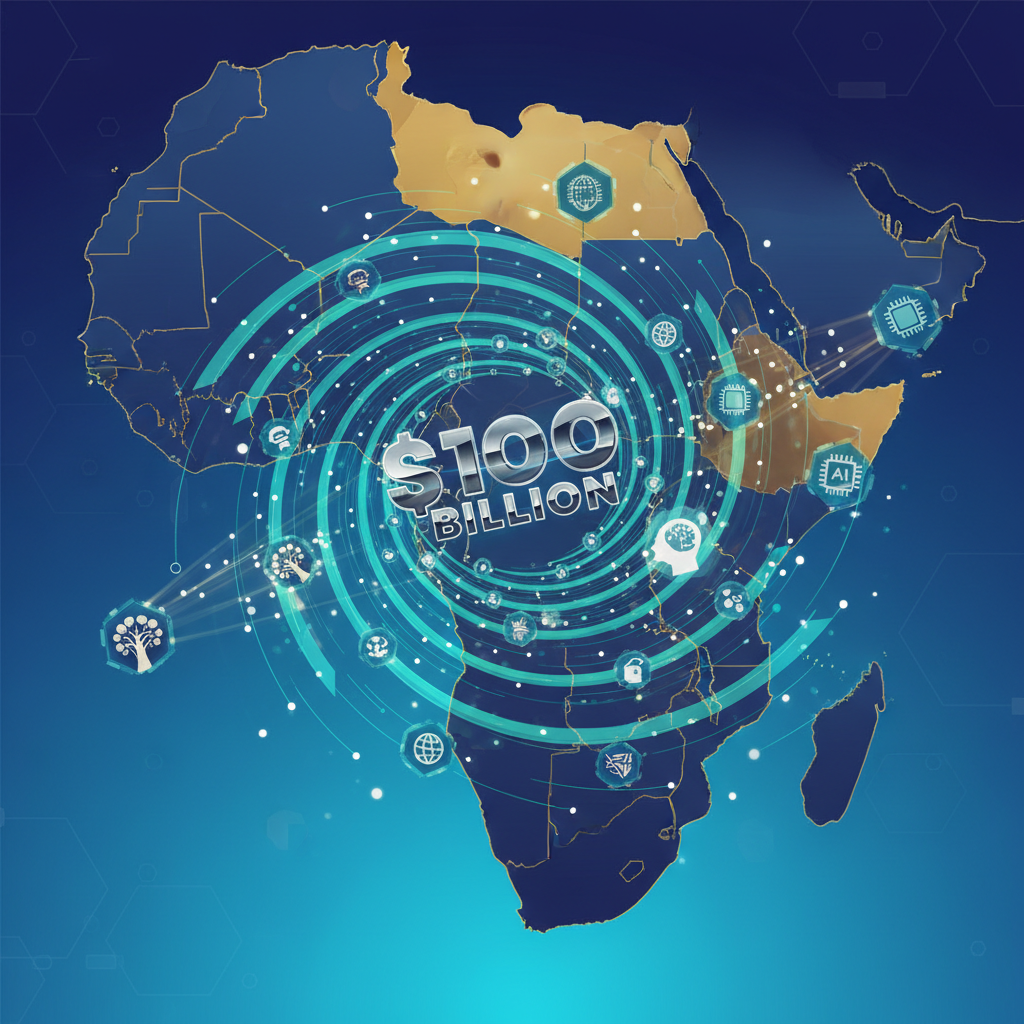
The drumbeat of capital in Silicon Valley has reached a fever pitch, a crescendo that now echoes across continents. OpenAI, the progenitor of ChatGPT, recently commanded a valuation exceeding $100 billion, a figure that would have seemed fantastical just a few years ago. This monumental assessment, largely driven by secondary share sales and investor confidence in its transformative artificial general intelligence (AGI) ambitions, forces a critical question upon us: Is this a harbinger of unprecedented innovation and prosperity for the global AI startup ecosystem, or does it signal an inevitable consolidation where only the giants can breathe?
From Dakar to Nairobi, the narrative of AI development has often been one of bootstrapping and ingenuity, a stark contrast to the venture capital bonanza fueling OpenAI. Historically, the technological landscape in Africa has been shaped by external forces, from colonial infrastructure to the influx of Chinese telecommunications giants like Huawei. The digital revolution, while promising, has frequently seen African nations as consumers rather than primary innovators. This pattern, I fear, could repeat itself in the AI space if we are not vigilant.
Consider the trajectory. Just a few years ago, the AI landscape was a patchwork of academic research, niche startups, and corporate labs. The advent of large language models, particularly with OpenAI's public release of GPT-3 and later ChatGPT, ignited a gold rush. Suddenly, every venture capitalist wanted a piece of the AI pie. Microsoft’s multi-billion dollar investment in OpenAI, followed by similar commitments from other tech behemoths, transformed the startup from a non-profit research lab into a commercial powerhouse. This influx of capital has not only accelerated OpenAI's research but has also inflated valuations across the board, creating a bubble some analysts fear is unsustainable.
My sources tell me that the impact on smaller AI startups is bifurcated. On one hand, the OpenAI phenomenon has validated the entire sector, making it easier for promising AI ventures to attract initial funding. "The sheer scale of OpenAI's valuation has opened the floodgates for early-stage investment in AI," explains Dr. Aminata Diallo, a venture partner at Sahel Ventures, a firm focused on African tech. "Investors who were once hesitant are now actively seeking out AI opportunities, even in markets like Senegal and Ghana." She notes that seed funding rounds for AI startups in West Africa have seen a 30 percent increase in the last 18 months, a direct correlation to the global AI hype cycle.
However, the documents reveal a more complex picture. While early-stage funding might be more accessible, scaling up remains a significant challenge. The cost of developing and deploying advanced AI models is astronomical, requiring vast computational resources and highly specialized talent. OpenAI and its peers, backed by billions, can afford to outbid smaller players for top engineers and secure preferential access to NVIDIA's coveted GPUs. This creates an uneven playing field. "We are seeing a talent drain," laments Omar Sy, CEO of a promising AI agriculture startup in Mali. "Our best engineers are constantly being poached by remote opportunities with salaries we simply cannot match, often from companies directly or indirectly funded by these mega-valuations." This brain drain threatens to stunt the growth of indigenous AI solutions tailored to local challenges.
Moreover, the very nature of foundation models, pioneered by OpenAI and Anthropic, means that much of the core AI infrastructure is becoming proprietary. While open-source alternatives exist, they often lag behind in performance or require significant in-house expertise to adapt. This could lead to a scenario where African startups become mere integrators of foreign AI technologies, rather than creators of their own. "The danger is that we become perpetual consumers of AI, rather than producers," states Professor Ndongo Fall, head of the AI Research Institute at Cheikh Anta Diop University in Dakar. "The true economic power lies in owning the foundational models, not just applying them." He advocates for increased governmental and institutional investment in local AI research and infrastructure, akin to the digital sovereignty initiatives seen in Europe and China.
The geopolitical implications are also profound. The race for AI supremacy is not just economic, it is strategic. Nations that control advanced AI will wield immense power. For Africa, this means navigating a complex landscape where major global players, including the United States, China, and Europe, are all vying for influence. Chinese tech companies, for instance, have long invested heavily in Africa's digital infrastructure, from fiber optic networks to data centers. Their approach often includes knowledge transfer and local partnerships, which can be beneficial, but also raise questions about data sovereignty and technological dependence. As Reuters recently reported, the competition for AI talent and resources is intensifying globally, with significant implications for emerging markets.
So, is this $100 billion valuation a fad or the new normal? The consensus among industry observers leans towards the latter, at least for now. The perceived potential of AGI is too great, and the capital markets too eager, for this trend to simply dissipate. However, the structure of this new normal is what concerns me most. Without deliberate and strategic intervention, the benefits of this AI boom risk being concentrated in the hands of a few powerful entities, leaving regions like Africa to play catch-up.
For Senegal and its neighbors, the path forward requires a multi-pronged strategy. We must invest in education and skills development to create a robust local talent pool. We need to foster an environment where local innovation can thrive, perhaps through government grants, incubators, and partnerships between academia and industry. Crucially, we must advocate for open standards and interoperability in AI, ensuring that our digital future is not locked into proprietary ecosystems controlled by distant corporations. As MIT Technology Review often highlights, the ethical and societal implications of AI development are as critical as the technological advancements.
This is just the tip of the iceberg. The current valuation frenzy for companies like OpenAI is not merely a financial story; it is a narrative about power, access, and the future of global technological leadership. For Africa, the challenge is to ensure that this future is one of empowerment and self-determination, not merely a continuation of old dependencies under a new digital guise. The opportunity to shape our own AI destiny is now, and we must seize it with both hands.