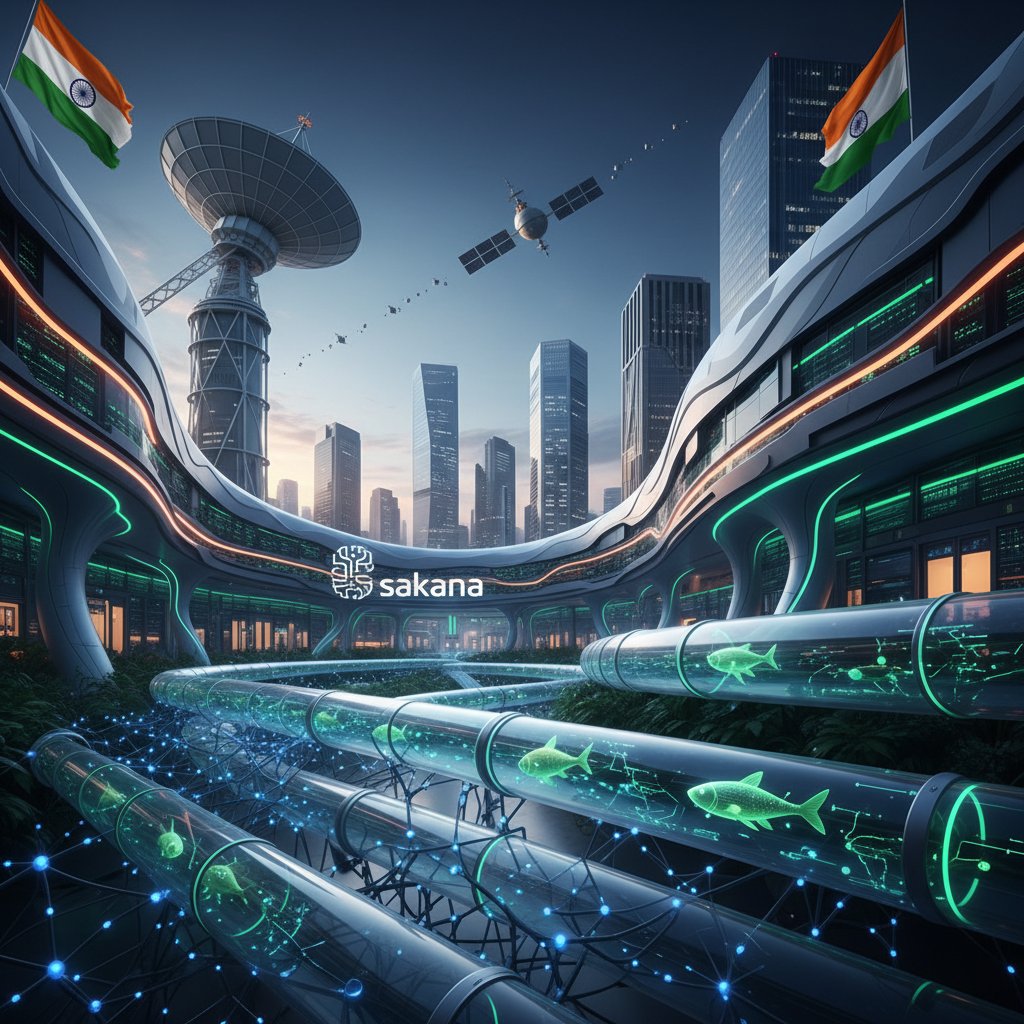

Namaste, tech enthusiasts! Rajèsh Krishnàn here, beaming with excitement from the heart of India's Silicon Valley, Bangalore. You know, sometimes, in this whirlwind of AI news, a story comes along that doesn't just grab your attention, it grips your imagination like a nail-biting finish in a cricket match. Today, that story is Sakana AI, a Tokyo-based startup that’s not just building AI, they're practically breeding it. And trust me, the implications for our dynamic Indian tech landscape are absolutely, positively mind-boggling.
We've all heard about large language models, right? GPT, Gemini, Llama, they're everywhere, transforming how we work, create, and even dream. But Sakana AI, founded by luminaries like David Ha, Llion Jones, and Ren Ito, who have serious pedigrees from Google Brain and other AI powerhouses, is taking a radically different approach. Instead of meticulously hand-crafting every layer and parameter, they're letting AI models evolve. Imagine that! It's like natural selection, but for algorithms, where the fittest models survive and thrive, getting smarter and more efficient with each generation. This isn't just the next iteration, my friends, this is a paradigm shift.
Their core philosophy, as I understand it, revolves around using evolutionary algorithms to discover novel AI architectures and training methodologies. David Ha, their CEO, has often spoken about the limitations of human intuition in designing increasingly complex neural networks. He's been quoted saying, "Human designers are often constrained by their own biases and cognitive limits. Evolution can explore a much wider design space, often finding solutions we wouldn't even think of." This is a fascinating concept, isn't it? It's like unleashing the power of billions of years of biological evolution onto the digital frontier. The scale is mind-boggling!
Now, why is this so exciting for us here in India? Well, think about it. Our nation is a hotbed of AI talent, with startups sprouting up faster than monsoon wildflowers. We're already a global hub for AI development and deployment. If Sakana AI's approach proves to be a more efficient and scalable way to build powerful, specialized AI models, then the opportunities for Indian developers and enterprises are immense. We could see a future where custom AI solutions, tailored for everything from agricultural optimization to personalized healthcare, can be developed with unprecedented speed and efficiency.
Consider the sheer volume of data we generate and process here. From our booming e-commerce platforms to the vast digital public infrastructure like Aadhaar and UPI, India is a data goldmine. Evolutionary AI could help us unlock insights from this data in ways we haven't even imagined. Instead of spending months or years on model architecture search, we could potentially 'evolve' optimal models in a fraction of the time. This means faster innovation cycles, quicker time to market, and a stronger competitive edge for Indian companies on the global stage.
"The potential for evolutionary AI to democratize access to advanced model development is huge," says Dr. Priya Sharma, a leading AI researcher at the Indian Institute of Science in Bangalore. "For countries like India, where we have abundant talent but sometimes lack the massive compute resources of Silicon Valley giants, these novel approaches could level the playing field. It's about working smarter, not just harder, and letting the algorithms discover their own optimal paths." Her words resonate deeply with the spirit of innovation that defines our tech ecosystem.
Sakana AI's initial work has already shown promising results in areas like image generation and smaller, more efficient language models. They're not just building massive, monolithic models, but exploring how smaller, specialized models can be 'bred' to perform specific tasks with incredible precision. This focus on efficiency and specialization is particularly relevant for India, where resource optimization is always a key consideration, and where AI needs to be deployed in diverse, sometimes resource-constrained environments.
This is just the beginning, of course. The field of evolutionary AI is still relatively nascent compared to traditional deep learning. There are challenges to overcome, like ensuring robustness, interpretability, and ethical alignment in models that are, in a sense, self-designed. But the promise is undeniable. Imagine AI models that can adapt and improve themselves continuously, learning from new data and evolving to meet changing demands. It's almost like giving AI its own intelligence to build better intelligence.
Our vibrant startup scene in Bangalore, Hyderabad, and Delhi is already buzzing with discussions about these new frontiers. Indian AI engineers, known for their ingenuity and problem-solving prowess, are keenly following Sakana AI's progress. I wouldn't be surprised if we see Indian startups adopting and even enhancing these evolutionary AI techniques in the very near future. The collaborative spirit between Asian tech hubs, from Tokyo to Bangalore, is stronger than ever, fostering an environment of shared learning and rapid advancement. You can read more about these global trends on TechCrunch's AI section.
What does this mean for the future? Well, if Sakana AI's vision takes root, we could be looking at a world where AI development is less about brute-force computation and more about clever algorithmic design and guided evolution. It could lead to a proliferation of highly specialized, efficient, and innovative AI solutions across every sector imaginable. From optimizing logistics in Mumbai to personalizing education in rural villages, the potential applications are limitless. This approach could even help us tackle some of India's grand challenges by evolving AI solutions that are perfectly suited to our unique contexts.
As we stand on the cusp of this exciting new era, one thing is clear: the way we build AI is evolving, and companies like Sakana AI are at the forefront of this transformation. India is having its moment in the global AI spotlight, and with our incredible talent pool and entrepreneurial spirit, we are perfectly positioned to embrace and contribute to these revolutionary developments. The future of AI, my friends, is not just about bigger models, it's about smarter, more adaptive, and yes, even evolved intelligence. And I, for one, cannot wait to see what wonders it brings. For more insights into the broader impact of AI, check out MIT Technology Review. The journey has just begun, and it promises to be an epic one! We are truly witnessing history in the making. The world is watching, and India is ready to play its part, just like a star batsman ready for a century. What a time to be alive! What a time for AI! What a time for India!