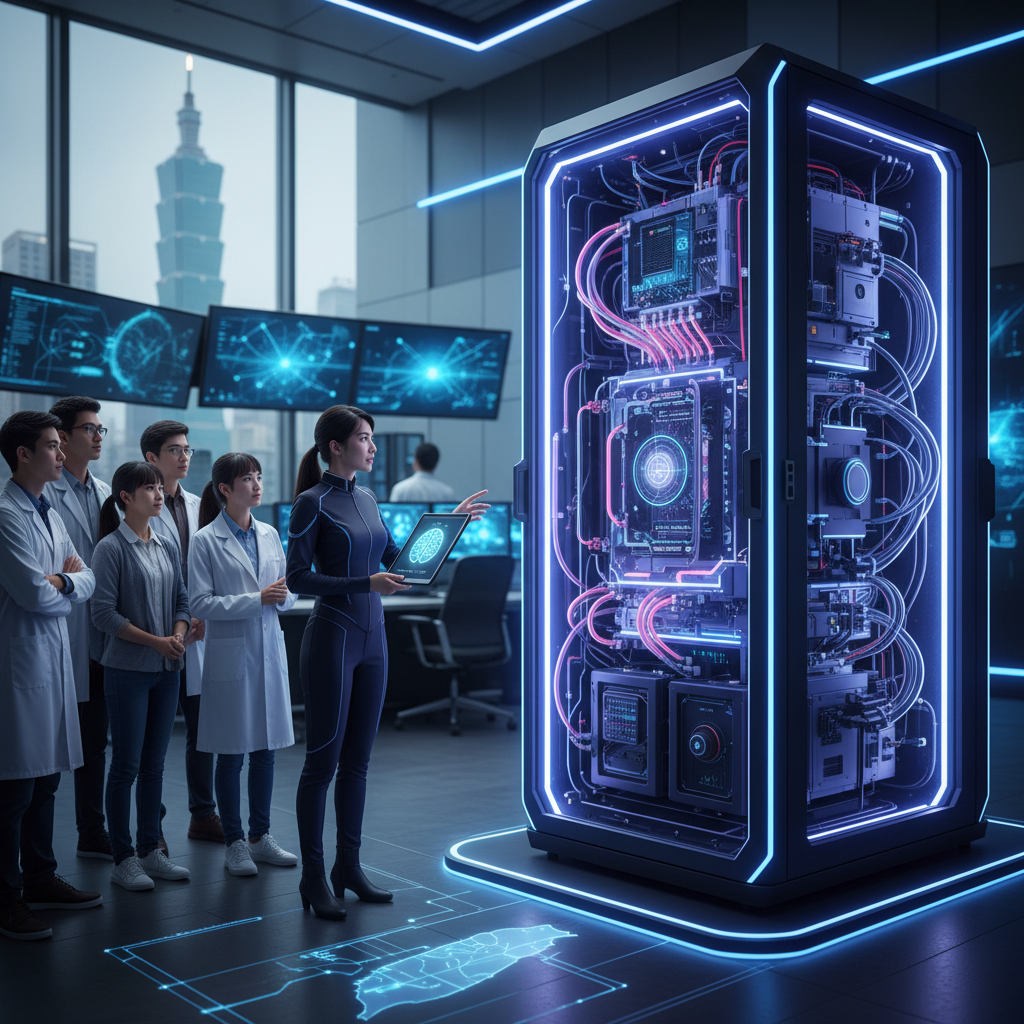

The air in Hsinchu Science Park, typically thick with the hum of advanced manufacturing, now carries a faint, almost imperceptible, buzz about quantum computing. Not the quantum computing of theoretical physics, mind you, but its increasingly intertwined relationship with artificial intelligence. This convergence, often presented as a panacea for humanity's most complex computational challenges, has captured the imagination of researchers and investors globally. However, from my desk in Taipei, I find myself asking: are we truly on the cusp of a revolution, or are we merely witnessing another wave of speculative enthusiasm?
Proponents argue that quantum AI, leveraging the unique properties of quantum mechanics, could dramatically accelerate AI training, optimize complex algorithms, and unlock capabilities far beyond the reach of classical supercomputers. Imagine AI models trained on datasets currently deemed intractable, or drug discovery simulations that predict molecular interactions with unprecedented accuracy. These are compelling visions, certainly. Yet, the data tells a more nuanced story.
While major players like Google's DeepMind and IBM have made headlines with quantum supremacy claims and the development of quantum processors, the practical applications remain largely confined to laboratories. "The leap from demonstrating quantum advantage on highly specific, contrived problems to solving real-world AI challenges is monumental," explains Dr. Chen-Li Wang, a senior researcher at Taiwan's National Center for High-Performance Computing. "We are still grappling with qubit stability, error correction, and the sheer engineering complexity of scaling these machines. Integrating this nascent technology with mature AI frameworks presents an even greater hurdle. The hype often outpaces the demonstrable progress."
Indeed, a recent report from the MIT Technology Review highlighted that despite billions invested globally, the commercial quantum computing market, particularly for AI applications, is still in its infancy. Most current 'quantum AI' experiments rely on hybrid classical-quantum approaches, where quantum processors handle only very specific, computationally intensive subroutines, while classical computers manage the bulk of the AI workload. This is not the wholesale paradigm shift many envision.
Taiwan's position in this emerging landscape is more complex than headlines suggest. As the global epicenter of advanced semiconductor manufacturing, particularly through Tsmc, we are indispensable to the classical AI boom. Our fabs produce the NVIDIA GPUs and custom AI chips that power everything from large language models to autonomous vehicles. This gives us a foundational strength. However, quantum computing demands a fundamentally different manufacturing paradigm. Superconducting qubits, trapped ions, and photonic quantum bits require specialized fabrication techniques and materials science expertise that, while present in Taiwan, are not yet scaled to the level of our traditional chip industry.
"While Taiwan possesses unparalleled expertise in microfabrication, the quantum realm introduces entirely new challenges," states Ms. Mei-Ling Hsu, a venture capitalist specializing in deep tech at Taiwania Capital. "The precision required for quantum devices, often at cryogenic temperatures, involves a different set of material sciences and engineering disciplines. We are seeing increased investment in quantum research at institutions like National Taiwan University and Academia Sinica, but translating this into industrial-scale production for quantum AI applications will necessitate significant strategic shifts and long-term capital commitment. It is not merely a matter of adapting existing fabs."
Consider the global race. China, for instance, has poured substantial resources into quantum research, aiming for self-sufficiency and leadership. The United States, through initiatives like the National Quantum Initiative Act, is also aggressively funding R&D. Where does Taiwan fit? Our strength lies in our ability to execute and innovate within established frameworks. The question is whether we can pivot with sufficient agility to a domain that is still largely undefined.
Let's separate fact from narrative. The narrative posits an imminent future where quantum computers supercharge AI, leading to breakthroughs in materials science, cryptography, and medical diagnostics. The fact is that quantum computers are still highly experimental, error-prone, and require extreme environmental controls. The 'quantum advantage' demonstrated so far is narrow and fragile. For AI, the immediate impact of quantum computing is likely to be limited to niche applications, such as optimizing specific machine learning algorithms or generating truly random numbers for cryptographic security, rather than revolutionizing general AI training or inference.
Moreover, the talent pool for quantum AI is exceedingly small. Building a robust ecosystem requires not just hardware, but also software developers, quantum algorithm specialists, and interdisciplinary researchers who can bridge the gap between quantum physics and machine learning. Taiwan has excellent Stem graduates, but the specialized training for quantum information science is still developing.
Despite these challenges, there are promising developments. Local startups, often spun out of university research, are exploring quantum-resistant cryptography and quantum-inspired optimization algorithms that run on classical hardware. These 'quantum-adjacent' technologies might offer more immediate, tangible benefits than full-fledged quantum AI in the short to medium term. For instance, companies are exploring how AI can assist in the design and error correction of quantum systems themselves, creating a symbiotic relationship that could accelerate quantum development.
As I observe the global landscape, it becomes clear that while the allure of quantum AI is potent, a healthy dose of skepticism is warranted. We must invest in fundamental research and talent development, certainly. We must also meticulously evaluate claims of breakthroughs and understand the true TRL, or Technology Readiness Level, of these innovations. Taiwan's economic prosperity has been built on pragmatic innovation and meticulous execution. We should not abandon that approach for the sake of chasing every glittering new technology without a clear path to industrialization.
The integration of quantum computing and AI is not a foregone conclusion for widespread application in the next five years. It is a long-term endeavor, fraught with scientific and engineering challenges. For Taiwan, the strategic imperative is to identify where our unique strengths in semiconductor manufacturing, materials science, and AI development can genuinely contribute to this future, rather than simply following the loudest pronouncements from abroad. The real revolution will occur not when quantum computers merely exist, but when they reliably and economically solve problems that classical computers cannot, and that, my friends, is still a distant horizon. For more on the broader implications of AI, consider the discussions on The Verge. The journey ahead demands patience, precision, and an unwavering commitment to empirical evidence over conjecture.