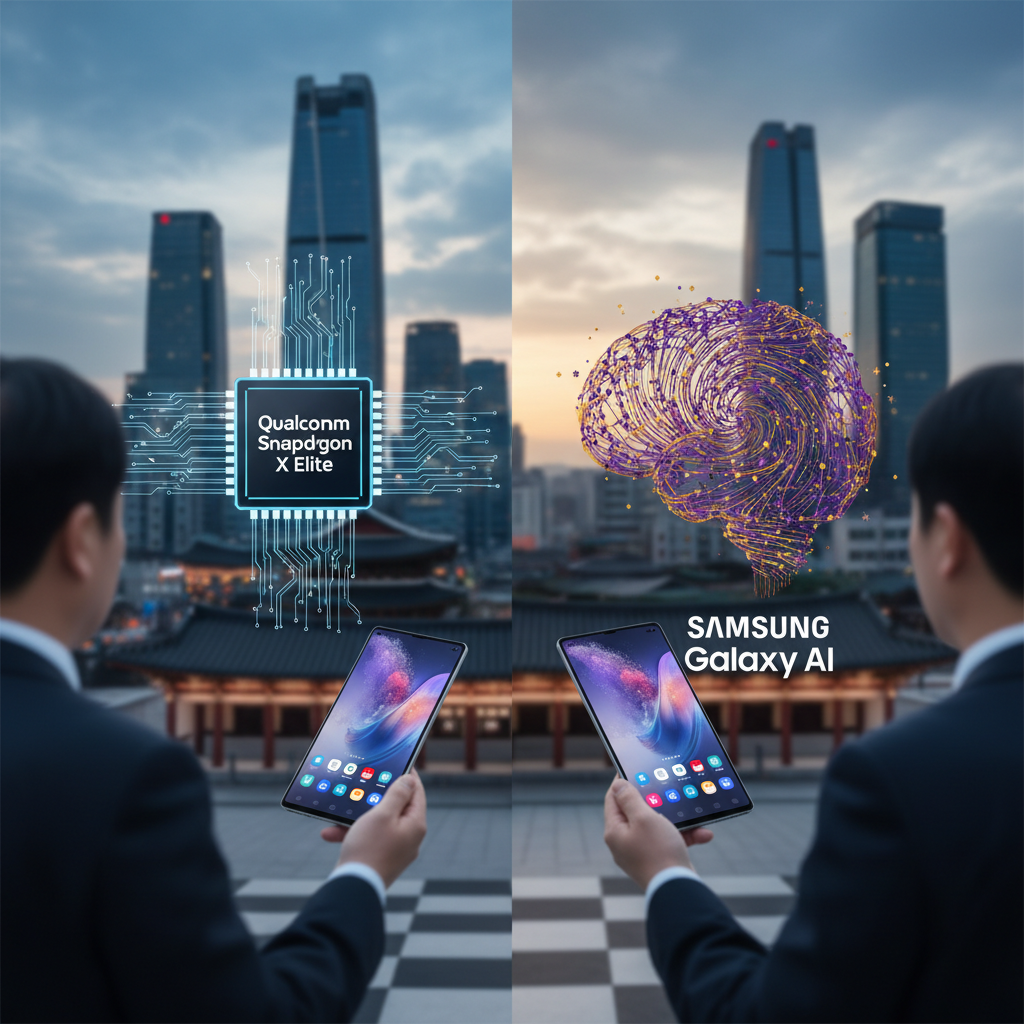

The digital world, much like the bustling streets of Seoul, is constantly in motion, evolving with a relentless pace. In this dynamic environment, the quiet revolution of on-device artificial intelligence is perhaps one of the most significant shifts we have witnessed this decade. At its heart lies Qualcomm, a company now aggressively positioning its Snapdragon X Elite processors as the foundational silicon for this new era, pushing AI computations away from distant cloud servers and directly onto our smartphones, laptops, and edge devices. This move is not merely a technical upgrade; it is a strategic maneuver with profound implications, particularly for South Korea's formidable tech ecosystem.
For years, the cloud has been the undisputed monarch of AI processing, offering seemingly infinite computational power. However, this centralized model comes with inherent trade-offs: latency, privacy concerns, and the ever-present demand for robust network connectivity. On-device AI, by contrast, promises instant responses, enhanced data security, and greater operational independence, a vision that resonates deeply with the Korean emphasis on efficiency and technological self-reliance. Qualcomm's latest generation of Snapdragon platforms, including the Snapdragon 8 Gen 3 for smartphones and the Snapdragon X Elite for PCs, are engineered with powerful Neural Processing Units, NPUs, designed specifically to handle complex AI workloads locally. These NPUs can deliver tens of trillions of operations per second, Tops, a metric that speaks volumes about their processing capability.
"Qualcomm's commitment to on-device AI is not just about faster processing; it is about redefining the user experience and enabling entirely new application paradigms," explains Dr. Lee Min-jun, a Senior Analyst at the Korea Institute of Science and Technology, Kist. "Imagine a future where your smartphone can generate intricate images or translate conversations in real-time, all without sending a single byte of data to a remote server. This is the promise, and the Snapdragon X Elite is a significant step towards fulfilling it." Indeed, the benchmarks released for the Snapdragon X Elite, boasting up to 45 Tops for its NPU, place it squarely in contention with dedicated AI accelerators found in some data centers just a few years ago. Reuters has extensively covered these developments, highlighting the competitive landscape.
Now, let us consider the Korean perspective. Samsung, a global titan in both smartphones and semiconductors, finds itself in a fascinating position. As a primary client for Qualcomm's Snapdragon chips in its flagship Galaxy series, Samsung benefits directly from these advancements. The Galaxy S24 series, for instance, heavily leverages the Snapdragon 8 Gen 3's NPU for its 'Galaxy AI' features, offering on-device functionalities like Live Translate, Chat Assist, and Generative Edit. This integration allows Samsung to differentiate its offerings, providing a seamless and private AI experience that cloud-dependent services cannot match. However, Samsung's latest move reveals a deeper strategy: its continued investment in its own Exynos processors, particularly their NPU capabilities. While Snapdragon remains dominant in many markets, Samsung's long-term vision likely involves a degree of independence, ensuring it controls its own destiny in the critical realm of AI silicon.
"The Korean approach to AI is fundamentally different from many Western counterparts," states Professor Kim Ji-yeon, head of AI research at Pohang University of Science and Technology, Postech. "We prioritize not just innovation, but also resilience and strategic autonomy. While partnering with global leaders like Qualcomm is essential, developing our indigenous capabilities, whether in hardware or foundational models, remains a core objective. This dual strategy is visible across our major conglomerates." This sentiment underscores a broader national ambition to secure a leading position in the global AI race, not merely as consumers of technology but as its architects.
Here is the technical breakdown: on-device AI chips like the Snapdragon X Elite are designed for efficiency. They are optimized for specific AI inference tasks, meaning they are excellent at executing pre-trained models. This contrasts with the training phase, which still largely requires the immense computational power of cloud-based GPUs from companies like NVIDIA. The shift to on-device inference means that AI models, once trained, can operate locally, reducing operational costs for cloud providers and enhancing user privacy. For edge computing, this translates into smarter factories, autonomous vehicles, and more responsive smart city infrastructure, all processing data closer to its source, minimizing the need for constant data transmission to the cloud.
Beyond Samsung, other Korean players are also keenly observing, and participating in, this shift. LG, for example, is exploring on-device AI for its smart home appliances and automotive components, aiming to create more intuitive and personalized user experiences. Hyundai Motor Group, a leader in future mobility, sees on-device AI as crucial for advanced driver-assistance systems, Adas, and eventually, fully autonomous driving. The ability to process sensor data and make critical decisions in milliseconds, without relying on external network connectivity, is paramount for safety and reliability.
The implications for data sovereignty are also significant. With AI processing moving to the device, sensitive personal information can remain local, reducing the risk of data breaches and complying more easily with stringent privacy regulations like Korea's Personal Information Protection Act. This localized processing also allows for greater customization and personalization, as AI models can adapt to individual user behavior without sharing that data broadly.
However, challenges remain. The size and complexity of AI models continue to grow, pushing the boundaries of what even advanced NPUs can handle. Optimization techniques, such as quantization and model pruning, are becoming increasingly vital to fit these powerful models onto resource-constrained edge devices. Furthermore, the development of robust, secure, and energy-efficient AI software stacks that can fully leverage these new hardware capabilities is an ongoing endeavor. Wired often delves into these challenges, exploring the intricate balance between performance and efficiency.
"The competition in the AI chip space is intensifying, with not only Qualcomm but also Apple, Google, and even Intel making significant strides," observes Ms. Park So-young, a semiconductor industry analyst at Hana Financial Group. "For Korean companies, this means a continuous need for innovation and strategic partnerships. The ability to integrate these cutting-edge chips into compelling products, and to develop the software ecosystem around them, will determine market leadership." This is not merely a race for raw processing power, but for the most effective integration of hardware and software, creating a holistic AI experience.
The future of AI, it appears, will not be solely centralized in the cloud, nor exclusively distributed at the edge. Instead, it will likely be a sophisticated hybrid model, intelligently distributing workloads where they are most efficiently processed. Qualcomm's aggressive push with Snapdragon X Elite and similar platforms is accelerating this transition, forcing every major tech player, including South Korea's industrial giants, to recalibrate their strategies. The stakes are high, encompassing not just market share, but also technological independence and the very nature of our digital interactions. The next few years will reveal whether this on-device AI wave will truly empower users and nations, or simply shift the locus of computational power.