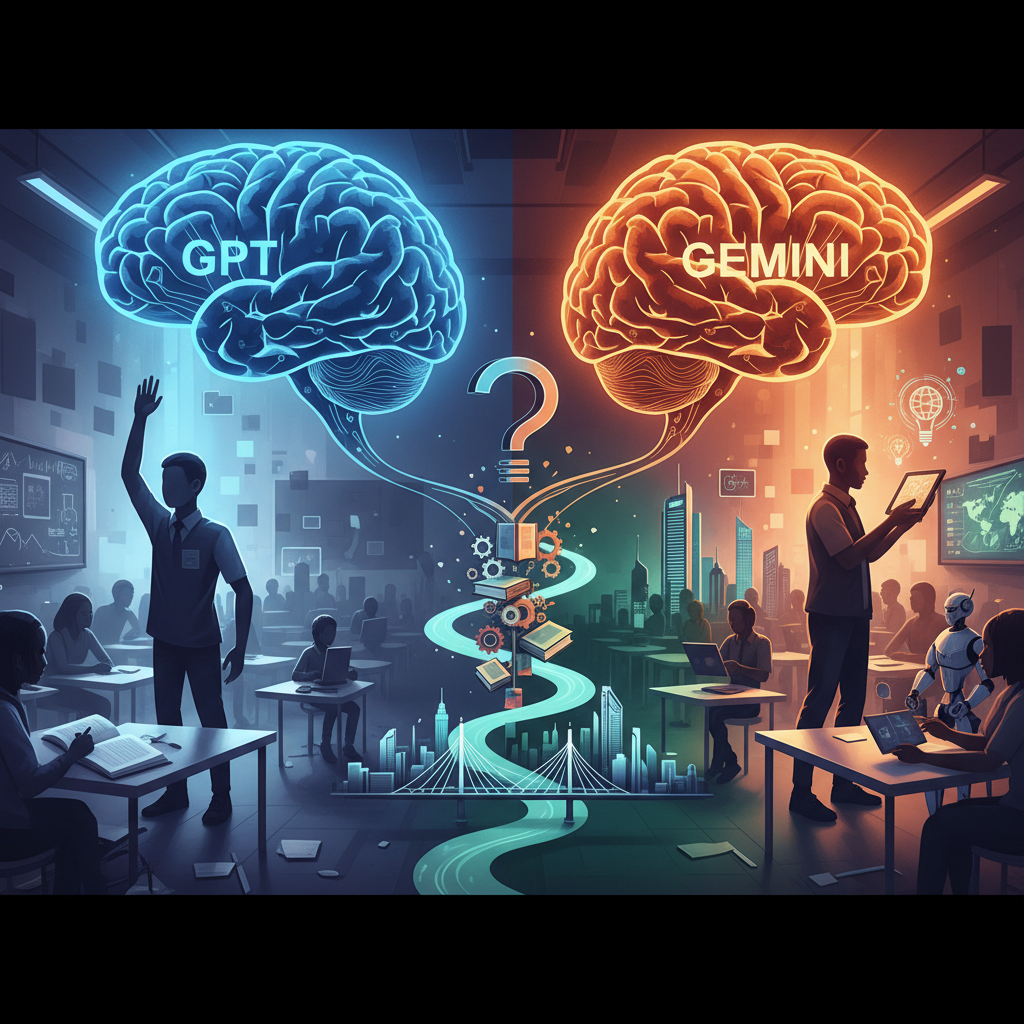

The noise, oh the noise. From every corner of the globe, from Silicon Valley think tanks to the PTA meetings in Ikoyi, the wailing about AI chatbots in schools has reached a fever pitch. Teachers are panicking, parents are protesting, and administrators are scrambling to ban what they barely understand. They cry 'cheating crisis,' I hear 'missed opportunity.' Mark my words, this hand-wringing over OpenAI's GPT and Google's Gemini in the classroom is not just misguided; it is a dangerous distraction from the real educational revolution unfolding before our very eyes.
Let me be clear: the notion that we can simply ban AI from the learning environment is as naive as trying to ban the internet in the early 2000s. It is a fool's errand. Our children, the digital natives of this generation, are already interacting with these tools, whether we like it or not. They are using them for everything from brainstorming project ideas to drafting emails, and yes, sometimes, to shortcut their homework. But instead of seeing this as a moral failing, we, especially here in Nigeria, should recognize it for what it is: a powerful, albeit raw, tool that demands integration, not prohibition.
When I look at the vibrant, hustling spirit of Lagos, I see a generation hungry for innovation. Our youth are not waiting for permission to build, to create, to solve problems. They are already doing it. To deny them access to the most powerful cognitive tools of our era, tools like those developed by Anthropic or Meta, is to handicap them in a global race they are more than capable of winning. The future is already here because it is just not evenly distributed, and we must ensure our children are at the forefront of its distribution, not relegated to the sidelines.
Consider the words of Dr. Moustapha Cissé, the head of Google AI in Ghana, a man who understands the African context deeply. He has often emphasized the importance of building AI capacity on the continent. He once stated, and I paraphrase, that for Africa to truly benefit from AI, we must not just be consumers, but active participants and creators. How can we expect our future scientists and entrepreneurs to be creators if we forbid them from understanding the very tools that will define their careers? It is illogical, a self-defeating prophecy.
The argument often put forth by the Luddites of academia is that AI stifles critical thinking and promotes intellectual laziness. They fear that students will simply prompt an AI to write an essay, thus bypassing the arduous process of research, analysis, and synthesis. And yes, if left unchecked, this is a valid concern. But the solution is not to remove the tool; it is to change the task. If an essay can be perfectly generated by an AI, perhaps the essay itself is no longer the most effective measure of learning. We need to evolve our pedagogy, not cling to antiquated methods.
Professor Ethan Mollick of the Wharton School, a leading voice on AI in education, has consistently advocated for teaching with AI, not against it. He suggests that educators need to redesign assignments to leverage AI as a co-pilot, a thinking partner. He has pointed out that the skill is not in avoiding AI, but in mastering the art of prompt engineering, evaluating AI output, and integrating it into a human-driven creative process. This is a far more valuable skill for the 21st century than memorizing facts or regurgitating information that is readily available at the click of a button or a well-crafted prompt.
Think about it: when the calculator was invented, did we ban it from math classes? No, we taught students how and when to use it, shifting the focus from rote calculation to problem-solving and conceptual understanding. The same paradigm shift is required with AI. We are not just teaching children to read and write; we are teaching them to think, to innovate, and to navigate a complex, technologically advanced world. AI, when used correctly, can be a powerful accelerator for these very skills.
I recently spoke with a young Nigerian entrepreneur, Aisha Bello, who is building an AI-powered learning platform for secondary school students in Kano. Her platform, still in its early stages, uses large language models to provide personalized tutoring and feedback, adapting to each student's learning style. She told me,