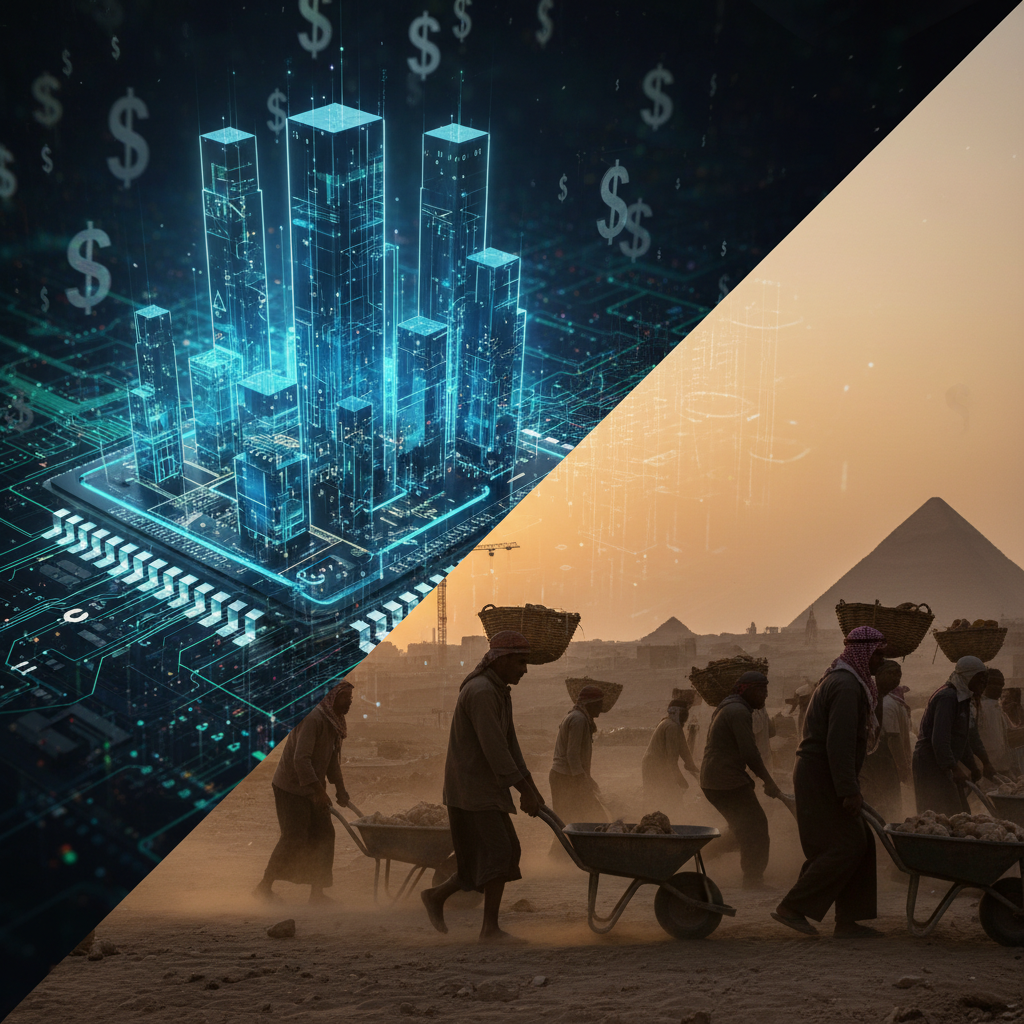

The scent of hibiscus tea and the murmur of conversations often fill the air in Cairo's bustling cafes, a stark contrast to the sterile, climate-controlled data centers where the future of AI is being forged. Yet, these two worlds are inextricably linked. As Jensen Huang, CEO of NVIDIA, dons his signature leather jacket and unveils yet another generation of H-series or B-series GPUs, pushing his company's valuation into the multi-trillion dollar territory, a question echoes in the back alleys of Alexandria and the burgeoning tech hubs of New Cairo: who truly benefits from this AI revolution? The answer, increasingly, points to a widening chasm, an AI wealth gap that is making billionaires richer while workers, especially in places like Egypt, struggle to keep pace.
Let me break this down. We are witnessing an unprecedented concentration of wealth and power in the hands of a few AI behemoths. This isn't just about market capitalization; it is about the very architecture of AI development and deployment, which inherently favors capital-intensive, data-rich entities. For developers, data scientists, and technical professionals, understanding this dynamic is crucial, not just for ethical considerations, but for navigating the future of our careers and economies.
The Technical Challenge: Centralization of Compute and Data
The fundamental problem we are solving, or rather, exacerbating, is the extreme centralization required for state-of-the-art AI. Training foundational models like OpenAI's GPT-4, Google's Gemini, or Anthropic's Claude demands colossal computational resources. We are talking about clusters of tens of thousands of GPUs, consuming megawatts of power, and processing petabytes of data. This is not a technical challenge that can be democratized easily. The sheer cost of acquiring and maintaining such infrastructure creates an insurmountable barrier to entry for smaller players, startups, and certainly, individual workers or even national initiatives in developing nations.
Architecture Overview: The Monolithic AI Stack
Think of it this way: the modern AI stack is less like a decentralized bazaar, where many small vendors thrive, and more like a massive, integrated shopping mall owned by a single conglomerate. At the base, we have the hardware layer, dominated by NVIDIA's GPUs. Their Cuda platform provides a proprietary software ecosystem that is deeply integrated with their hardware, creating a powerful moat. Above this, hyperscale cloud providers like Amazon Web Services, Microsoft Azure, and Google Cloud Platform host these GPU clusters, offering them as services. These providers are often the largest customers for NVIDIA, creating a symbiotic relationship that further entrenches their dominance.
Then comes the data layer. Training large language models, for instance, requires vast, diverse datasets scraped from the internet. Curating, cleaning, and storing this data is an immense undertaking, again favoring entities with significant capital and infrastructure. Finally, at the application layer, we see proprietary models and APIs being offered by companies like OpenAI and Google, effectively monetizing the entire stack. This monolithic architecture means that innovation and economic value tend to flow upwards, concentrating at the top.
Key Algorithms and Approaches: The Scale Imperative
From a technical perspective, the algorithms driving this wealth concentration are those that thrive on scale: transformer architectures, diffusion models, and self-supervised learning. Consider the transformer, the backbone of almost all large language models. Its attention mechanism allows it to weigh the importance of different parts of the input sequence, a revolutionary concept. However, the computational complexity of self-attention is quadratic with respect to sequence length, meaning it scales poorly without massive parallelization. This is where GPUs shine.
# Conceptual pseudocode for a simplified transformer block
def transformer_block(x, head_count, key_dim):
 # Multi-head Self-Attention
 q, k, v = linear_projections(x, key_dim * head_count * 3) # Project input to query, key, value
 q = reshape_for_attention(q, head_count, key_dim)
 k = reshape_for_attention(k, head_count, key_dim)
 v = reshape_for_attention(v, head_count, key_dim)

attention_scores = matmul(q, transpose(k)) / sqrt(key_dim)
 attention_weights = softmax(attention_scores)
 attention_output = matmul(attention_weights, v)

attention_output = concatenate_heads(attention_output)
 attention_output = linear_projection(attention_output)

# Add & Norm
 x = layer_norm(x + attention_output)

# Feed Forward Network
 ffn_output = linear_projection(relu(linear_projection(x)))

# Add & Norm
 x = layer_norm(x + ffn_output)
 return x
# Conceptual pseudocode for a simplified transformer block
def transformer_block(x, head_count, key_dim):
 # Multi-head Self-Attention
 q, k, v = linear_projections(x, key_dim * head_count * 3) # Project input to query, key, value
 q = reshape_for_attention(q, head_count, key_dim)
 k = reshape_for_attention(k, head_count, key_dim)
 v = reshape_for_attention(v, head_count, key_dim)

attention_scores = matmul(q, transpose(k)) / sqrt(key_dim)
 attention_weights = softmax(attention_scores)
 attention_output = matmul(attention_weights, v)

attention_output = concatenate_heads(attention_output)
 attention_output = linear_projection(attention_output)

# Add & Norm
 x = layer_norm(x + attention_output)

# Feed Forward Network
 ffn_output = linear_projection(relu(linear_projection(x)))

# Add & Norm
 x = layer_norm(x + ffn_output)
 return x
This simplified conceptualization hides the immense parallelization required. Each matrix multiplication, each softmax, each linear projection, when applied to sequences of thousands of tokens across billions of parameters, demands thousands of concurrent operations. This is why a single NVIDIA H100 GPU, with its 80 billion transistors and specialized Tensor Cores, can cost upwards of $30,000, and a cluster can run into hundreds of millions. The algorithms themselves, while brilliant, are intrinsically tied to this high-cost, high-compute paradigm.
Implementation Considerations: The Cost of Entry
For developers in Egypt, building and deploying AI solutions often means relying on cloud-based APIs from these dominant players. While convenient, it means paying for every inference, every token generated, every image processed. This creates a dependency, and the economic value generated by local applications often flows back to the global AI giants. Consider a startup in Cairo aiming to build a specialized Arabic language model for medical transcription. Training such a model from scratch, even on a smaller scale, would require significant investment in GPUs, storage, and specialized data pipelines. The alternative is fine-tuning an existing large model, but even that incurs substantial inference costs over time.
Performance considerations are also critical. While open-source models like Llama 2 or Mistral have offered some relief, their performance often lags behind the proprietary state-of-the-art for many tasks, especially those requiring nuanced understanding or vast general knowledge. Furthermore, deploying these models efficiently requires expertise in distributed computing, model quantization, and efficient serving frameworks like NVIDIA's Triton Inference Server or Hugging Face's TGI, which again, demand specific technical skills and infrastructure.
Benchmarks and Comparisons: The Performance Chasm
When we look at benchmarks like the Mmlu (Massive Multitask Language Understanding) or HumanEval, the top performers are consistently proprietary models from well-funded labs. For example, GPT-4 and Gemini Ultra often outperform even the largest open-source models by significant margins on complex reasoning tasks. This performance gap translates directly into competitive advantage and market share. While open-source models are improving rapidly, the resources required to push the absolute frontier remain concentrated. This is not to say open-source is not valuable; it is a vital counter-force, but it operates within the shadow of these massive, proprietary systems.
Code-Level Insights: Frameworks and Dependencies
Here's what's actually happening under the hood for many of us. We are leveraging frameworks like PyTorch and TensorFlow, which are excellent abstractions over the underlying hardware. We use libraries like Hugging Face Transformers for model loading and fine-tuning. However, when we want to deploy these models in production, especially at scale, we often find ourselves reaching for NVIDIA's software stack: Cuda for GPU acceleration, cuDNN for deep neural network primitives, and TensorRT for optimization and inference acceleration. This ecosystem, while powerful, reinforces the hardware dependency. For example, optimizing a model for inference might involve converting it to Onnx format and then using TensorRT for further optimization, a process heavily geared towards NVIDIA GPUs. Even cloud-agnostic tools often have NVIDIA-specific optimizations baked in.
Real-World Use Cases: The Double-Edged Sword
- Content Generation for Marketing: A digital marketing agency in Downtown Cairo might use OpenAI's API to generate ad copy or social media posts in Arabic. This boosts productivity but means a portion of their revenue flows directly to OpenAI, reducing local value retention.
- Customer Service Chatbots: Many Egyptian banks and telecommunication companies deploy chatbots powered by large language models. These improve customer experience and reduce operational costs, but the underlying AI infrastructure is typically hosted by global cloud providers, often using proprietary models, limiting local control and data sovereignty.
- Medical Imaging Analysis: A startup in Alexandria might develop an AI tool to assist radiologists in detecting anomalies in X-rays. While impactful, the training of such a model, especially if it uses advanced deep learning architectures, likely relies on cloud GPUs and pre-trained models from global research institutions, again highlighting the dependency.
- Automated Translation Services: With Egypt's growing international business, AI-powered translation services are invaluable. Companies like Google Translate leverage massive datasets and compute to offer superior quality, making it difficult for smaller, local efforts to compete, even with specialized Arabic dialects.
Gotchas and Pitfalls: The Digital Divide's New Form
One significant pitfall is the exacerbation of the digital divide. Access to high-speed internet, affordable computing resources, and skilled AI talent is unevenly distributed globally. Countries like Egypt, despite having a vibrant youth population and growing tech sector, face challenges in competing with the sheer scale of investment seen in Silicon Valley. Moreover, the 'brain drain' phenomenon is real; top AI talent often migrates to where the resources and opportunities are most abundant, further concentrating expertise. Data privacy and sovereignty are also major concerns when relying on foreign-owned cloud infrastructure and models. Who truly owns the insights derived from Egyptian data when it is processed by a model trained and hosted elsewhere?
Resources for Going Deeper
For those who wish to delve further into the technical underpinnings and societal implications, I recommend exploring research papers on transformer scaling laws, such as those published by Google DeepMind and OpenAI. The MIT Technology Review frequently publishes excellent analyses on the economic and ethical dimensions of AI. For more on the technical side of model deployment and optimization, NVIDIA's developer blog and documentation for Cuda and TensorRT are invaluable. You can also find a wealth of open-source models and tools on Hugging Face, which provides a more democratized approach to model sharing and deployment. For a broader perspective on AI's impact on global economies, news sources like Reuters Technology offer timely updates.
The wealth gap isn't just about money; it's about access, control, and the future of innovation. As we continue to build this incredible technology, we must also build pathways for equitable participation. Otherwise, the AI revolution risks becoming a gilded cage for the many, while only a select few enjoy the view from the top of the pyramid.