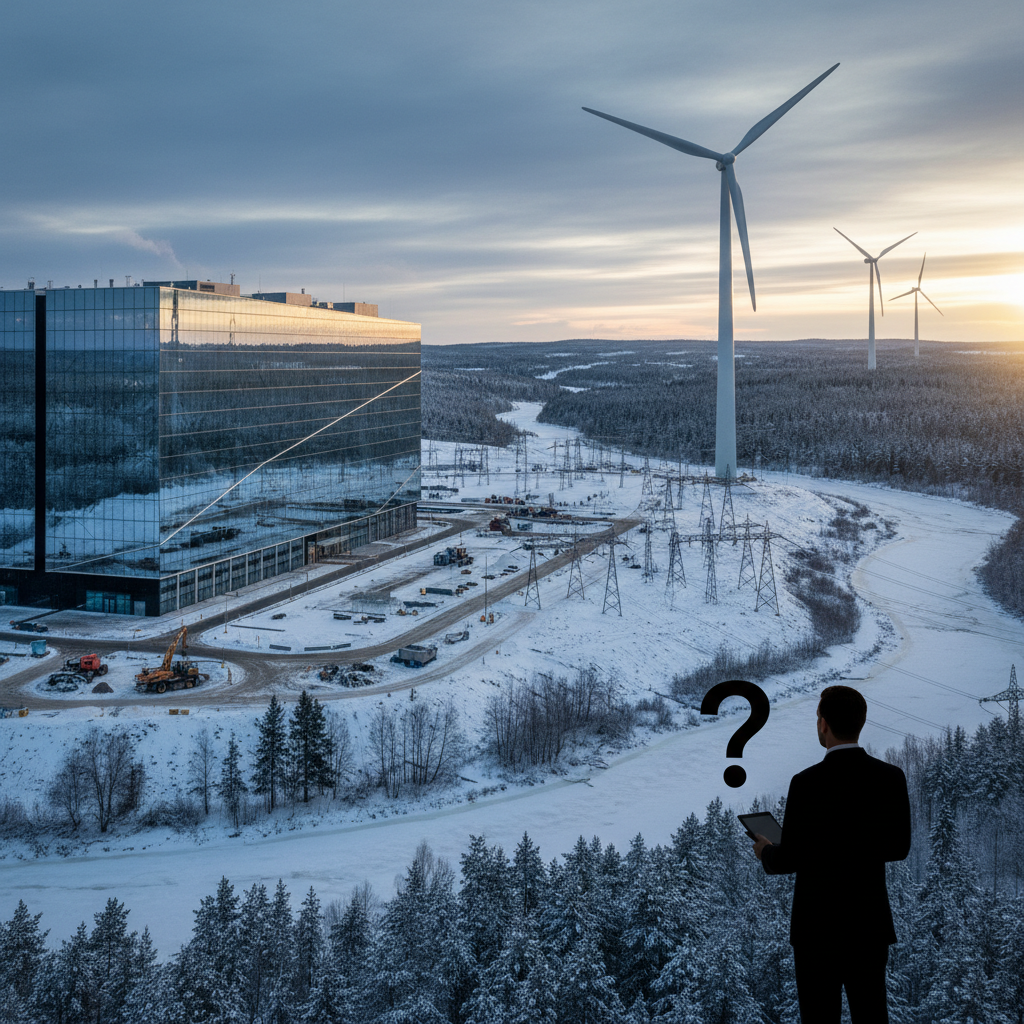
The flickering lights of Stockholm, the steady hum of industry across the continent, all depend on a delicate balance of supply and demand. Yet, an unseen force is rapidly tilting this equilibrium: the burgeoning energy consumption of artificial intelligence. It is a topic that demands rigorous scrutiny, particularly as nations like Sweden find themselves at the epicenter of this evolving power crisis.
For years, Sweden has prided itself on a robust, largely renewable energy infrastructure, a cornerstone of our national identity and economic strategy. Our abundant hydropower and growing wind energy capacity have made us an attractive location for energy-intensive industries, including data centers. However, the scale of AI's current and projected energy needs threatens to overwhelm even the most resilient grids. The narrative of AI as a purely beneficial, efficiency-driving technology often overshadows its profound environmental footprint, a discrepancy that warrants immediate attention.
Consider the sheer computational power required to train and operate advanced large language models, such as those from OpenAI or Google DeepMind. These processes are not merely abstract algorithms; they translate directly into billions of floating-point operations per second, each demanding a measurable amount of electricity. NVIDIA, the undisputed leader in AI hardware, with its powerful GPUs, is at the heart of this computational explosion. Their H100 Tensor Core GPUs, for instance, are designed for peak performance, and that performance comes with a significant power draw. A single high-end AI server rack can consume as much electricity as several dozen homes, and modern data centers house thousands of these racks.
Recent estimates from the International Energy Agency, IEA, indicate that data centers globally could consume over 1,000 terawatt-hours, TWh, by 2026. To put this into perspective, this figure approaches the current electricity consumption of entire nations, such as Japan or Germany. For Sweden, a country with a total annual electricity consumption hovering around 140 TWh, this global trend is not merely an abstract statistic; it is a direct challenge to our energy security and sustainability goals. The Swedish model suggests a different approach, one rooted in long-term planning and environmental stewardship, yet even our foresight is tested by this unprecedented demand.
Several prominent AI leaders have acknowledged this growing concern, albeit often in the context of future solutions rather than immediate constraints. Sam Altman, CEO of OpenAI, has openly spoken about the need for a breakthrough in energy production, specifically mentioning nuclear fusion, to meet the future demands of superintelligence. While such long-term visions are compelling, they do not address the immediate strain on existing grids. The reality is that the current generation of AI models is already pushing the limits of available power, and the next iterations promise to be even more demanding.
“The energy intensity of AI is not merely an operational cost; it is becoming a strategic geopolitical factor,” stated Dr. Anna Borg, CEO of Vattenfall, one of Sweden's largest energy companies, in a recent industry forum. “We are seeing unprecedented requests for grid capacity from data center developers, often driven by AI workloads. While we welcome investment, the pace and scale require careful planning to ensure grid stability and maintain our sustainability targets.” Her remarks underscore the tension between economic opportunity and environmental responsibility.
Data centers are not new to Sweden. Companies like Facebook, now Meta, established significant server farms in Luleå, drawn by the cold climate for natural cooling and the abundant, cheap hydropower. However, the AI data centers of today are a different beast. Their power density, the amount of electricity consumed per square meter, is substantially higher. This means that even a smaller footprint can have a disproportionately large impact on local and regional grids. Scandinavian data paints a clearer picture: while our energy mix is cleaner, the sheer volume of consumption is the problem.
Let's look at the evidence. In 2023, Sweden's energy agency, Energimyndigheten, reported a significant increase in applications for new grid connections from data center operators. Many of these projects are explicitly linked to AI development and deployment. The challenge extends beyond mere generation capacity; it involves transmission and distribution infrastructure, which is expensive and time-consuming to upgrade. The lead times for building new power lines or substations can span years, far outstripping the rapid deployment cycles of AI hardware.
Microsoft, a major player in cloud computing and AI, has also been actively investing in data center expansion across Europe. Their Azure cloud platform, heavily utilized for AI services, necessitates robust infrastructure. While these companies often tout their commitments to renewable energy, the fundamental issue remains: even if the energy is green, there must be enough of it, reliably delivered. The current rate of AI adoption suggests that energy demand will continue to outpace the growth of new renewable generation and grid upgrades in the short to medium term.
This situation presents a complex dilemma for policymakers in Sweden and across Europe. On one hand, there is a desire to foster innovation and attract high-tech investment. On the other, there is a pressing need to meet climate targets and ensure energy security for citizens and traditional industries. The European Union's AI Act, while primarily focused on ethical and safety concerns, will inevitably need to grapple with the environmental impact of AI as well. Perhaps a future iteration will include provisions for energy efficiency standards for AI models or data centers.
The discussions around this issue are not confined to technical papers or corporate boardrooms. They are increasingly entering the public discourse. Citizens in areas targeted for new data center developments are asking difficult questions about land use, water consumption, and, critically, energy availability. The promise of local jobs often comes with the caveat of increased strain on public resources.
What are the potential solutions? Beyond the long-term hope for fusion, more immediate measures are necessary. Improved energy efficiency in AI algorithms and hardware design is paramount. Researchers are actively exploring more energy-efficient neural network architectures and specialized chips. However, the current trend suggests that efficiency gains are often outpaced by the increasing complexity and scale of AI models. We need to ask ourselves if the current trajectory is sustainable, or if a more deliberate, perhaps even restrictive, approach is warranted.
Furthermore, better integration of data centers with local energy systems, including waste heat recovery for district heating, as pioneered in some Nordic cities, could mitigate some environmental impacts. However, these are localized solutions that do not solve the macro problem of overall grid strain. The conversation must shift from simply locating data centers where energy is cheap to strategically placing them where the entire energy ecosystem, from generation to grid capacity, can truly support them without compromising national energy goals. MIT Technology Review has highlighted the urgency of this planning.
The AI energy crisis is not a distant threat; it is a present reality. As countries like Sweden continue to attract data center investment, a critical examination of the true cost of AI, beyond the financial balance sheets, becomes imperative. The question is not if our grids can handle the demand, but for how long, and at what environmental price. We must ensure that our pursuit of technological advancement does not inadvertently undermine the very foundations of our sustainable future. The time for proactive, evidence-based policy is now, before the lights begin to dim. For more on the broader implications, one might consider the challenges faced across the continent, as detailed by Reuters. The path forward demands more than just innovation; it requires responsibility and foresight.
This is not merely a technical challenge; it is a societal one. The decisions made today regarding energy infrastructure and AI development will shape the European landscape for decades to come. We must proceed with caution, asking the difficult questions and demanding transparent answers from those who promise a brighter, AI-powered future. The evidence suggests that without a fundamental shift in how we power our AI ambitions, the promise of progress may come at an unsustainable cost.