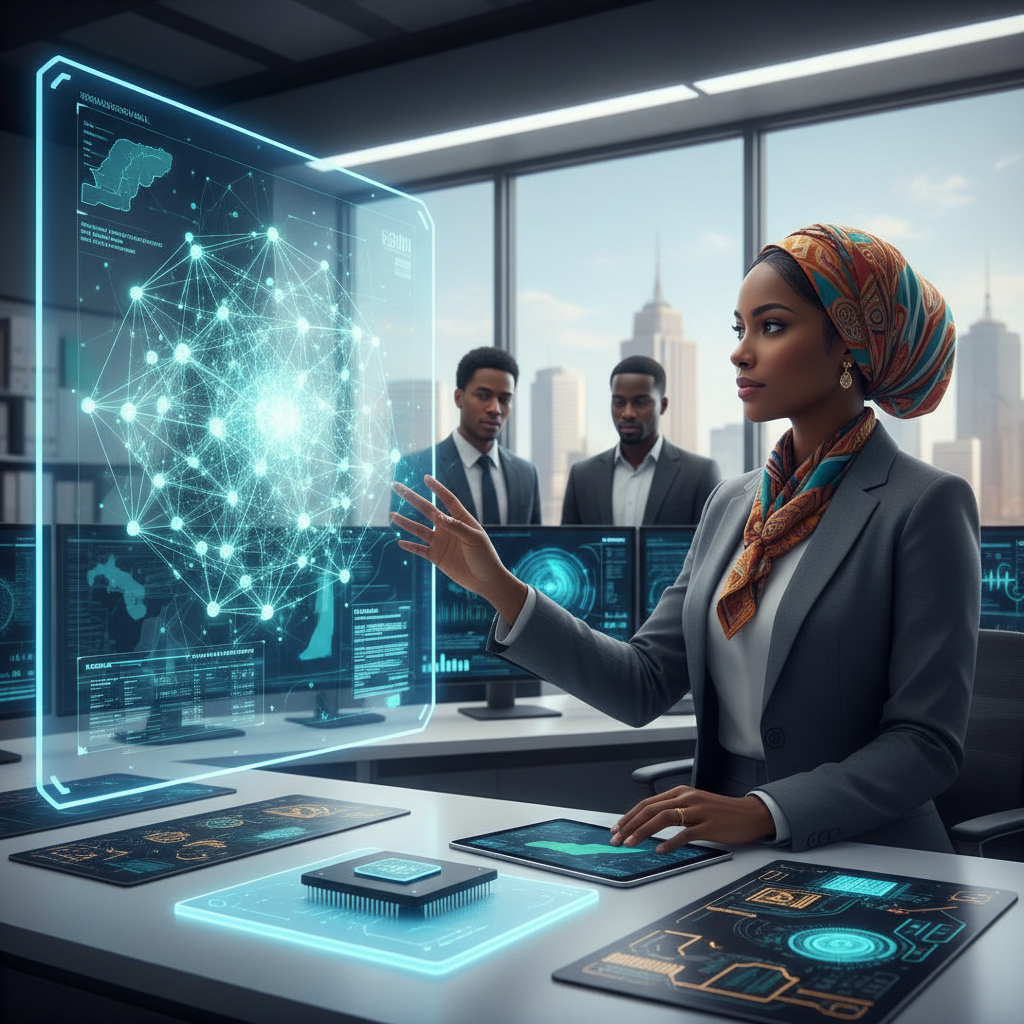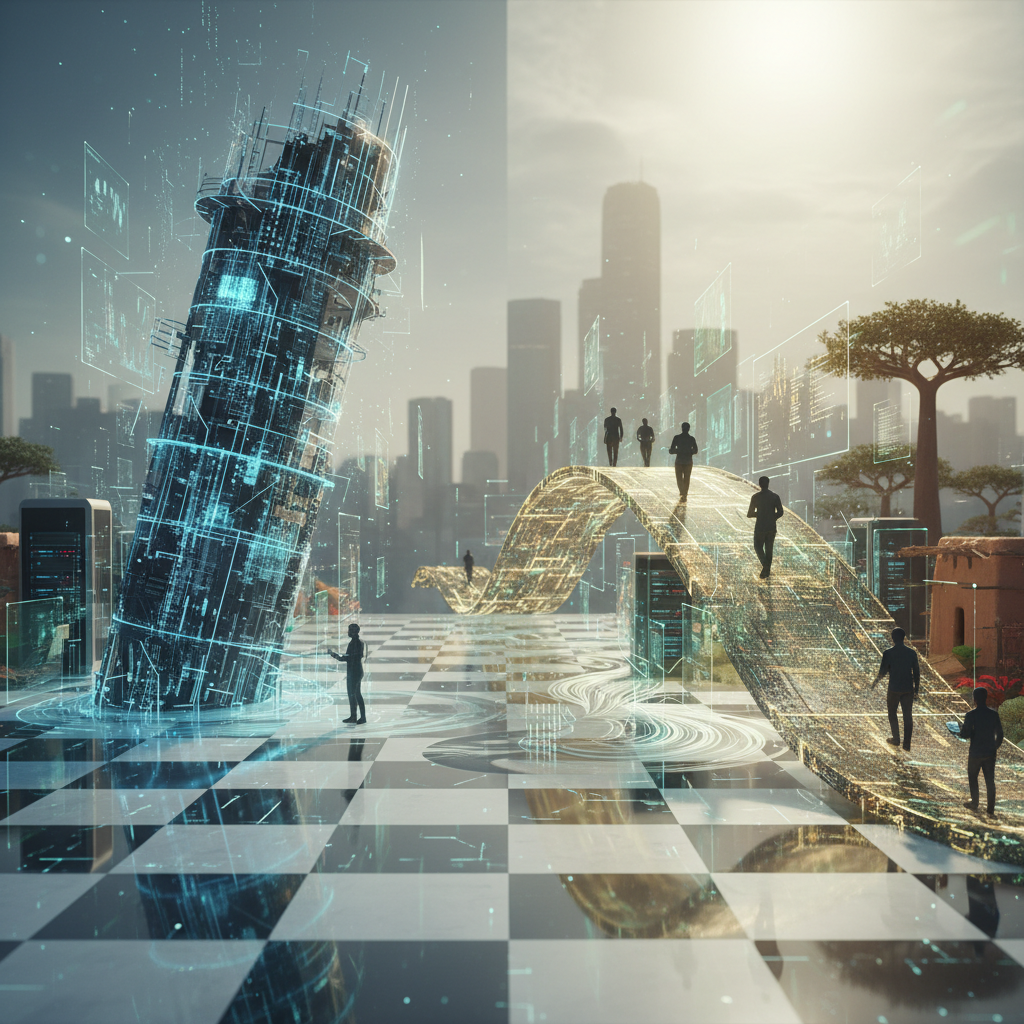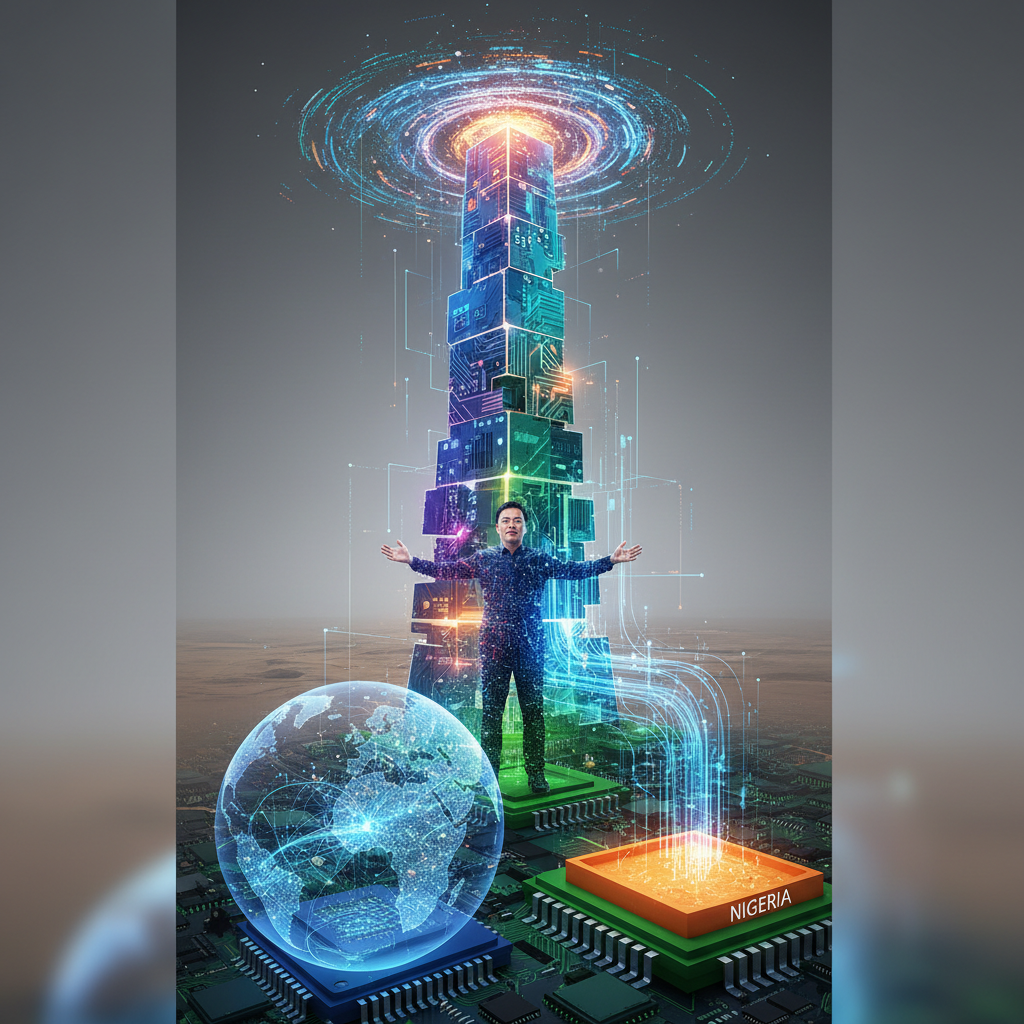

The universe, they say, is an enigma wrapped in a mystery, and for decades, humanity has been poking at its fundamental particles, trying to unwrap it. Now, the buzz is all about AI, specifically how NVIDIA's powerful GPUs and sophisticated algorithms are accelerating discoveries at Cern and other particle physics labs across the globe. From identifying elusive neutrinos to sifting through petabytes of collision data from the Large Hadron Collider, AI is being hailed as the new microscope, the new telescope, the new everything. Everyone's celebrating, but I have questions. Is this a genuine leap for humanity, or another instance where Africa's scientific future is decided in distant labs, powered by foreign tech?
Let's talk about what nobody wants to discuss. The excitement is palpable, I grant you that. Researchers are using machine learning models, often built on frameworks like Google's TensorFlow or Meta's PyTorch, to analyze complex data sets that would take human scientists lifetimes to process. These AI systems can spot patterns, predict particle interactions, and even help design new experiments with unprecedented efficiency. Imagine the sheer volume of data produced by CERN's LHC: billions of collisions per second, each generating terabytes of raw information. Without AI, much of this would remain an undifferentiated digital noise, a cacophony of quantum events.
Historically, particle physics has always been at the forefront of technological innovation. From the development of the World Wide Web at Cern itself, to the sophisticated detectors that can track particles moving at near light speed, this field has pushed boundaries. The integration of AI is simply the latest iteration of this relentless pursuit of knowledge. For instance, AI is now crucial for real-time data filtering, separating the signal from the noise, and for reconstructing particle tracks. This allows scientists to focus on the most promising events, dramatically speeding up the discovery process. According to a recent report on AI in scientific discovery, the computational efficiency gains in particle physics alone have been estimated to be in the range of 10x to 100x for specific tasks, a truly staggering figure MIT Technology Review.
Yet, as I watch the headlines gush, I can't help but feel a familiar unease. The narrative is always about 'global collaboration' and 'humanity's quest for knowledge,' but who truly owns the keys to this new kingdom of discovery? It's NVIDIA, with its Cuda platform and specialized GPUs, that forms the backbone of much of this AI acceleration. It's Google DeepMind and other Western tech giants that develop the foundational AI models. It's Cern, a European consortium, that hosts the most advanced facilities. Where does Africa fit into this grand scheme, beyond being a potential market for these technologies or a source of raw materials for their chips?
Unpopular opinion, perhaps, but I see a pattern here. We are often told that these advancements will eventually benefit everyone, that the knowledge gained will trickle down. But the reality on the ground, in places like Lagos or Accra, is often different. We are still grappling with basic infrastructure, with access to reliable electricity, let alone supercomputing clusters capable of running cutting-edge AI models for particle physics. The digital divide isn't just about internet access; it's about access to the very tools that define the future of scientific inquiry and economic power.
I spoke with Dr. Ngozi Okoro, a theoretical physicist at the University of Ibadan, who echoed some of my concerns. “The breakthroughs are undeniable,” she admitted, “but the infrastructure gap is widening. Our brilliant young minds are often forced to seek opportunities abroad because we lack the computational resources and funding to engage at the same level. We can download papers, yes, but participating in the actual discovery process, contributing to the core algorithms, that’s a different ball game entirely.” Dr. Okoro highlighted that while African scientists are collaborating on projects, the primary beneficiaries of the technological advancements and intellectual property often remain outside the continent.
Another expert, Professor Adebayo Yusuf, a data science lead at a burgeoning tech hub in Yaba, Lagos, offered a more optimistic but still cautious perspective. “We are seeing an increased interest in AI and machine learning among our students, even those in pure sciences,” he told me. “The challenge is translating that interest into tangible research that can compete globally. We need more partnerships that involve genuine knowledge transfer and infrastructure development, not just token collaborations. We need our own NVIDIA, our own DeepMind, built for our context.” He emphasized the need for local data sets and locally relevant AI applications, rather than simply importing foreign solutions.
This isn't to say that African scientists aren't contributing. Far from it. Many brilliant minds from Nigeria and across the continent are working at Cern, at FermiLab, and other major research institutions. But their contributions are often within systems designed and controlled elsewhere. The question isn't about individual talent, it's about systemic capacity and sovereignty. When the next Higgs boson is discovered, or the next fundamental force is unveiled, will Africa be an active participant in the discovery and its subsequent applications, or merely an appreciative audience?
The economic implications are also significant. The technologies developed for particle physics, including advanced AI algorithms and high-performance computing, often have downstream applications in medicine, energy, and materials science. If Africa is not at the table where these foundational discoveries are being made, we risk being perpetual consumers, rather than innovators. This is a form of scientific colonialism, where the intellectual capital and technological infrastructure remain concentrated in a few powerful regions.
Consider the recent announcement by NVIDIA regarding their new 'QuantumAI' platform, aimed at accelerating quantum computing research. While exciting, it further solidifies their central role in advanced scientific computation. Jensen Huang, NVIDIA's CEO, often speaks of democratizing AI, but the reality is that access to their most powerful chips and platforms remains largely dictated by economic might and geopolitical alignment. For a nation like Nigeria, navigating its own complex economic realities, investing billions in a particle accelerator or a dedicated AI supercomputing cluster for fundamental physics might seem like a distant dream when basic healthcare and education still demand urgent attention.
My verdict? AI in particle physics is undeniably the new normal for scientific discovery. It's not a fad; it's a fundamental shift in how we approach the deepest questions about the universe. The ability of AI to process vast amounts of data, identify subtle anomalies, and even propose new theories is revolutionary. However, its benefits are not distributed equally. The current trajectory risks deepening the technological divide, creating a future where scientific breakthroughs are increasingly concentrated in the hands of a few powerful nations and corporations. We need to demand more than just access to the results; we need to demand equity in the process, genuine partnerships that build local capacity, and a seat at the table where the future of science is being forged. Otherwise, we risk a future where the universe's secrets are unveiled, but only for a select few, leaving the rest of us marveling from afar, just as we have for far too long. For more on the broader implications of AI's rapid ascent, you might find this piece on AI ethics insightful. We must ensure that this technological marvel serves all of humanity, not just a privileged segment.