The buzz around multimodal AI models has reached a fever pitch, a crescendo of hype that even I, a seasoned observer of technological fads, find hard to ignore. We are told these systems, capable of seeing, hearing, and reasoning across multiple senses simultaneously, will fundamentally transform everything. From self-driving cars that perceive the world with human-like intuition to digital assistants that understand our every spoken nuance, the promises are grand. But nowhere are these claims bolder, or potentially more impactful, than in healthcare. Yet, as I watch the parade of announcements from giants like NVIDIA, Google, and OpenAI, a familiar skepticism bubbles up, a distinctly Hungarian perspective that asks: for whom, and at what cost?
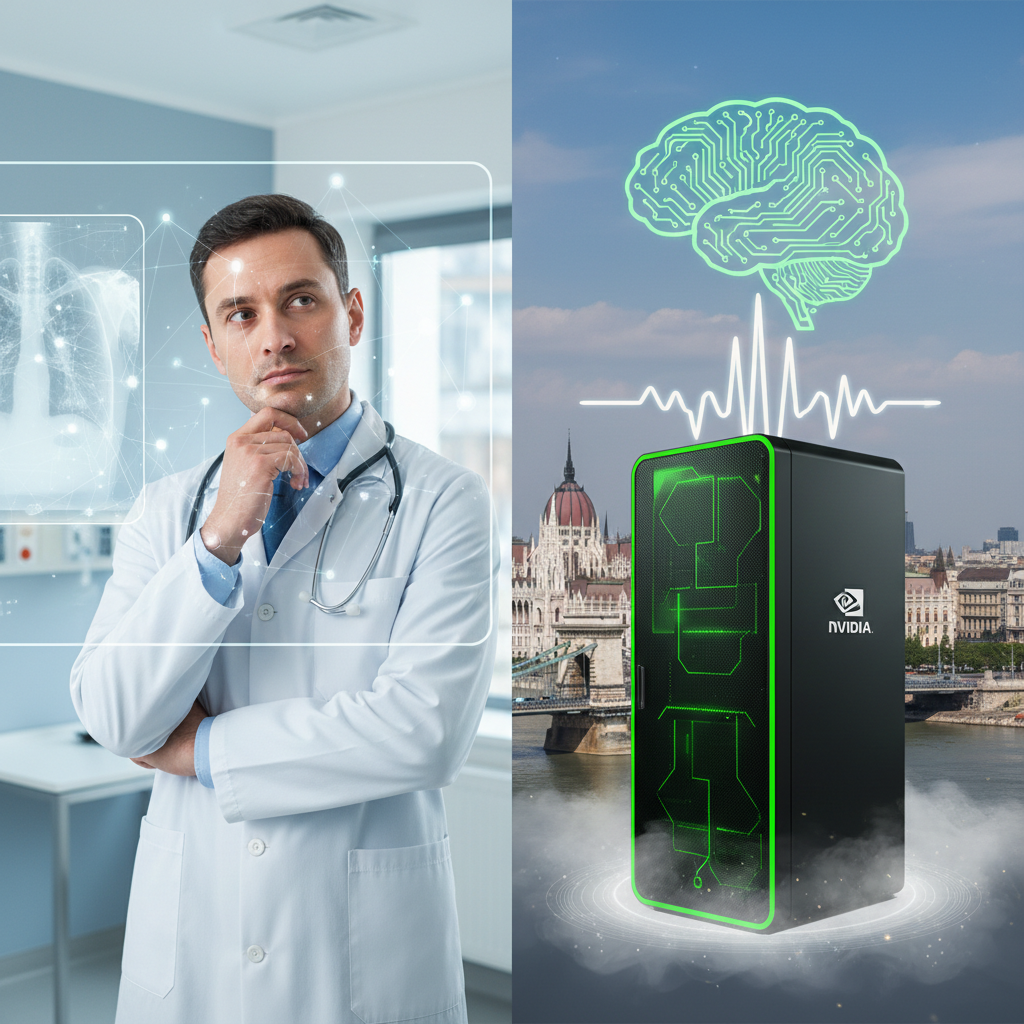
NVIDIA, a company that has become synonymous with the raw compute power underpinning this AI explosion, recently unveiled its 'Med-VLM' initiatives. These are not just about faster image processing, mind you, but about models that can interpret complex medical scans, listen to patient symptoms, and even read through reams of clinical notes, synthesizing information across modalities to aid diagnosis and treatment. Jensen Huang, NVIDIA's CEO, has been particularly vocal, painting a picture of a future where every doctor has an AI co-pilot, a digital assistant that never tires, never misses a detail. He often speaks of a 'new industrial revolution' driven by accelerated computing and AI, and healthcare is clearly in his sights. It sounds utopian, almost too good to be true, and that is precisely where my antennae start twitching.
Consider the sheer complexity of medical data. It is not just images, it is pathology slides, genomic sequences, electronic health records filled with free-text notes, audio recordings of patient consultations, and even physiological sensor data. A true multimodal AI for healthcare must not only process these disparate data types but also understand their intricate relationships, the subtle context that a human physician spends years, if not decades, mastering. It is a monumental task, one that requires not just computational brute force but also a deep, nuanced understanding of human biology and clinical practice. And here is where the rubber meets the road, or rather, where the silicon meets the stethoscope.
In Hungary, our healthcare system, like many across Central Europe, faces its own unique challenges. Resource constraints, an aging population, and a persistent brain drain of medical professionals to Western Europe are stark realities. We are not some blank canvas for Silicon Valley's grand experiments. Our doctors are overworked, our hospitals often underfunded. The question is not just whether these multimodal AI systems work in a lab, but whether they can seamlessly integrate into existing workflows, whether they can be trusted, and crucially, whether they actually alleviate burdens or simply create new ones. Budapest has a message for Brussels and for Silicon Valley: show us the tangible, cost-effective benefits, not just the dazzling demos.
Take the example of medical imaging. Multimodal AI models are being trained on vast datasets of X-rays, MRIs, and CT scans, often paired with radiology reports. The idea is that the AI can not only detect anomalies but also generate a preliminary report, or flag critical findings for a human radiologist. Google DeepMind has been a pioneer in this area, with their work on retinal scans for diabetic retinopathy detection showing impressive accuracy. Their research, often published in top journals, highlights the potential for early disease detection and improved patient outcomes. Yet, translating these academic successes into real-world clinical impact is a hurdle of a different magnitude. Regulatory approval, data privacy concerns, and the inherent variability of real-world clinical data make deployment a minefield.
Moreover, the data itself is a critical point of contention. Most of the foundational multimodal models are trained on datasets predominantly from Western countries, often with a bias towards English language medical texts and specific demographic profiles. What happens when these models encounter the nuances of Hungarian medical terminology, or the specific epidemiological patterns prevalent in our region? Will they be as accurate, as reliable? I have my doubts. The Hungarian perspective nobody wants to hear is that a one-size-fits-all AI solution rarely fits anyone perfectly, least of all in something as sensitive as healthcare.
Consider the ethical implications. If an AI system, trained on millions of data points, makes a diagnostic recommendation, who is ultimately responsible if that recommendation is flawed and leads to patient harm? Is it the developer, the hospital, the physician who relied on the AI, or the patient who consented to its use? These are not trivial questions, and our existing legal and ethical frameworks are woefully unprepared for the rapid advancement of these technologies. The MIT Technology Review has extensively covered the ethical quagmire surrounding AI in medicine, highlighting the urgent need for robust regulatory oversight and clear lines of accountability.
OpenAI, with its Gpt-4v model, has also demonstrated impressive multimodal capabilities, showing it can interpret images and answer questions about them. While not specifically designed for medical use, its underlying architecture suggests a pathway towards more generalist medical AI. Imagine a future where a patient describes symptoms to a conversational AI, which then cross-references that information with their medical history, genetic predispositions, and even real-time biometric data from wearables. This is the vision, but the path is fraught with peril. The potential for misinterpretation, for hallucination, or for simply missing the subtle cues that a human doctor would pick up, remains a significant concern.
Dr. Katalin Karikó, the Hungarian-born biochemist whose pioneering work on mRNA technology revolutionized vaccine development, has often spoken about the importance of fundamental research and rigorous validation. While not directly commenting on multimodal AI, her emphasis on scientific integrity and painstaking verification serves as a powerful reminder for the AI community. We need that same level of rigor applied to these new AI systems, especially when human lives are at stake. Contrarian? Maybe. Wrong? Prove it.
The investment pouring into this space is staggering. NVIDIA's healthcare sector revenue, driven largely by its GPU sales to research institutions and pharmaceutical companies, continues to climb, reportedly reaching billions annually. Google and Microsoft are integrating AI capabilities into their cloud healthcare platforms, vying for market dominance. Startups are emerging daily, promising to solve every conceivable medical problem with AI. But a significant portion of this investment is still in foundational research and early-stage development. The real-world impact, particularly in diverse healthcare settings like Hungary's, is yet to be fully demonstrated.
We need to move beyond the fascination with what AI can do in controlled environments and focus on what it should do in the messy reality of clinical practice. This means prioritizing explainability, ensuring transparency in how these models arrive at their conclusions, and building systems that augment human intelligence, rather than seeking to replace it. It also means investing in local talent, nurturing our own AI researchers and engineers, so we are not merely consumers of foreign technology but active participants in its development and adaptation. Our universities, like Eötvös Loránd University in Budapest, are doing commendable work in AI research, but they need more support to compete on a global scale and ensure our specific needs are met.
Ultimately, the promise of multimodal AI in healthcare is immense. The ability to synthesize vast amounts of complex data could indeed lead to earlier diagnoses, more personalized treatments, and ultimately, better patient outcomes. But this future will not arrive simply because Silicon Valley wills it into existence. It requires careful consideration, rigorous validation, and a commitment to addressing the unique challenges and ethical dilemmas that arise. For now, I remain cautiously optimistic, but my skepticism, honed by years of observing technological cycles, reminds me to always look beyond the dazzling surface and ask the inconvenient questions. The health of our people depends on it. For more on the broader implications of AI in healthcare, you might find this article on AI ethics insightful.