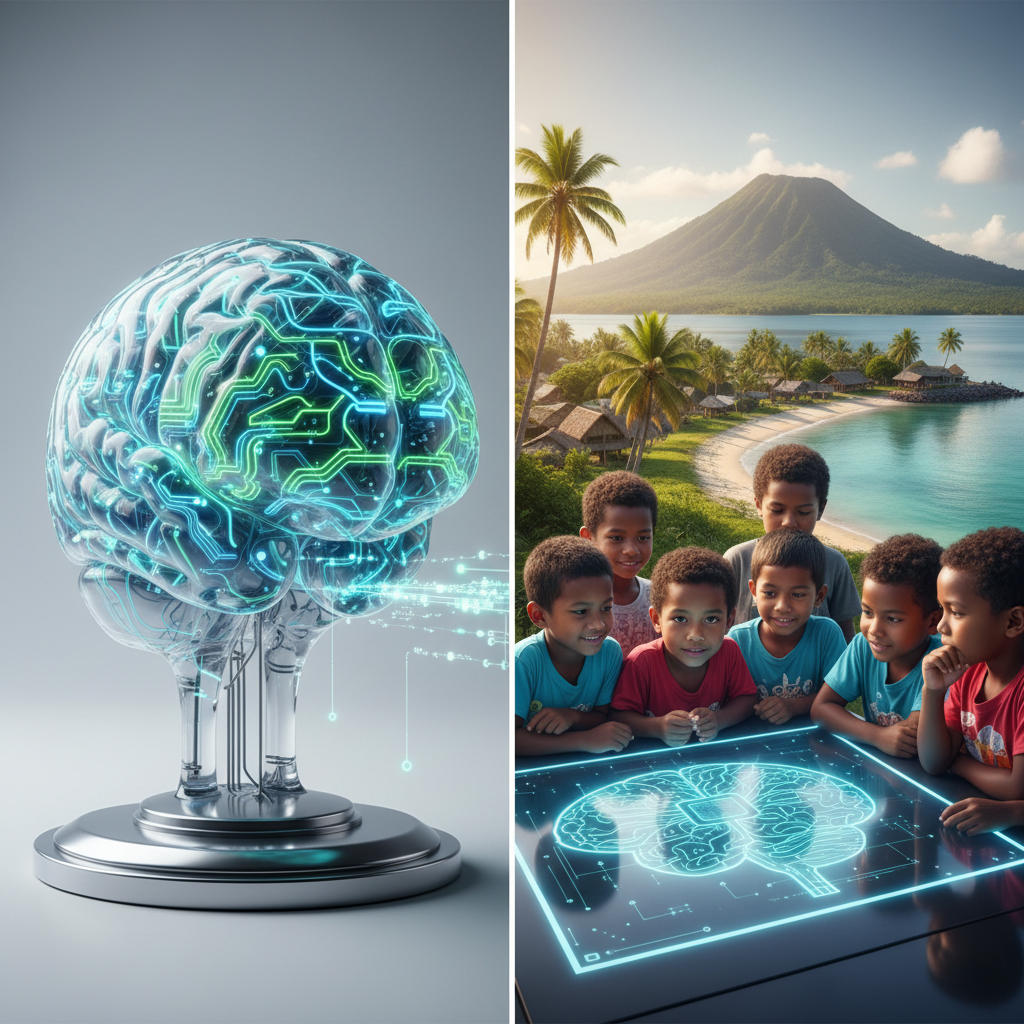

The world has been captivated by the grand pronouncements of OpenAI and Google, by the dazzling feats of generative AI that can write poetry or compose music. Here in Fiji, we watch the global tech trends with a different lens. While the digital artists and content creators celebrate, we are asking: How does this help us prepare for the next cyclone? How does it make our infrastructure more resilient, or our healthcare more accessible across scattered islands?
This is why I want to talk about something far less glamorous, but infinitely more practical for us: neuromorphic computing. It is a mouthful, I know, but bear with me. We are talking about AI chips that are engineered to work like the human brain, processing information in parallel, learning on the fly, and doing it all with a fraction of the energy of traditional processors. Companies like Intel and IBM have been quietly developing these for years, and now NVIDIA is pushing the envelope further, integrating these brain-inspired architectures into their next-generation platforms.
The Headline Development: Brain-Inspired Chips Get Real
For too long, AI has been a power hog. Training a large language model can consume as much energy as a small town for days. This is simply not sustainable, especially for countries like Fiji that are already grappling with energy security and the escalating costs of climate change. The development that demands our attention now is the increasing maturity of neuromorphic hardware. We are seeing breakthroughs in chips that can perform complex AI tasks with unprecedented energy efficiency. Imagine an AI system that can continuously monitor coral reef health, predict localized weather patterns with greater accuracy, or manage smart grids, all running on minimal power, perhaps even off-grid with solar power.
NVIDIA, a company often associated with the powerful GPUs that fuel today's AI boom, is also investing heavily in this area, recognizing the limitations of current architectures. Their research, alongside others, points to a future where AI is not just powerful, but also profoundly efficient. This shift from raw computational power to intelligent, efficient processing is a game changer, particularly for regions with limited and expensive energy resources.
Why Most People Are Ignoring It: The Attention Gap
Most people are understandably focused on the immediate, flashy applications of AI: the chatbots, the image generators, the self-driving cars. These are tangible, often entertaining, and directly impact consumer experiences. Neuromorphic computing, on the other hand, operates at the hardware level. It is about transistors and synapses, not pretty pictures or witty prose. It is foundational, not superficial. This makes it harder to grasp, less sensational to report on, and consequently, easier for the general public to overlook. The immediate gratification of a new AI app overshadows the complex engineering that makes future, more sustainable AI possible.
Here in Fiji, we face the future with clear eyes, and we know that what is flashy is not always what is useful. The long-term implications of energy-efficient AI for our climate resilience efforts far outweigh the immediate appeal of a new digital toy.
How It Affects YOU: Personal Impact on Readers
Even if you are not an AI researcher or a chip designer, neuromorphic computing will touch your life. Think about your smartphone. Current AI tasks, like advanced facial recognition or real-time language translation, drain your battery. Neuromorphic chips could allow your devices to perform these complex tasks locally, without sending data to the cloud, and without running out of power halfway through the day. This means more privacy, faster responses, and longer battery life for the devices you rely on daily.
For those in healthcare, imagine diagnostic tools that can analyze medical images with the speed and accuracy of a specialist, right on a portable device in a remote village, powered by a small battery. For our farmers, imagine smart sensors that monitor soil conditions and crop health, making real-time recommendations, all powered by tiny, long-lasting AI modules. This is not science fiction; it is the promise of efficient, localized AI that neuromorphic computing brings.
The Bigger Picture: Societal, Economic, or Political Implications
The societal implications are profound. Energy efficiency in AI is not just a technical detail; it is a climate imperative. As AI becomes more pervasive, its carbon footprint grows. Neuromorphic computing offers a path to decouple AI's growth from its energy consumption. This is critical for global sustainability goals and for reducing the strain on energy grids, especially in developing nations.
Economically, this technology could democratize AI. If powerful AI can run on less expensive, lower-power hardware, it lowers the barrier to entry for innovators and entrepreneurs in regions that cannot afford massive data centers. This could spark local AI industries, creating jobs and fostering homegrown solutions to local problems. Politically, it could reduce reliance on centralized, energy-intensive cloud infrastructure, enhancing data sovereignty and digital resilience for nations. For small island nations, this decentralization is a form of empowerment, allowing us to process and protect our own data without constant reliance on distant, vulnerable servers.
What Experts Are Saying: A Glimpse into the Future
“The current trajectory of AI compute is unsustainable,” states Dr. Alisi Vakaloloma, a senior research fellow at the University of the South Pacific's School of Computing, Information and Mathematical Sciences. “Neuromorphic computing offers a viable alternative, promising orders of magnitude improvement in energy efficiency. For Fiji, this means we can deploy advanced AI for climate monitoring and disaster prediction without exacerbating our energy challenges.” Her research focuses on practical applications of low-power AI for environmental sensing.
Dr. Thomas Reardon, a lead architect at Intel Labs, noted in a recent virtual conference, “We are moving beyond simply making chips faster. The goal now is to make them smarter, more adaptive, and fundamentally more efficient. Our Loihi research chip, for example, demonstrates how event-driven processing can drastically cut power consumption for certain AI workloads.” This focus on efficiency over brute force is a crucial paradigm shift.
Jensen Huang, CEO of NVIDIA, has also hinted at the integration of brain-inspired principles into future GPU architectures. “The human brain is the ultimate computer, incredibly powerful and incredibly efficient,” he remarked in a recent interview with Reuters Technology. “Our journey towards more intelligent and sustainable AI must draw inspiration from biology.” This signals a clear direction for one of the industry's giants.
And from a global perspective, Professor Anya Sharma, an AI ethics and policy expert at the Oxford Internet Institute, recently highlighted, “The energy footprint of AI is a growing ethical concern. Neuromorphic computing, by addressing this directly, could become a cornerstone of responsible AI development, allowing equitable access to advanced AI capabilities globally.” This speaks to the potential for a more just distribution of AI's benefits.
What You Can Do About It: Actionable Takeaways
For policymakers and leaders in Fiji and other developing nations, it is crucial to invest in research and pilot projects that explore the practical applications of neuromorphic computing for local challenges. Partner with universities, both local and international, to build expertise in this emerging field. Advocate for international funding and collaboration on sustainable AI hardware development.
For businesses, consider how low-power AI could enable new services or optimize existing operations in remote areas, or where energy is scarce. Look beyond the immediate, cloud-based AI solutions and explore edge computing possibilities. For individuals, stay informed. Understand that not all AI is created equal, and that the underlying hardware matters. Support initiatives that prioritize sustainable technology.
Small island, big challenges, smart solutions. This is the Pacific way of problem-solving, and neuromorphic computing fits right into that philosophy.
The Bottom Line: Why This Will Matter in 5 Years
In five years, the energy efficiency of AI will no longer be a niche concern; it will be a primary design constraint and a competitive differentiator. Neuromorphic computing will move from the research lab to mainstream applications, especially in edge devices, IoT, and critical infrastructure. We will see AI systems that are not only powerful but also incredibly frugal with energy, enabling truly pervasive and sustainable AI. This will be particularly transformative for regions like Oceania, where climate resilience and resource management are paramount. The ability to deploy sophisticated AI locally, powered by renewable energy, will be a cornerstone of our adaptive strategies. It is not just about faster AI; it is about smarter, more responsible, and ultimately, more accessible AI for everyone. This shift will redefine how we build and deploy intelligent systems, making AI a true partner in global sustainability, not just another energy burden. For more on the technical advancements, you might find articles on MIT Technology Review insightful.