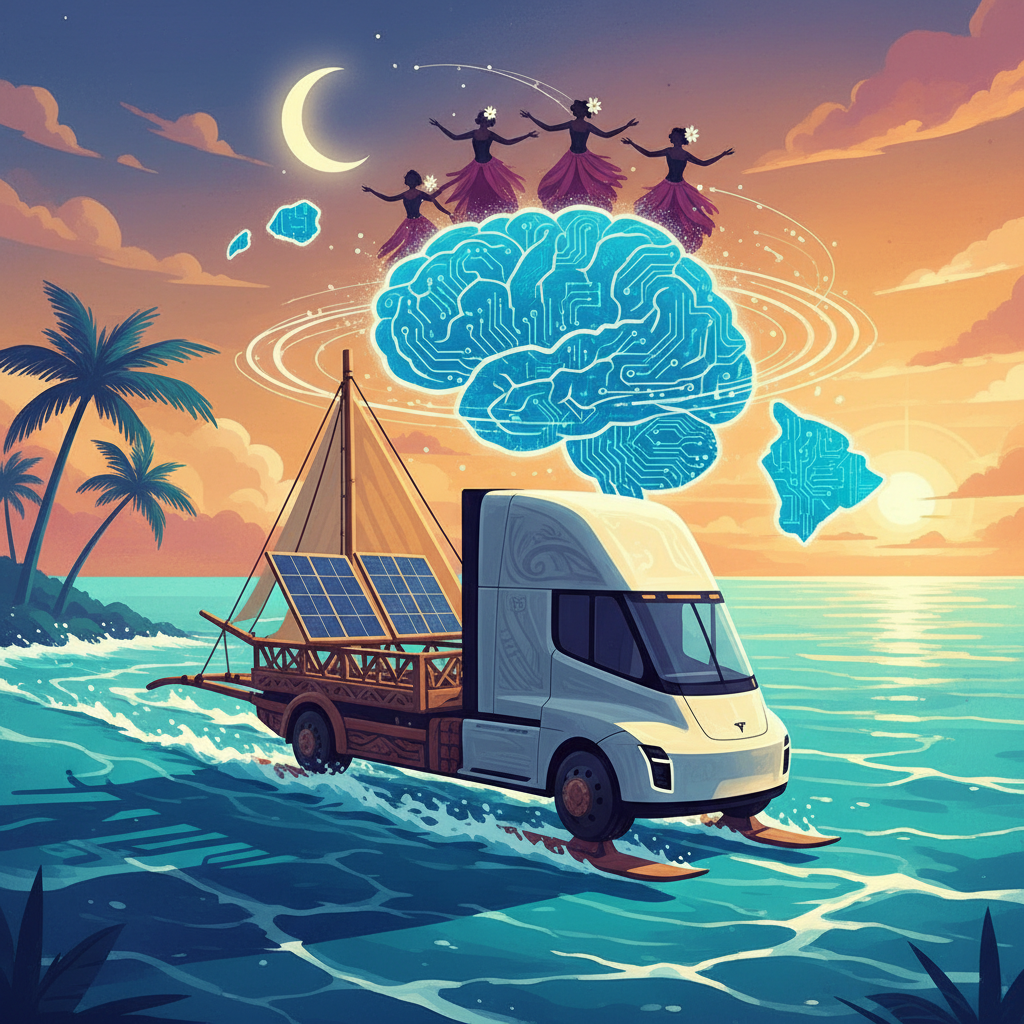

The sun is just kissing the horizon over Moorea as I write this, painting the sky in hues of pink and orange that no algorithm could truly replicate. Yet, in the bustling digital currents far from our tranquil lagoons, companies like Pika Labs are racing to create precisely that: digital echoes of reality, crafted by artificial intelligence. They dream of a future where anyone can conjure a video with a few whispered words, a 'YouTube of AI-generated content,' as many are calling it. But from here, in the heart of the Pacific, I have to ask: whose stories will these new oceans of pixels tell, and whose voices will be amplified?
Pika Labs, a startup that emerged from the halls of Stanford and quickly captured the imagination of the tech world, is certainly making waves. Their platform allows users to generate short video clips from text prompts or images, offering a level of creative control that was unimaginable just a few years ago. It is impressive, truly. The ability to animate a still photograph, to bring a concept to life without complex software or expensive equipment, feels like magic. And they are not alone; Runway ML, Stability AI, and even giants like Google and Meta are pouring resources into this space, each vying for a piece of the burgeoning AI video pie. The market is projected to reach billions, with analysts at Bloomberg Technology suggesting a rapid expansion in creative industries.
But here is my concern, a feeling that settles deep in my bones like the ancient corals beneath our waters. This is a story about paradise and pixels, yes, but it is also a story about power and perspective. When Silicon Valley builds the tools, it often dictates the narratives. The algorithms are trained on vast datasets, overwhelmingly drawn from dominant cultures and languages. What happens then, when a young artist in Tahiti wants to generate a video depicting a traditional himene performance, or the intricate patterns of a tīfaifai quilt? Will the AI truly understand the subtle movements, the spiritual resonance, the cultural context, or will it produce a generic, sanitized, and ultimately inauthentic imitation?
I believe the current trajectory of AI video generation, while technically brilliant, risks creating a visual monoculture. It is a powerful technology, but one that currently prioritizes speed and scale over depth and authenticity. The argument I hear often is that these tools democratize creation, allowing anyone to become a filmmaker. And yes, in theory, that is wonderful. But true democratization is not just about access to tools; it is about ensuring those tools are culturally sensitive, ethically sound, and capable of reflecting the full, vibrant tapestry of human experience, not just a narrow slice of it.
Anticipating the counterargument, some might say, 'Tiàre, you are missing the point. These are just tools. It is up to the users to input diverse prompts and guide the AI.' And they would be partly right. The user holds significant power. But the foundation matters. If the very models are biased, if the training data lacks representation from indigenous cultures, from the unique landscapes and faces of the Pacific, then the output will inevitably reflect that imbalance. It is like trying to draw a detailed map of our archipelago with only satellite images of California. You will miss the intricate channels, the hidden coves, the very essence of what makes this place unique.
Imagine a scenario where a film studio, perhaps even one based in Hollywood, decides to create content about the Pacific using these AI video generators. Without proper guidance, without deep cultural understanding embedded in the very fabric of the AI, we risk seeing our stories told through a distorted lens, perpetuating stereotypes or simply getting it wrong. As Dr. Teina Pora, a cultural anthropologist at the University of French Polynesia, often reminds us, 'Our stories are not just entertainment; they are our history, our identity, our connection to our ancestors and our future. To misrepresent them is to diminish us.' This is not just about aesthetics; it is about cultural sovereignty.
My rebuttal is simple: the very architecture of these AI systems needs to be built with diversity and inclusion at its core, not as an afterthought. This means more diverse datasets, more collaboration with indigenous communities, and a commitment from companies like Pika Labs to actively seek out and integrate perspectives from beyond the usual tech hubs. It means understanding that in the Pacific, technology takes a different form; it is often a tool for connection, for preservation, for amplifying voices that have long been unheard.
The ocean connects us and so does AI, but only if we steer it with wisdom and foresight. The race to build the next YouTube of AI video should not be a sprint to the cheapest, fastest, or most prolific generator. It should be a thoughtful journey towards a platform that truly empowers global storytelling, one that respects the nuances of every culture, every landscape, every human heart. We need to ask ourselves: are we building a digital mirror that reflects the world in all its beautiful complexity, or just another echo chamber for the loudest voices?
For companies like Pika Labs, the opportunity is immense. They could be pioneers not just in technology, but in ethical and inclusive AI development. They could collaborate with institutions like the Polynesian Cultural Center or local artists to build models specifically trained on diverse cultural heritage, ensuring that when someone asks for a video of a tapa cloth being made, the AI understands the intricate process and meaning behind it. This would not only enrich their platforms but also build trust and foster genuine creative partnerships.
The future of AI-generated video is not just about the pixels on a screen; it is about the stories those pixels tell, and the people those stories represent. Let us ensure that as we dive deeper into this digital ocean, we do not forget the vibrant, living cultures that make our world so incredibly rich. Let us demand that these powerful tools are built with a conscience, a respect for heritage, and a genuine desire to amplify every voice, not just the dominant ones. Otherwise, what kind of paradise are we truly building? It is a question that echoes across our lagoons, demanding an answer from the tech giants of the world. For more insights into the broader implications of AI, I often turn to sources like MIT Technology Review for their thoughtful analyses.