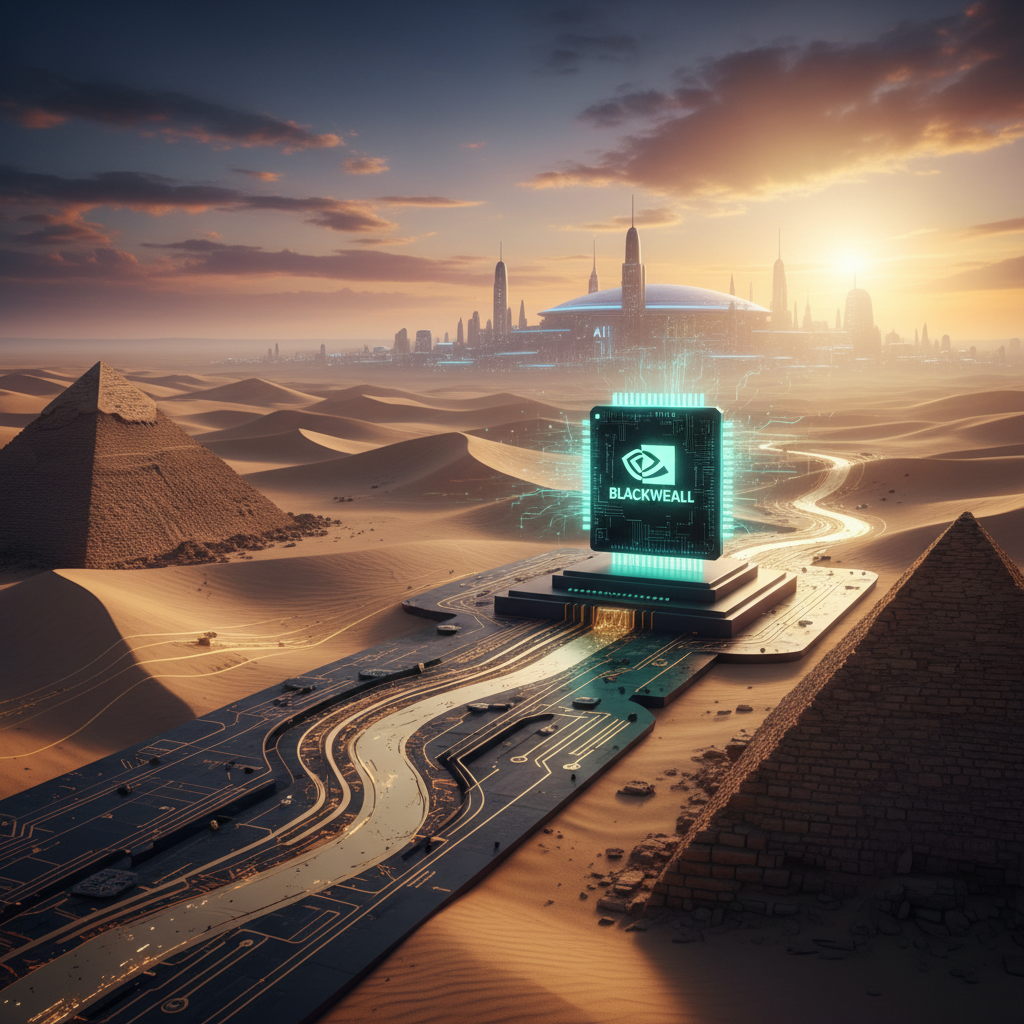

Step into any bustling market in Cairo, like Khan el-Khalili, and you'll quickly understand the concept of a dominant player. One vendor has the best spices, the most vibrant textiles, or the freshest produce, and everyone flocks to them. They set the prices, they dictate the trends. In the world of artificial intelligence, NVIDIA, and its Graphics Processing Units or GPUs, are that dominant vendor, and their latest offering, the Blackwell architecture, is the talk of the souk. But what exactly is this Blackwell architecture, and why is it being hailed as the next great leap for AI training?
What is NVIDIA's Blackwell Architecture?
At its core, NVIDIA's Blackwell is the latest generation of GPU architecture designed specifically to accelerate the most demanding AI workloads, particularly the training of massive large language models, LLMs. Think of it this way: if previous NVIDIA GPUs, like Hopper, were powerful diesel engines, Blackwell is a hyper-efficient, multi-fuel rocket engine, capable of propelling AI development at speeds previously unimaginable. It is not just a faster chip, it is an entire platform, a system of systems, designed to handle the colossal computational demands of today's and tomorrow's AI.
Jensen Huang, NVIDIA's CEO, unveiled Blackwell earlier this year, touting it as a fundamental shift. "Blackwell is not just a chip, it's a platform for the next era of computing," he declared at the GTC conference. This new architecture features a staggering 208 billion transistors, a monumental leap from the 80 billion in its predecessor, Hopper. This isn't just about more transistors, it's about how they are arranged and what they enable.
Why Should You Care?
Now, you might be thinking, 'Amiraà, I am not training a large language model, why should I care about NVIDIA's latest silicon?' And that is a fair question, one I hear often in my conversations around Cairo. But here's what's actually happening under the hood: the advancements Blackwell brings will trickle down and reshape nearly every digital interaction you have. From the accuracy of medical diagnostics powered by AI, to the sophistication of autonomous vehicles navigating our busy streets, to the very language models that power your chatbots and search engines, Blackwell is the engine making it all possible.
Consider our daily lives here in Egypt. Imagine AI systems that can accurately translate ancient hieroglyphs in real-time, or predict crop yields with unprecedented precision to combat food insecurity, or even power smart cities that optimize traffic flow in places like Alexandria. These are not distant dreams, but applications that require immense computational power. Blackwell is designed to deliver that power, making these AI breakthroughs not just possible, but faster and more efficient to develop. It is about accelerating the future, making AI more ubiquitous and, hopefully, more beneficial to humanity.
How Did It Develop?
The story of Blackwell is not an overnight sensation, but rather the culmination of decades of relentless innovation at NVIDIA. From its origins in graphics rendering for video games, NVIDIA pivoted early to recognize the potential of GPUs for parallel processing, a critical requirement for AI. Their Cuda platform, introduced in 2006, democratized GPU programming and laid the groundwork for the AI revolution. "cuda was the key that unlocked the GPU for general-purpose computing, and specifically for AI," explains Dr. Layla Mansour, a senior researcher in AI hardware at the American University in Cairo. "Without it, the software ecosystem for AI would look vastly different today." You can read more about the broader impact of AI hardware on the industry in articles like those found on TechCrunch.
Subsequent architectures like Pascal, Volta, Ampere, and Hopper each pushed the boundaries, adding specialized tensor cores for AI computations, increasing memory bandwidth, and improving interconnectivity. Blackwell is the latest iteration of this continuous drive, building on these foundations with new innovations like the fifth-generation NVLink and the Transformer Engine, which is specifically optimized for the colossal transformer models that power LLMs like OpenAI's GPT and Google's Gemini.
How Does It Work in Simple Terms?
Let me break this down. Imagine you are trying to build a magnificent pyramid, like the Great Pyramid of Giza. In the early days of computing, you had one very strong person, a CPU, trying to lift massive blocks one by one. It was powerful, but slow for such a grand task. Then came GPUs, which are like having thousands of smaller, but still strong, workers. Each worker can lift a smaller stone, and together they can move mountains much faster. This parallel processing is what makes GPUs ideal for AI.
Blackwell takes this analogy further. It is not just having more workers, but also giving them better tools, better coordination, and a smarter way to move the stones. For instance, the Blackwell GPU has two 'dies' or chips, fused together into a single, cohesive unit. Think of it as having two highly skilled teams of workers operating in perfect sync, communicating instantly through a super-fast internal network, the NV-High Bandwidth Interface, which moves data at 10 terabytes per second. That is like having a dedicated high-speed rail line connecting two construction sites, ensuring no delays.
Then there is the Transformer Engine, a crucial innovation for LLMs. LLMs are built on a 'transformer' architecture, which involves a lot of matrix multiplications and attention mechanisms. The Transformer Engine in Blackwell is like having specialized cranes and levers designed specifically for lifting and placing the unique blocks of a transformer model. It dynamically adjusts computations, using lower precision formats when possible without sacrificing accuracy, much like an experienced foreman knows exactly how much force is needed for each stone, saving energy and time. This allows Blackwell to handle models with trillions of parameters, processing them with incredible speed and efficiency. According to NVIDIA's AI blog, this dynamic precision is a game-changer for large-scale AI training.
Real-World Examples
- Accelerating Drug Discovery: Pharmaceutical companies, like those in Cairo's burgeoning biotech sector, can use Blackwell to simulate molecular interactions and predict drug efficacy far more quickly. Instead of years, AI models trained on Blackwell could potentially reduce drug discovery timelines to months, bringing life-saving medicines to market faster.
- Advanced Climate Modeling: Researchers at institutions like Egypt's National Research Centre are employing AI to build more accurate climate models. Blackwell's power allows them to process vast datasets, simulate complex atmospheric and oceanic phenomena, and predict climate change impacts with greater resolution, informing critical policy decisions for our vulnerable region.
- Hyper-Realistic Content Creation: From Hollywood studios to Egyptian animation houses, Blackwell is enabling artists to render complex 3D scenes, generate lifelike digital characters, and create immersive virtual worlds in a fraction of the time. This means more compelling visual effects and interactive experiences, pushing the boundaries of digital art and entertainment.
- Next-Generation Robotics and Autonomous Systems: Imagine autonomous robots navigating the intricate alleyways of Old Cairo, delivering goods or performing maintenance. Blackwell's ability to process massive amounts of sensor data in real-time is crucial for training these robots, allowing them to perceive, understand, and interact with their environment safely and effectively. Companies like Tesla are heavily investing in such AI training for their autonomous driving systems.
Common Misconceptions
One common misconception is that Blackwell will instantly make AI accessible and affordable for everyone. While it dramatically increases efficiency, the initial cost of these high-end GPUs remains substantial. It is like building a state-of-the-art factory; the output is incredible, but the initial investment is high. This creates a potential divide, where only well-funded corporations and nations can afford the bleeding-edge hardware, further concentrating AI power. Another myth is that more powerful GPUs automatically mean 'smarter' AI. While hardware is foundational, the quality of data, the ingenuity of algorithms, and the skill of the researchers are equally, if not more, important. A faster car does not make a better driver.
What to Watch For Next
The immediate future will see a scramble among tech giants like Microsoft, Amazon, and Google to acquire Blackwell systems for their cloud AI infrastructure. This will fuel the next generation of LLMs, making them larger, more multimodal, and more capable. We will also see increased competition from other chipmakers, with Intel and AMD pushing their own AI accelerators, though NVIDIA's lead remains significant. The energy consumption of these powerful chips is also a growing concern, and I expect to see more innovation in energy-efficient AI training.
From my vantage point in Cairo, I see this as a pivotal moment. The power of Blackwell is undeniable, but how we wield it, how we ensure its benefits are distributed equitably, and how we address the ethical implications of ever more powerful AI, these are the questions that truly matter. The digital revolution, much like the Nile's annual flood, brings immense potential for growth, but also demands careful management and foresight. We must ensure this new wave of innovation uplifts all, not just a select few. The future of AI, powered by Blackwell and its successors, is not just a technical challenge, it is a societal one, and one we must all engage with. For further insights into the societal impact of AI, I often turn to publications like Wired.
This is not merely about faster calculations, it is about shaping the very fabric of our digital world, and by extension, our human experience. And that, my friends, is something worth paying attention to.