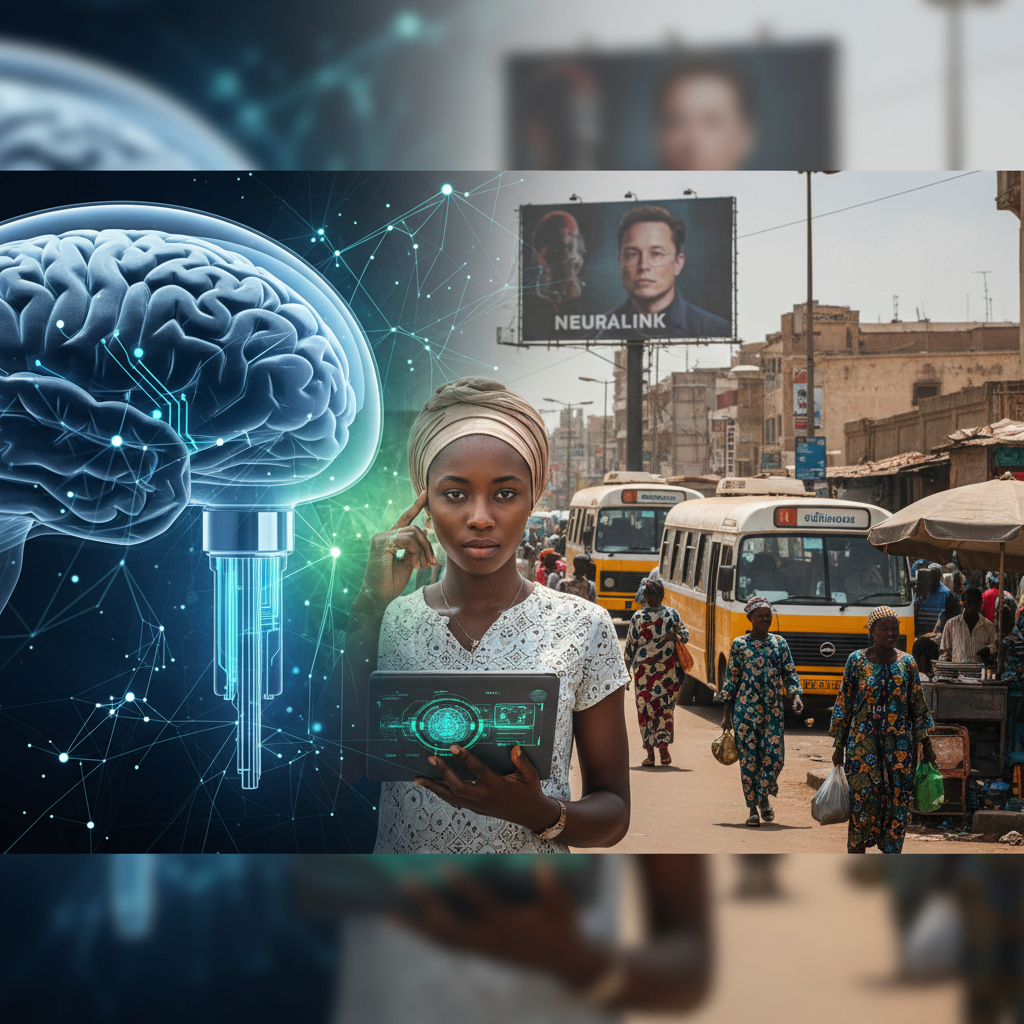
The drumbeat of technological progress often reverberates loudest from the West, a powerful, sometimes overwhelming, rhythm that dictates the pace for the rest of the world. Today, that rhythm is punctuated by the audacious claims of brain-computer interfaces, or BCIs, powered by artificial intelligence. Companies like Neuralink, founded by the ever-controversial Elon Musk, are not merely dabbling in science fiction, they are actively implanting devices into human brains, promising to restore sight, speech, and movement to those who have lost them. This is not just a medical marvel in the making, it is a profound shift in human capability, one that inevitably casts its gaze upon the African continent, including my home, Senegal.
For years, the narrative around African technology has been one of leapfrogging, of adopting mobile phones before landlines, of embracing fintech solutions where traditional banking lagged. Now, the conversation is shifting to a far more intimate and invasive technology. The idea of a chip in the brain, controlled by AI, offers a tantalizing prospect for millions suffering from neurological disorders, paralysis, or sensory impairments. Imagine a child in a rural village, born blind, suddenly able to perceive light and form through a neural implant. Or a victim of a debilitating stroke in Dakar regaining the ability to communicate with their loved ones, not through arduous therapy, but through direct thought translation. The potential is undeniable, almost utopian.
However, as an investigative journalist, I am trained to look beyond the glittering promises, to peel back the layers of corporate rhetoric and examine the underlying currents. My sources tell me that while the philanthropic and humanitarian aspects are often highlighted, the geopolitical and economic implications for Africa are rarely discussed with the same fervor. When a technology is this transformative, the questions of access, affordability, ethical oversight, and data sovereignty become paramount, especially in regions where regulatory frameworks are still evolving.
Consider the sheer cost. While Neuralink has not publicly disclosed the exact price of its procedures, early estimates for similar, less advanced BCI surgeries in the West run into hundreds of thousands of dollars. How will this be reconciled with healthcare systems in countries like Senegal, where basic medical services often struggle for funding? Will these life-altering technologies be reserved for the elite, creating a new form of digital divide, or perhaps a neurological one? The documents reveal that the initial targets for BCI adoption in Africa are likely to be in private, high-end clinics, accessible only to a privileged few. This raises serious concerns about equity and justice.
Furthermore, the data generated by these implants is incredibly personal and sensitive. A BCI records brain activity, essentially capturing thoughts, intentions, and perceptions. Who owns this data? How will it be stored, secured, and used? In a landscape where data privacy laws are nascent, and where the allure of foreign investment can sometimes overshadow long-term national interests, the potential for exploitation is significant. Will African patients become unwitting data mines for foreign corporations, their most intimate neural patterns fed into algorithms developed thousands of kilometers away? This is just the tip of the iceberg.
Dr. Aminata Touré, a leading neuroscientist at Cheikh Anta Diop University in Dakar, expressed her reservations recently. “While the medical advancements are exciting, we must approach this with extreme caution,” she stated during a recent symposium on AI ethics. “Our priority must be to ensure that these technologies are developed and deployed in a manner that respects our dignity, our autonomy, and our unique cultural context. We cannot afford to be mere recipients of technology; we must be active participants in its governance and ethical framing.” Her words echo a growing sentiment among African researchers and policymakers.
Indeed, the involvement of major global players like Neuralink, backed by figures like Elon Musk, brings with it immense resources and influence. Musk's ventures often operate with a certain disregard for conventional regulatory speed, pushing boundaries at a pace that can leave national governments scrambling. While this can accelerate innovation, it also risks bypassing crucial ethical considerations that are particularly pertinent in diverse cultural settings. The concept of brain privacy, for instance, might be interpreted differently in a collectivist society than in an individualistic one.
Beyond the ethical quandaries, there is the question of local capacity building. Will the introduction of advanced BCIs foster local research and development, or will it create a dependency on foreign expertise and technology? For Senegal and other African nations, the goal should be to cultivate indigenous capabilities in AI and neurotechnology, rather than simply becoming consumers of imported solutions. There is a burgeoning tech scene in Dakar, with startups and innovators eager to tackle local challenges. Their voices must not be drowned out by the thunder of multinational corporations.
Consider the example of telecommunications. While the rapid adoption of mobile phones brought undeniable benefits, it also led to a landscape dominated by foreign operators and equipment manufacturers. We must learn from these experiences. As Reuters has reported, the global AI market is fiercely competitive, and Africa represents a significant growth frontier. The scramble for market share in this new neural frontier will be intense.
The path forward requires a delicate balance. It necessitates robust regulatory frameworks that protect patient rights and data privacy, while also fostering an environment conducive to ethical research and innovation. It demands significant investment in local scientific talent and infrastructure, ensuring that African neuroscientists and AI experts are at the forefront of these developments, not merely on the receiving end. We need to ask ourselves: are we prepared to engage with this technology on our own terms, or will we allow others to define the terms for us?
The promise of restoring sight, speech, and movement is a powerful one, capable of inspiring hope and driving progress. But for the people of Senegal and the wider African continent, this promise must come with a clear understanding of the implications, a commitment to equitable access, and a steadfast defense of our sovereignty in the new frontier of the human mind. The future of brain-computer interfaces in Africa is not just a medical story; it is a story of power, ethics, and self-determination. As MIT Technology Review often emphasizes, the ethical dimensions of AI are as crucial as the technological advancements themselves. We must ensure that the benefits are truly universal, not just a privilege for a select few. The conversation has only just begun, and its outcome will shape not only our bodies but perhaps the very essence of what it means to be human in the digital age.