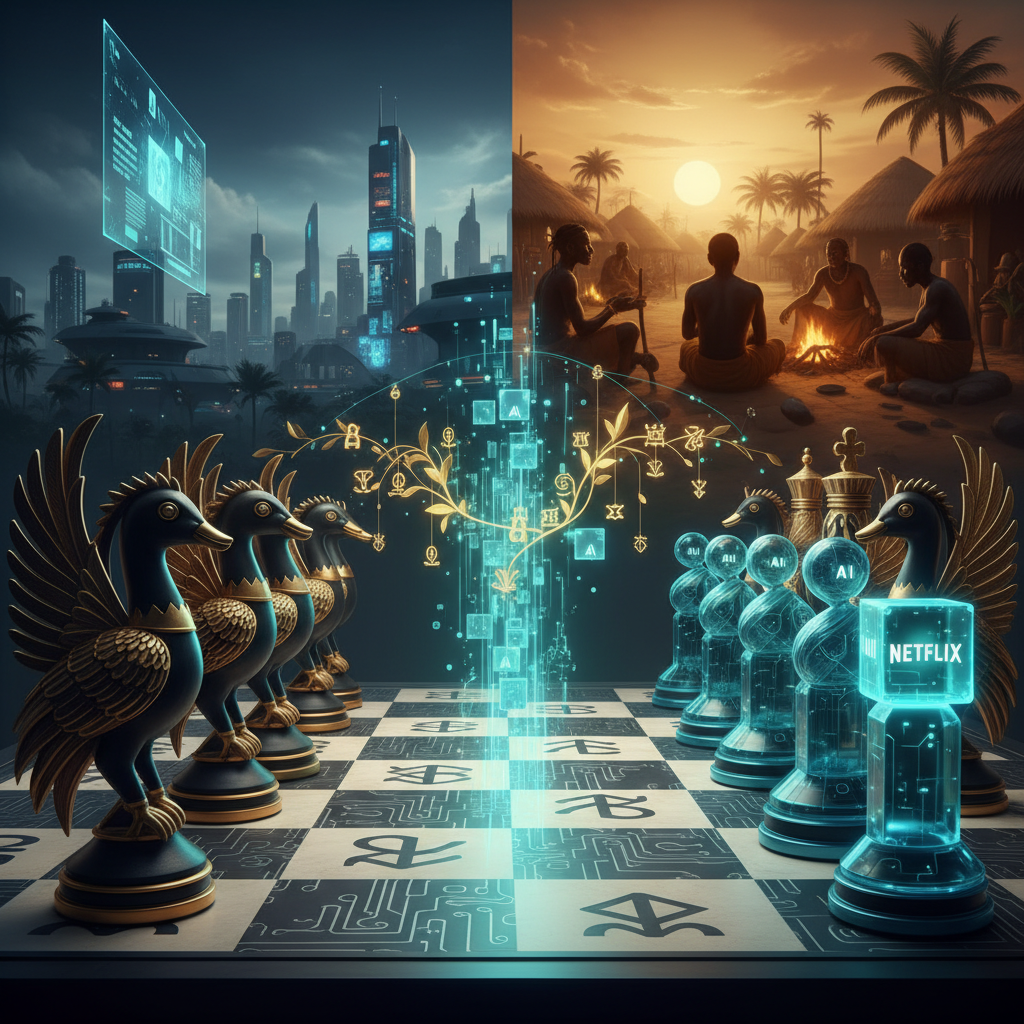
The drumbeats of change are echoing through Hollywood, not from a new blockbuster score, but from the whirring of AI servers. We are talking about AI-generated movies and TV shows, a concept that feels like it leaped straight out of a science fiction script. For a global streaming behemoth like Netflix, this isn't just a futuristic fantasy, it is a strategic play, a calculated gamble on the future of content creation. But from my vantage point here in Accra, Ghana, I have to ask: what does this mean for us, for our stories, for our very identity on the global stage?
Netflix, a company that has invested billions in original content, is reportedly exploring generative AI tools to streamline scriptwriting, character design, and even pre-visualization. Their motivation is clear: efficiency, cost reduction, and the ability to churn out content at an unprecedented pace to feed an insatiable global audience. The strategic move is to leverage AI to predict trends, automate repetitive tasks, and potentially even personalize narratives for individual viewers. Imagine a future where a viewer in Kumasi gets a slightly different version of a story than someone in London, tailored by AI to their cultural preferences. On the surface, it sounds like a technological marvel, a new frontier for entertainment.
Context and motivation for Netflix are rooted in the hyper-competitive streaming wars. Companies like Disney+, Amazon Prime Video, and HBO Max are constantly vying for subscriber attention. The ability to produce high-quality, engaging content faster and cheaper could be a significant differentiator. Netflix has already demonstrated a willingness to experiment, from interactive films to diverse international productions. Their push into AI-generated content is a natural extension of this innovation drive, aiming to maintain its market leadership and subscriber growth in a saturated landscape. The promise is a content pipeline that never runs dry, offering endless entertainment possibilities.
However, this strategy is not without its shadows, especially when viewed through an African lens. The competitive analysis reveals a stark reality. While Netflix and other Western studios pour resources into AI development, African film industries, like Ghana's own vibrant Ghallywood or Nigeria's Nollywood, are still grappling with fundamental issues of funding, infrastructure, and distribution. Our stories, rich with history, mythology, and contemporary struggles, are often told on shoestring budgets, with passion as their primary currency. How can we compete when the very act of storytelling is being industrialized and automated by entities with virtually limitless resources?
The strengths of Netflix's AI strategy are undeniable. It promises speed, scalability, and potentially new forms of creative expression. AI could help identify niche markets, optimize production schedules, and even reduce the risk of creative flops by pre-testing concepts. Imagine an AI that can analyze millions of scripts and audience reactions to suggest plot twists or character arcs that resonate most deeply. This could lead to a more diverse range of stories, theoretically, if the training data is truly representative.
But the weaknesses, for us, are profound. The biggest concern is cultural appropriation and the homogenization of narratives. Generative AI models are trained on vast datasets, predominantly reflecting Western cultural norms, perspectives, and storytelling conventions. If Netflix uses these models to generate content, even for African audiences, will it truly capture the nuance, the spirit, the very soul of our stories? Or will it produce a sanitized, algorithmically palatable version, devoid of authentic cultural depth? We have seen this before, where our rich traditions are reduced to exotic backdrops or superficial tropes. This affects every single one of us, because our stories are mirrors of our humanity.
Consider the concept of 'Sankofa' in Akan philosophy, which teaches us to look back at our past to inform our present and future. Our storytelling traditions are deeply rooted in oral histories, communal experiences, and specific cultural contexts. Can an AI, no matter how sophisticated, truly understand the rhythm of a Highlife tune, the symbolism of an Adinkra motif, or the complex social dynamics of a Ghanaian family? Or will it simply regurgitate patterns it has learned from Hollywood blockbusters, inadvertently erasing our unique narrative voices?
Furthermore, there is the issue of economic displacement. If AI can write scripts, compose scores, and even animate characters, what becomes of the human creatives, the writers, directors, actors, and artists who are the lifeblood of our industries? In Ghana, where creative industries are a significant source of employment and cultural pride, this prospect is deeply troubling. We need to talk about this, because the livelihoods of countless individuals are at stake.
I recall a statement by Dr. Joy Buolamwini, founder of the Algorithmic Justice League, who has consistently highlighted the biases embedded in AI systems. She has often spoken about how 'the algorithms are often reflections of the data they are trained on, and the data often reflects historical biases.' This sentiment resonates strongly with the concerns around AI-generated content. If the training data for these powerful models is predominantly Western, then the 'creativity' they exhibit will inevitably carry those biases, potentially perpetuating stereotypes or overlooking the richness of non-Western cultures.
Another voice, Yann LeCun, Meta's Chief AI Scientist, has often championed the open development of AI, suggesting it democratizes access. While open models might offer some tools, the sheer computational power and proprietary data needed to train truly sophisticated generative AI for film remain largely in the hands of a few tech giants. This creates an uneven playing field, where the 'democratization' is more about access to tools, not necessarily the power to shape the narrative landscape.
The verdict and predictions are complex. Netflix's strategy to embrace AI for content creation is a powerful, almost inevitable, move in the global entertainment industry. It will undoubtedly lead to more content, produced faster and potentially cheaper. However, for regions like Africa, it presents a critical juncture. Will we become passive consumers of algorithmically-generated stories that may not truly represent us, or will we find ways to harness this technology to amplify our own voices?
My prediction is that without deliberate, proactive intervention, the latter is unlikely to happen at scale. Silence is complicity when it comes to shaping our digital future. African governments, cultural institutions, and creative industries must demand a seat at the table. We need to advocate for diverse training datasets, for AI tools that understand and respect cultural nuances, and for policies that protect human creativity and intellectual property. Perhaps we need to explore our own 'AI-Sankofa' approach, using AI not to replace our storytellers, but to empower them, to help them reach global audiences with stories that are authentically ours. We must ensure that the future of storytelling is not just efficient, but also equitable, diverse, and truly human.
Ultimately, the revolution of AI-generated content can either be a force for global storytelling, enriching the world with diverse narratives, or it can be a new form of digital colonization, where our stories are consumed, processed, and regurgitated by machines, losing their original flavor and essence. The choice, and the fight, is ours. We must ensure that our cultural heritage is not just another dataset for Silicon Valley, but a living, breathing wellspring of creativity that continues to flow freely, authentically, and powerfully.