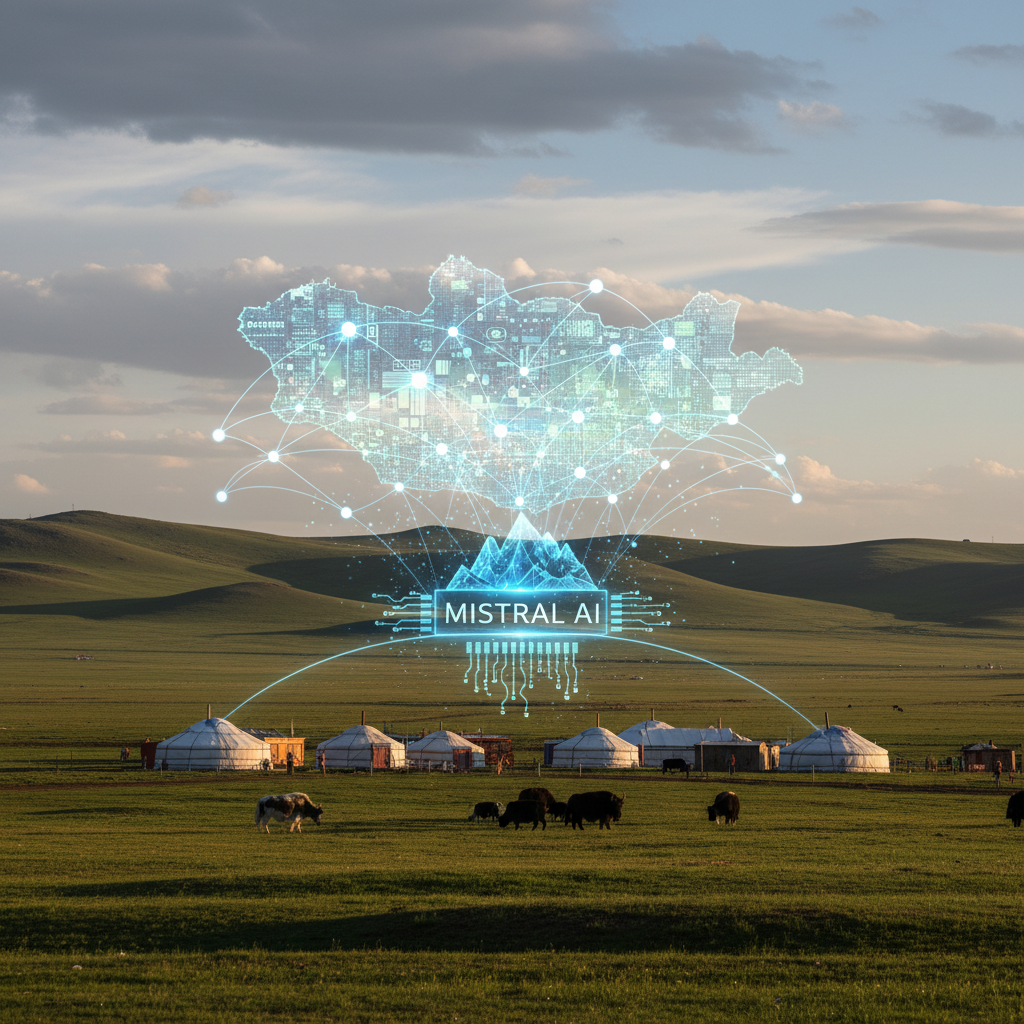

The digital world often feels like a vast, open steppe, yet much of its underlying infrastructure, particularly in advanced AI, remains fenced off by a few powerful entities. For nations like Mongolia, with its immense landscapes and unique cultural heritage, relying solely on proprietary models developed thousands of kilometers away presents a complex challenge. This is where companies like Mistral AI, emerging from Europe, offer a compelling alternative, pushing the boundaries of what 'open' truly means in the AI landscape.
Mistral AI has rapidly become a significant player, not by trying to outspend or out-hype the likes of OpenAI or Google, but by focusing on efficiency, performance, and, crucially, openness. Their approach resonates deeply with the growing global desire for sovereign AI, where countries and organizations can build and deploy AI solutions without being entirely dependent on external, often opaque, systems. The question for us in Asia, particularly in places like Ulaanbaatar and beyond, is whether this European initiative can truly offer practical innovation for our distinct needs.
The Technical Challenge: Balancing Performance with Openness
The core problem Mistral AI aims to solve is the tension between state-of-the-art performance and the ability for developers and researchers to inspect, modify, and deploy models on their own terms. Large language models (LLMs) from major players are often massive, requiring immense computational resources and offering little transparency into their inner workings. This 'black box' nature can be a barrier to customisation, security audits, and local adaptation, especially when dealing with sensitive data or specific linguistic nuances not well-represented in global datasets. For a country like Mongolia, where data privacy and cultural context are paramount, this is not just a technical preference, but a strategic necessity.
Architecture Overview: Lean, Mean, and Open-Source
Mistral AI's success largely stems from its innovative model architectures, particularly in making smaller, more efficient models competitive with much larger ones. Their flagship models, like Mistral 7B and Mixtral 8x7B, employ a decoder-only transformer architecture, similar to GPT models, but with key optimizations. The Mistral 7B model, for instance, introduced Grouped-Query Attention (GQA) and Sliding Window Attention (SWA). GQA allows multiple attention heads to share the same key and value projections, significantly reducing memory bandwidth requirements during inference without a substantial performance hit. SWA, on the other hand, limits the attention mechanism to a fixed-size window around the current token, preventing the quadratic complexity of full self-attention and enabling longer context windows with manageable computational cost. This is crucial for deploying models on more modest hardware, a common reality in many parts of the world.
Mixtral 8x7B takes this a step further by implementing a Sparse Mixture of Experts (SMoE) architecture. Instead of a single, monolithic model, Mixtral consists of eight 'expert' feed-forward networks. For each token, a router network selects two of these experts to process the token. This means that while the model has 45 billion parameters in total, only 12 billion are active during inference for any given token. This dramatically improves inference speed and reduces memory footprint compared to a dense model of similar parameter count, making it a highly efficient choice for deployment. As Arthur Mensch, CEO of Mistral AI, stated, "Our goal is to push the boundaries of what is possible with open models, making them accessible and efficient for everyone." This philosophy is evident in their architectural choices.
Key Algorithms and Approaches: Efficiency is King
Beyond the architectural choices, Mistral's training methodologies also emphasize efficiency. They leverage extensive, high-quality datasets, often curated with a focus on diverse linguistic and factual content. The training process itself is optimized for distributed computing, allowing them to train powerful models on clusters of NVIDIA GPUs, similar to their larger counterparts, but with a focus on achieving competitive performance at smaller scales. The use of techniques like FlashAttention, which optimizes attention computations to reduce memory I/O, is also crucial for their performance gains.
Conceptually, the SMoE approach in Mixtral can be thought of as a specialized team. Instead of one generalist trying to know everything, you have a team of specialists. When a new problem (token) comes in, a manager (router network) quickly decides which two specialists are best suited to handle it. This parallel processing of expertise makes the overall system much faster and more effective than if a single, larger generalist had to process everything sequentially. This is a practical innovation that resonates with how we often solve problems in the real world, delegating tasks to those best equipped.
Implementation Considerations: From Cloud to Edge
Deploying Mistral models offers significant advantages. Their smaller size and efficient architecture mean they can run on consumer-grade GPUs or even on-premises servers, reducing reliance on expensive cloud infrastructure. This is particularly important for data sovereignty, as it allows organizations to keep their data and models within their own controlled environments. For developers, the open-source nature means they can fine-tune these models on domain-specific data, integrate them into custom applications, and even modify the underlying code. The models are available on platforms like Hugging Face, making them easily accessible for experimentation and deployment. For example, a common approach involves using the transformers library from Hugging Face for loading and inference:
from transformers import AutoModelForCausalLM, AutoTokenizer

model_id = "mistralai/Mistral-7B-Instruct-v0.2"
tokenizer = AutoTokenizer.from_pretrained(model_id)
model = AutoModelForCausalLM.from_pretrained(model_id)

text = "What is the capital of Mongolia?"
inputs = tokenizer(text, return_tensors="pt")
outputs = model.generate(**inputs, max_new_tokens=50)
print(tokenizer.decode(outputs[0], skip_special_tokens=True))
from transformers import AutoModelForCausalLM, AutoTokenizer

model_id = "mistralai/Mistral-7B-Instruct-v0.2"
tokenizer = AutoTokenizer.from_pretrained(model_id)
model = AutoModelForCausalLM.from_pretrained(model_id)

text = "What is the capital of Mongolia?"
inputs = tokenizer(text, return_tensors="pt")
outputs = model.generate(**inputs, max_new_tokens=50)
print(tokenizer.decode(outputs[0], skip_special_tokens=True))
This simple snippet demonstrates the ease of integration. However, practical deployment requires careful consideration of hardware, memory, and latency. Even with efficient models, serving many concurrent requests demands robust infrastructure. Quantization techniques, like running models in 4-bit precision, can further reduce memory footprint and increase inference speed, albeit with a slight trade-off in accuracy. This kind of flexibility is a game-changer for regions where compute resources might be constrained.
Benchmarks and Comparisons: Punching Above Their Weight
Mistral models consistently perform well on standard benchmarks, often outperforming much larger models from competitors. For instance, Mixtral 8x7B has shown performance competitive with or exceeding OpenAI's GPT-3.5 and Llama 2 70B on many benchmarks, despite having fewer active parameters. On tasks like Mmlu (Massive Multitask Language Understanding) and HumanEval (code generation), Mistral models demonstrate strong capabilities. This efficiency means that for many real-world applications, the performance difference between a proprietary, closed model and an open Mistral model might be negligible, while the benefits of openness are substantial. According to a Reuters report, Mistral AI's valuation has soared, reflecting investor confidence in their strategy.
Code-Level Insights: Libraries and Frameworks
For developers, the ecosystem around Mistral models is robust. Besides Hugging Face's transformers library, frameworks like vLLM and TGI (Text Generation Inference) are commonly used for high-throughput inference serving. These frameworks optimize GPU utilization and batching, crucial for production environments. For fine-tuning, libraries like peft (Parameter-Efficient Fine-Tuning) allow developers to adapt Mistral models to specific tasks or datasets using techniques like LoRA (Low-Rank Adaptation) without retraining the entire model. This significantly reduces computational cost and time, making custom model development more accessible.
Real-World Use Cases: Beyond the Hype
- Localized Customer Support Chatbots: Companies can fine-tune Mistral models on their specific product documentation and customer interactions, deploying them on-premises to handle inquiries in local languages, ensuring data privacy and cultural relevance. Imagine a Mongolian telecom company using a fine-tuned Mixtral to assist customers in Khalkha Mongolian, respecting local idioms and communication styles.
- Code Generation and Assistance: Developers can integrate Mistral models into their IDEs (Integrated Development Environments) to generate code snippets, debug, and refactor, keeping their proprietary code within their own network.
- Content Moderation and Analysis: Organizations can deploy Mistral models to analyze large volumes of text for content moderation, sentiment analysis, or compliance checks, maintaining full control over the data and the model's behavior.
- Scientific Research and Data Extraction: Researchers can use Mistral models to sift through scientific literature, extract key information, and summarize findings, especially in fields with specialized terminology, ensuring the data remains within their research institution.
Gotchas and Pitfalls: The Road is Never Smooth
While promising, deploying open models like Mistral is not without its challenges. The primary 'gotcha' is the need for expertise. While the models are open, effectively fine-tuning, deploying, and maintaining them requires skilled engineers and data scientists. This talent pool can be scarce, especially in developing regions. Another pitfall is the computational cost of training and fine-tuning, even with efficient methods. While inference is cheaper, significant data processing and model adaptation still demand resources. Furthermore, the open nature means more responsibility falls on the user for ensuring model safety, bias mitigation, and ethical deployment. There is no central entity to fall back on for these concerns; the onus is on the implementer.
Resources for Going Deeper: Knowledge is Power
For those looking to delve further, the Mistral AI blog is an excellent starting point for official announcements and technical insights. The Hugging Face Transformers documentation provides extensive guides on using and fine-tuning these models. Academic papers on Grouped-Query Attention, Sliding Window Attention, and Mixture of Experts architectures offer detailed theoretical foundations. Platforms like ArXiv are invaluable for staying current with research. For practical implementation, exploring repositories that demonstrate optimized inference with vLLM or TGI will prove beneficial.
The Steppe Meets the Server Farm
Mistral AI represents a significant shift, offering a viable path for organizations and nations to embrace advanced AI while retaining control and sovereignty. For Mongolia, where the challenges are unique and so are its solutions, open models like Mistral are not just theoretical curiosities. They are practical tools that can be adapted to our specific linguistic heritage, our mining industry's data, or even our efforts to preserve nomadic traditions through digital means. The ability to inspect, adapt, and run these powerful models locally means we can build AI that truly serves our people, rather than being dictated by distant algorithms. This is the future of AI that I, for one, am keen to see unfold across our vast and resilient land.