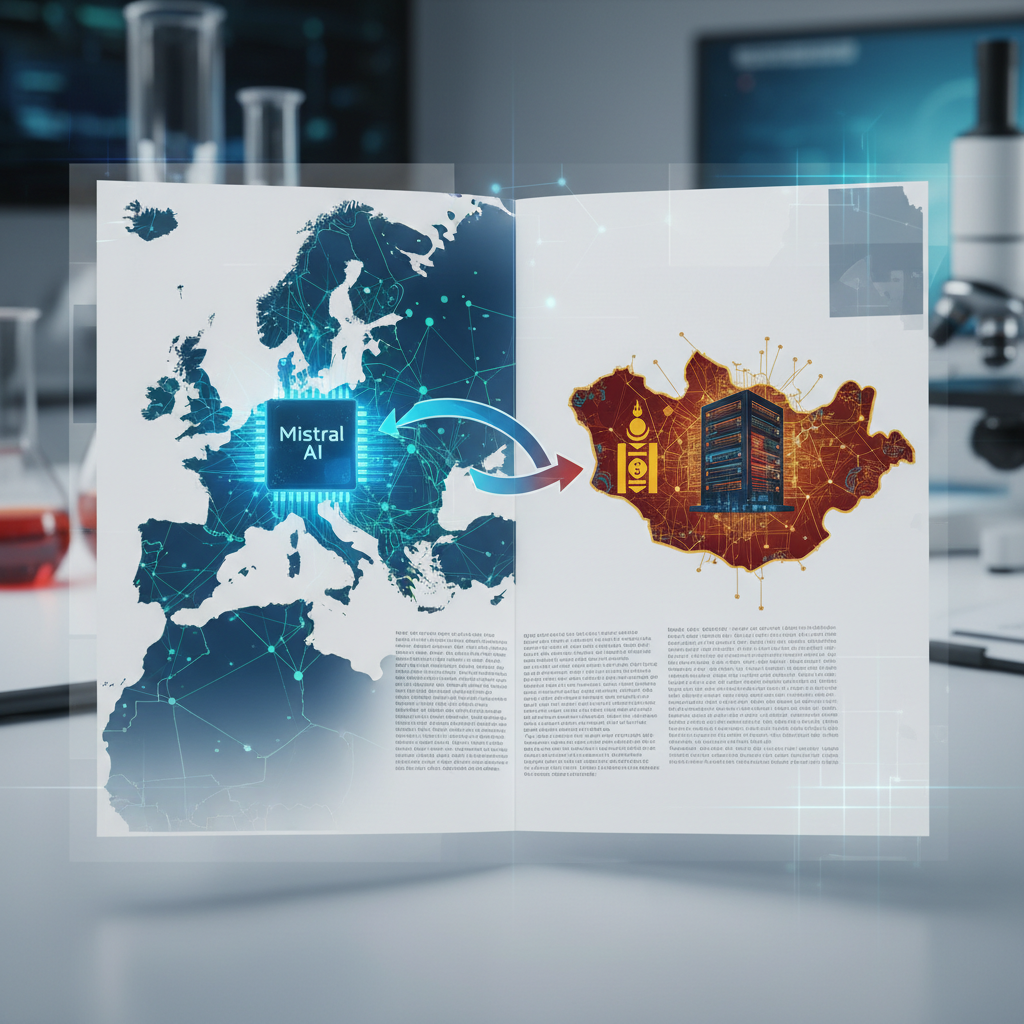
The wind whips across the steppe, carrying the scent of juniper and distant herds. It’s a familiar feeling, this vastness, this sense of being both connected and profoundly isolated. Here in Mongolia, we understand the value of independence, of charting our own course. So when I look at the global AI landscape, dominated by a few colossal players from Silicon Valley, I can’t help but see a similar struggle for sovereignty playing out on a digital frontier. This is where Mistral AI, the European startup, enters the picture, offering a compelling alternative to the closed-door approach of companies like OpenAI and Google.
For too long, the narrative around advanced AI has been dictated by a handful of American tech giants. Their large language models, while powerful, operate as black boxes. We feed them data, they give us answers, but the inner workings, the biases, the very control over the technology, remains largely opaque and firmly in their hands. This creates a dependency that many nations, including those far from the bustling tech hubs, are starting to question. What happens if their priorities diverge from ours? What if their models reflect cultural norms that don't align with our own?
This is the core of the 'sovereign AI movement,' a push for nations and regions to develop and control their own AI capabilities. And Mistral AI, founded by former researchers from Google DeepMind and Meta, has positioned itself as a leading force in this movement, particularly for Europe. Their recent research breakthrough, detailed in a paper titled 'Mixtral 8x22B: A Sparse Mixture of Experts for Efficient and Open Language Models,' published just last month, is a significant step in this direction. It's not just about building powerful models, it's about building them differently.
The Breakthrough in Plain Language
Imagine you have a team of eight incredibly smart specialists, each an expert in a different field. When you ask a question, instead of having one generalist try to answer everything, you send your question to a 'router' that quickly identifies the two most relevant specialists. Those two experts then collaborate to give you the best possible answer. That's essentially what Mistral AI has done with Mixtral 8x22B. It’s a 'Mixture of Experts' (MoE) model, but with a crucial twist: it's sparse. This means that for any given piece of information, only a small fraction of the model's total parameters are activated. Think of it like a highly efficient parliamentary system where only the most relevant committees convene for each specific issue, rather than the entire body debating every single point.
This sparsity is a game-changer. Traditional large language models, like OpenAI's GPT series or Google's Gemini, activate almost all their parameters for every task, demanding immense computational power. Mixtral 8x22B, by selectively activating only 2 of its 8 'expert' networks per token, achieves comparable performance to much larger, denser models while requiring significantly less computational resources for inference. This isn't just a technical detail; it's a practical innovation with profound implications for accessibility and cost.
Why It Matters, Especially for Mongolia
For a country like Mongolia, where infrastructure can be challenging and resources are often stretched thin, the efficiency of Mixtral 8x22B is not just interesting, it's vital. Less computational power means lower energy consumption, reduced hardware costs, and faster deployment. This makes advanced AI models more attainable for local businesses, research institutions, and even government services. We don't have the luxury of endless data centers or the budget to compete with Silicon Valley's GPU farms. Practical innovation is what moves us forward.