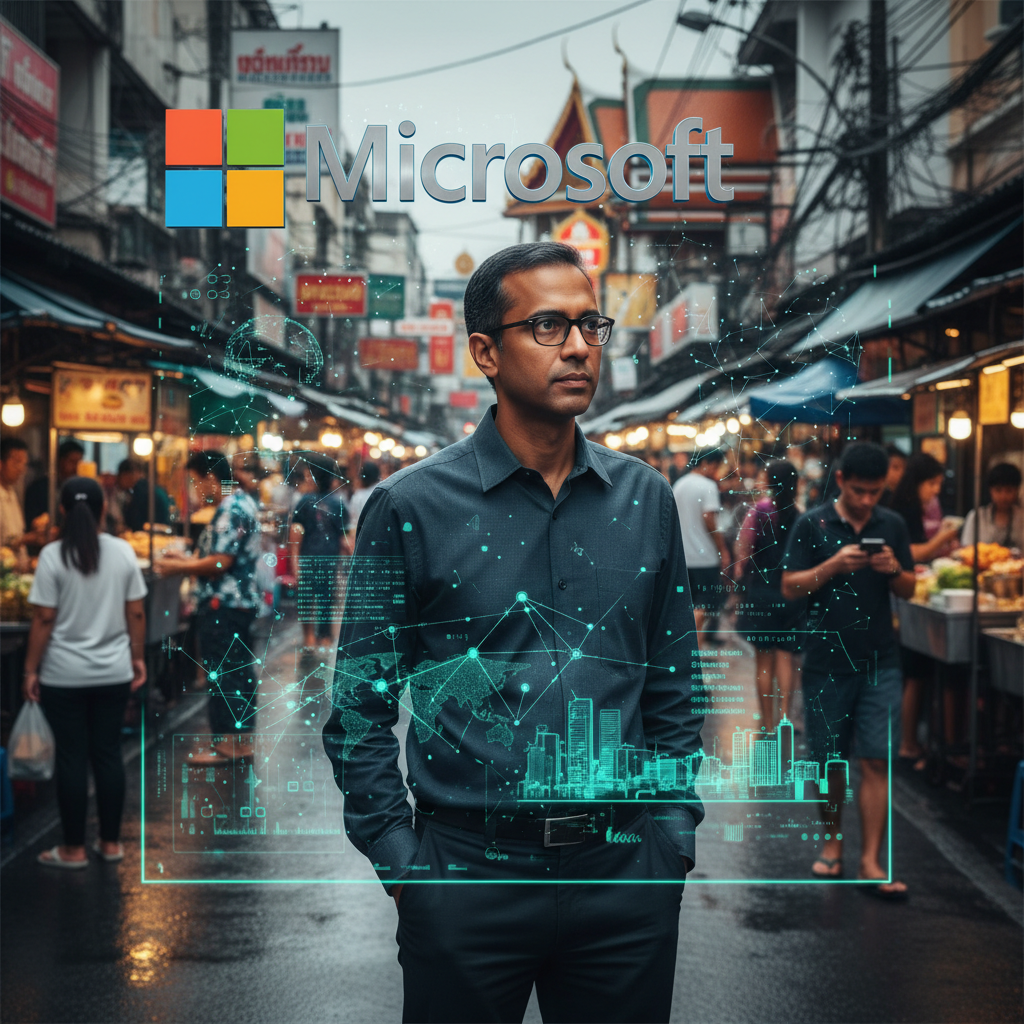

Let me tell you, sometimes I look at these tech giants and think, 'Are they even playing the same game as the rest of us?' One minute, Microsoft is that dependable, slightly boring uncle who always brings a fruit basket to the family gathering. The next, under Satya Nadella, they are doing a full-on ramwong dance, twirling their way to a market capitalization that makes your head spin faster than a tuk-tuk on Sukhumvit Road. We are talking about numbers so big, they almost become abstract, like trying to count grains of sand on Patong Beach. But here is the thing: this isn't just a rich company getting richer. Nadella's AI-first strategy, and the subsequent surge in Microsoft's valuation, is a seismic shift that is sending ripples all the way to our corner of the world, whether we are ready for it or not.
Why Most People Are Ignoring This (The Attention Gap)
Most folks here in Thailand, bless their pragmatic hearts, are probably more concerned with the price of pad krapow or the latest traffic jam on Ratchadapisek than with Microsoft's stock performance. And honestly, who can blame them? The tech news cycle is a relentless beast, spitting out new acronyms and buzzwords faster than a street vendor can fry up a fresh batch of spring rolls. 'AI-first strategy' sounds like something for the suits in glass towers, not for the farmers in Isaan or the artisans in Chiang Mai. We see the headlines, perhaps a blurb on our phones, but the sheer scale of what is happening, the fundamental retooling of a global tech behemoth around artificial intelligence, often gets lost in the daily grind. It is easy to dismiss it as 'just another Silicon Valley thing,' a distant drumbeat that won't reach our shores. But that, my friends, is where the absurdity lies. This drumbeat is already here, humming beneath the surface of our digital lives.
How It Affects YOU (Personal Impact on Readers)
Think about it. Are you using Microsoft 365 at work? Congratulations, your documents, your emails, your presentations are increasingly getting an AI makeover. Copilot, Microsoft's AI assistant, is not just a fancy spell-checker anymore. It is writing drafts, summarizing meetings, and analyzing data. For some, this is a godsend, freeing up time for more creative tasks, or perhaps a longer lunch break to enjoy some som tum. For others, it is a looming question mark: if AI can do half my job, what is left for me? This isn't just about corporate productivity, it is about the fundamental nature of work itself. Your kids, if they are in school, might soon be using AI-powered learning tools developed with Microsoft's tech. If you are a small business owner, perhaps using cloud services, you are already benefiting, or soon will be, from the efficiencies AI brings, whether it is optimizing inventory or personalizing customer service. The Land of Smiles has a new expression because it's called 'disruption', and it is coming to a workplace near you, powered by Redmond's finest.
The Bigger Picture (Societal, Economic, or Political Implications)
Economically, Microsoft's AI dominance, alongside other giants like Google and OpenAI, means a concentration of power. Countries like Thailand, which are still developing their own AI ecosystems, face a choice: become consumers of foreign AI, or build their own. The Thai government, for its part, has been pushing for digital transformation, recognizing the potential of AI in sectors from agriculture to tourism. Imagine AI-powered chatbots helping tourists navigate Bangkok's labyrinthine alleys, or AI optimizing crop yields for our rice farmers. This is Thai-style innovation, leveraging global tools for local benefit. However, there are also concerns about data sovereignty, ethical AI use, and ensuring that the benefits of AI are distributed equitably, not just enriching a select few. Politically, the influence of companies wielding such advanced technology can be immense, shaping everything from national security to public discourse. It is a delicate balance, like walking a tightrope over a bustling night market.
What Experts Are Saying (3-4 Expert Perspectives)
Leading voices in the tech world have been vocal about Microsoft's trajectory. "Satya Nadella has masterfully pivoted Microsoft, transforming it from a software behemoth into an AI powerhouse," observed Amy Hood, Microsoft's Chief Financial Officer, during a recent earnings call. "Our strategic investments in AI are driving unprecedented growth across all our segments." This sentiment is echoed by many analysts. "Microsoft's deep integration of OpenAI's models, particularly GPT, into their Azure cloud services and productivity suite has created an almost unassailable competitive advantage," stated Dr. Lee Su-Jin, a professor of AI ethics at the National University of Singapore, in a recent online seminar. "They are not just building AI; they are embedding it into the very fabric of enterprise computing." Closer to home, Dr. Prapasri Thanasukarn, a prominent Thai AI researcher, recently cautioned, "While Microsoft's advancements offer incredible tools, we must ensure that our local businesses and workforce are equipped to adapt, and that we develop our own AI talent to avoid simply being users, rather than creators, in this new era." This is a critical point for nations like Thailand, where the digital divide, though shrinking, still exists. And even Sam Altman, CEO of OpenAI, has spoken about the synergy, noting that Microsoft's infrastructure has been crucial in scaling their ambitious AI projects, calling it a "truly symbiotic partnership" in a past interview.
What You Can Do About It (Actionable Takeaways)
So, what is a regular person, or a small business in Thailand, to do amidst all this AI-fueled corporate drama? First, educate yourself. Understand what AI is, and more importantly, what it isn't. Don't fall for the hype or the fear. Explore how AI tools, like those offered by Microsoft, can genuinely improve your work or business. Many of these tools have free tiers or trials. Second, advocate for responsible AI development and deployment. Support policies that prioritize ethical considerations, data privacy, and upskilling for workers whose jobs might be impacted. Third, encourage local innovation. We have brilliant minds here in Thailand, from our universities to our burgeoning startup scene. Investing in and nurturing homegrown AI talent and companies is crucial for our long-term digital sovereignty. Only in Bangkok, or anywhere in Thailand, can we truly shape our own AI future, not just passively receive it.
The Bottom Line (Why This Will Matter in 5 Years)
In five years, the idea of using a computer or a smartphone without pervasive AI assistance will feel as quaint as trying to find your way around Bangkok with only a paper map. Microsoft, under Nadella's vision, isn't just selling software anymore; they are selling intelligence, baked into every digital interaction. This means more personalized experiences, more automated tasks, and potentially, a significant shift in the skills required for the workforce. For Thailand, this translates to both immense opportunity and pressing challenges. We can leverage these powerful tools to boost our economy, enhance our world-renowned tourism, and even preserve our rich cultural heritage through digital means. But we must also be vigilant, ensuring that this technological tide lifts all boats, not just the biggest yachts. The future of work, creativity, and even how we order our next bowl of boat noodles might just be decided by the strategic bets made today in Redmond, and how we choose to respond to them here in the Land of Smiles. It is a fascinating, slightly terrifying, and utterly unavoidable future, and it is already knocking on our digital door.