The world of artificial intelligence, much like the intricate gears of a finely tuned Japanese clock, operates with a delicate balance of innovation, competition, and strategic maneuvering. Recently, however, a seismic event occurred that has many questioning the very structure of this mechanism: the effective absorption of Inflection AI's entire founding team, including CEO Mustafa Suleyman, into Microsoft.
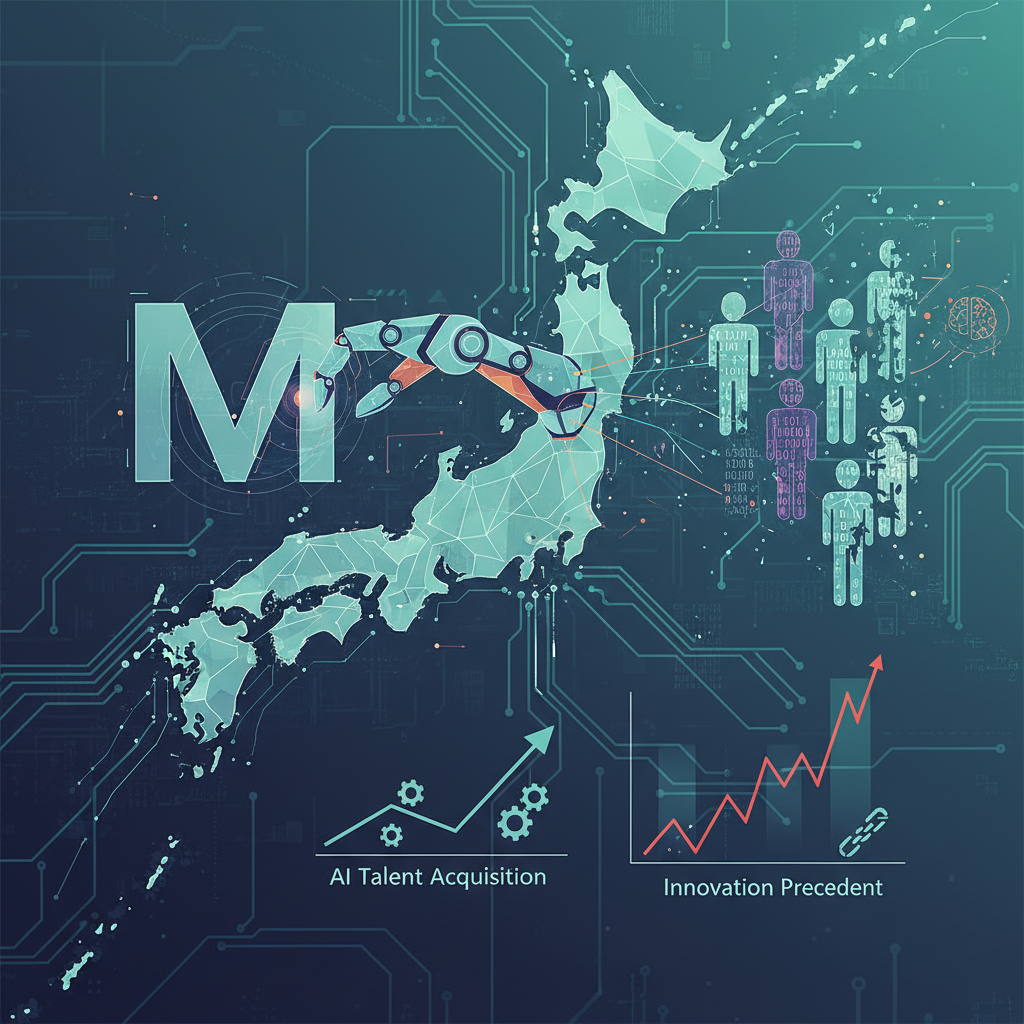
This was not a traditional acquisition, but a talent transfer of unprecedented scale, reportedly valued at around $650 million for licensing Inflection's technology and hiring its key personnel. It prompts a critical inquiry: Is this a new blueprint for AI talent acquisition, a necessary evolution in the hyper-competitive AI arms race, or a dangerous precedent that stifles the very innovation it purports to accelerate?
To understand the gravity of this event, we must first consider its historical context. Japan has been quietly building and refining its technological capabilities for decades, often through a meticulous process of incremental improvement and strategic partnerships. Our industrial landscape, particularly in robotics and precision manufacturing, thrives on both fierce internal competition and collaborative ventures. Yet, the Inflection AI scenario presents a different paradigm, one where a major player essentially dismantles a promising startup to integrate its human capital.
Inflection AI, co-founded by Mustafa Suleyman, Karén Simonyan, and Reid Hoffman, emerged with a distinct vision: to create deeply personalized AI, often referred to as a “personal AI” or “PI.” Their flagship product, Pi, aimed to be a compassionate and helpful conversational AI, a stark contrast to the more utilitarian or knowledge-focused models prevalent elsewhere. With an impressive $1.3 billion funding round in 2023, including investments from NVIDIA and Microsoft, Inflection was seen as a formidable contender in the foundational model space. Its valuation was reportedly around $4 billion, making its dissolution as an independent entity all the more striking.
The immediate impact of Microsoft's move is clear. Satya Nadella, Microsoft's CEO, has secured a significant infusion of top-tier AI talent and intellectual property. Mustafa Suleyman, now CEO of Microsoft AI, brings not only his technical acumen but also his leadership experience from Google DeepMind. This strategic hiring spree, which saw approximately 70 Inflection employees join Microsoft, effectively positions Microsoft to accelerate its consumer AI initiatives and further integrate AI across its product suite, from Copilot to Windows. "We've been deeply impressed by Mustafa's vision and the team's ability to execute," Nadella stated in a recent internal memo, highlighting the perceived value of this talent acquisition.
However, the long-term implications are far more complex. For startups, particularly in the AI domain, the promise of independent innovation and the potential for a disruptive exit are powerful motivators. When a company with significant funding and a unique product like Inflection AI is effectively absorbed, it sends a mixed message. On one hand, it validates the talent and technology within the startup. On the other, it suggests that the path to scaling and achieving impact might increasingly lead to assimilation by a larger entity, rather than sustained independence.
Dr. Hiroaki Kitano, CEO of Sony AI and a leading voice in artificial intelligence research, expressed a nuanced view. "The engineering is remarkable, undoubtedly, to attract such attention from a giant like Microsoft," he observed in a recent interview with Reuters. "However, the ecosystem relies on diverse approaches and independent research. When too many bright minds consolidate under one roof, even a very large one, the breadth of exploration might inadvertently narrow. Precision matters in scientific discovery, and sometimes that precision benefits from multiple, distinct lenses." His words echo a concern that a monoculture of AI development, dominated by a few large corporations, could lead to a reduction in creative diversity.
Data from CB Insights indicates a trend of increasing M&A activity in the AI sector, with a notable uptick in talent acquisitions. While specific figures for 2026 are still emerging, the pattern from 2023 and 2024 showed major tech companies actively acquiring smaller AI firms, often for their specialized teams and proprietary models. This phenomenon is not entirely new; the tech industry has a history of acqui-hires. However, the scale and public nature of the Inflection AI event, particularly given its substantial prior funding, mark a distinct shift.
Consider the perspective of venture capitalists. Reid Hoffman, a co-founder of Inflection AI and a prominent venture capitalist, commented on the situation, emphasizing the need for talent to be deployed where it can have the greatest impact. "In the current AI landscape, speed and scale are paramount," Hoffman told TechCrunch. "This move ensures that Inflection's innovations and, more importantly, its exceptional team, can accelerate their work with the resources of Microsoft. It's about impact at scale." While this perspective highlights the pragmatic realities of the AI race, it also implicitly acknowledges the immense resource disparity between startups and tech giants.
From a Japanese perspective, where long-term vision and corporate stability are highly valued, this rapid absorption might seem both efficient and somewhat unsettling. Our corporate culture often favors nurturing internal talent and fostering long-term, stable growth, rather than such swift, large-scale external integrations. Yet, Japan has also experienced its share of strategic partnerships and consolidations in the face of global competition, particularly in semiconductors and electronics. The fundamental question remains: Does this type of consolidation lead to a stronger, more resilient industry, or does it merely centralize power and risk, like concentrating all the water in a single, large reservoir, making it vulnerable to a single crack?
My verdict leans towards cautious optimism, tempered by a significant concern for the broader innovation ecosystem. While Microsoft gains immediate, tangible benefits, the trend itself could be a double-edged sword. On one hand, it allows for the rapid deployment of advanced AI capabilities, potentially accelerating breakthroughs that benefit society. On the other hand, it raises barriers for new entrants. The capital requirements for training large language models are astronomical, and if the most promising teams are consistently drawn into the orbit of a few behemoths, the entrepreneurial spirit that fuels disruptive innovation could wane.
The analogy of a bonsai tree comes to mind. A master gardener carefully prunes and shapes the tree, guiding its growth to achieve a specific, beautiful form. However, if all trees were pruned by the same hand, following the same vision, the forest would lose its natural diversity and resilience. Similarly, the AI landscape requires a rich diversity of approaches, philosophies, and organizational structures to truly flourish. The Inflection AI development is a powerful reminder that while the pursuit of scale and talent is relentless, the health of the entire ecosystem depends on preserving space for independent thought and unconventional paths. This is a trend DataGlobal Hub will continue to monitor with great interest, particularly as its implications unfold across Asia and beyond, shaping the future of robotics and intelligent systems. The question is not just who builds the next great AI, but how many distinct visions are allowed to compete for that future. Microsoft's Inflection Gambit: A Talent Grab or a Strategic Retreat in the AI Arms Race? [blocked]