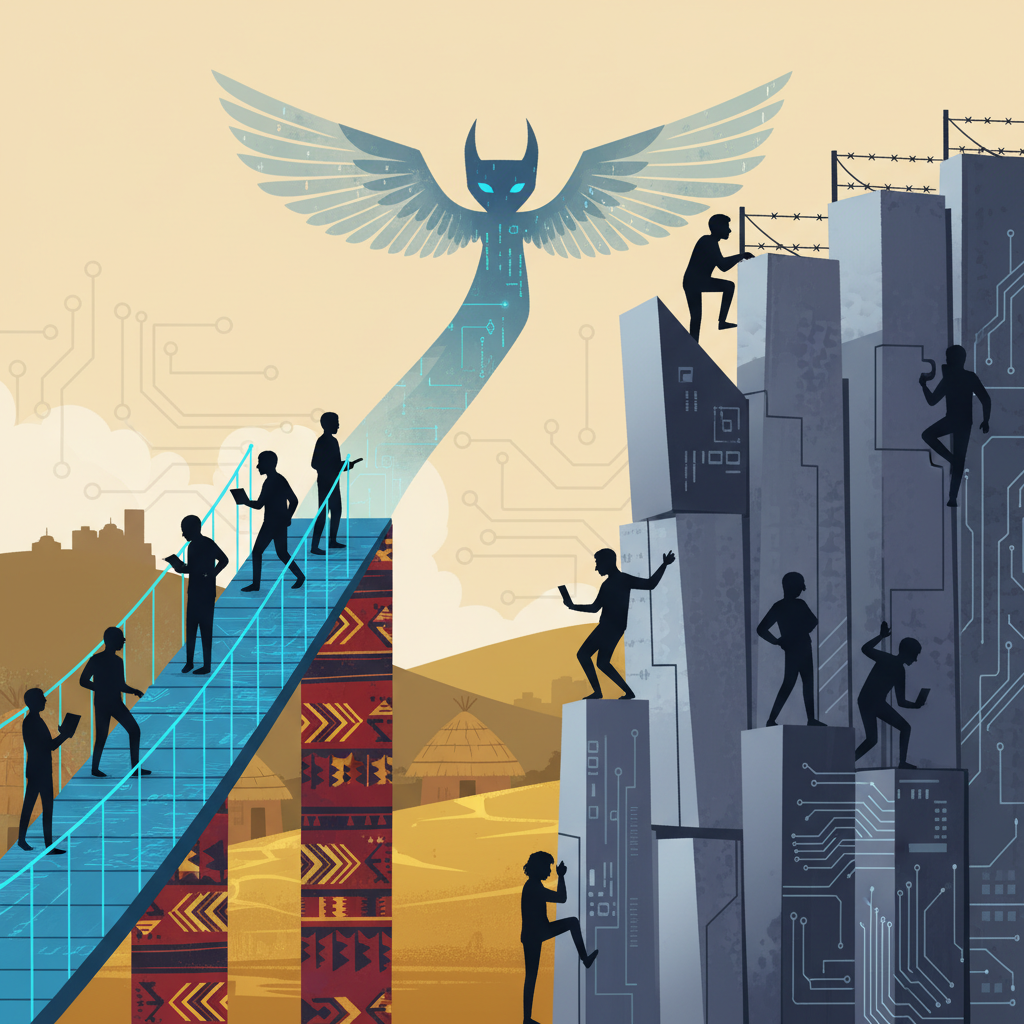

The sun rises over the Lubombo Mountains, painting the sky with hues of orange and purple, much like the vibrant patterns of our traditional lihiya. Here in Eswatini, life moves with a rhythm tied to the land and the community. We are a small nation, yes, but our hearts beat with big dreams, especially when it comes to technology. So, when I hear about tools like Microsoft's GitHub Copilot, my mind immediately jumps to our young people, the bright sparks in places like the Eswatini National University and the Limkokwing University of Creative Technology, who are eager to code their way to a brighter future.
GitHub Copilot, for those who haven't yet dipped their toes into the swirling waters of AI assisted coding, is essentially an AI pair programmer. It sits there, watching you type, learning your patterns, and then, with an almost uncanny intuition, suggests lines of code, entire functions, or even complex algorithms. Microsoft, through its partnership with OpenAI, has poured significant resources into this tool, promising to boost productivity, reduce boilerplate code, and ultimately, democratize software development. The idea is that it frees developers from the mundane, allowing them to focus on the truly creative and problem-solving aspects of their work. It sounds wonderful, doesn't it, like a digital umhlanga reed, ready to be shaped into something beautiful and useful?
But here is where my journalist's heart, and my Swazi perspective, begins to ask difficult questions. Is this tool truly a universal boon, or does it inadvertently create new barriers for those of us in emerging economies? My clear position is this: while GitHub Copilot offers undeniable efficiencies for experienced developers in well-resourced environments, its widespread adoption risks deskilling junior developers and exacerbating the digital divide, particularly in nations like Eswatini where foundational coding skills are still being nurtured.
Think of a young graduate from our local universities, perhaps someone who has just spent four years grappling with Python or Java, learning the logic, the syntax, the art of debugging. They are ready to build, ready to innovate. Then they encounter Copilot. Suddenly, much of the scaffolding that helps build understanding, the trial and error, the deep dive into documentation, is bypassed. The AI offers solutions, often elegant ones, but without the struggle, does the true understanding take root? It is like being given a perfectly woven lukhuni basket without ever learning to weave the reeds yourself. You have the product, but not the skill, not the knowledge of its making.
Satya Nadella, Microsoft's CEO, has often spoken about empowering every person and every organization on the planet to achieve more. He's a visionary, no doubt. But I worry about the 'how'. When he says, as he did in a recent interview, that "AI is going to change every category of software, starting with how developers build software," I hear the promise, but I also hear the potential for disruption that might not always be equitable. The transformation is real, and it is happening at a dizzying pace, as reported by outlets like The Verge.
Some might argue that Copilot is merely a tool, no different from an advanced IDE or a powerful search engine. They would say it accelerates learning, allowing beginners to see best practices and complex patterns they might not discover on their own. They might point to the fact that it frees up time for more creative problem-solving, which is a skill that Eswatini desperately needs to cultivate. "It's a force multiplier," I've heard some argue, "not a replacement for human ingenuity." And indeed, for a seasoned developer, it can be precisely that, a powerful assistant that takes care of the repetitive tasks, allowing them to architect grander solutions. This is the argument I hear from many in Silicon Valley, a place so far removed from the daily realities of our kingdom.
However, I counter this by asking: what happens when the foundation is weak? If our young developers rely too heavily on Copilot from the outset, will they truly develop the rigorous problem-solving skills and deep understanding of computer science principles that are essential for true innovation? The risk is that they become proficient users of AI-generated code, rather than master creators of it. In Eswatini, we say 'a person is a person through other people', and I believe AI should learn this lesson. True growth comes from interaction, from struggle, from building knowledge brick by brick, not from having the wall appear fully formed.
Moreover, there is the issue of context. Copilot is trained on a vast ocean of code, much of it reflecting the problems and solutions prevalent in the global north. Will it be as effective in generating solutions for the unique challenges faced by our communities, such as developing low-bandwidth applications for rural areas, or creating software that integrates seamlessly with our local languages and cultural nuances? The biases inherent in training data are a constant concern in AI, and code is no exception. As Wired has often highlighted, these biases can have real-world impacts.
This is not to say that we should shun such powerful tools. Far from it. But our approach must be deliberate and thoughtful. We need to integrate tools like Copilot into our educational curricula in a way that enhances learning, rather than short-circuiting it. We must teach our students how to critically evaluate AI-generated code, how to understand its limitations, and how to use it as a springboard for their own original thought, not as a crutch. Perhaps we could even use it to accelerate our own local data collection and model training, to build a 'Copilot waSwati' that understands our unique needs and languages.
We must also remember that access remains a huge hurdle. While Microsoft offers Copilot as a subscription service, even a small monthly fee can be a significant barrier for students and emerging developers in Eswatini. The digital infrastructure, the reliable internet access, and the powerful computing resources needed to run such tools smoothly are not always readily available across our nation. This tiny kingdom has big ideas about technology, but those ideas need fertile ground to grow.
My hope is that as these AI tools evolve, companies like Microsoft will consider the global implications more deeply. They have the power, and I believe, the responsibility, to ensure that their innovations genuinely empower everyone, not just those already at the forefront of technological advancement. Let us not create a future where the ability to code becomes a mere prompt-engineering exercise, especially for the next generation of innovators in places like Eswatini. We need creators, not just consumers, of technology. We need our young people to be the architects of their digital destiny, not just the users of someone else's blueprint. The transformation of software development is upon us, but let us ensure it is a transformation that lifts all boats, not just the largest ships in the harbor.