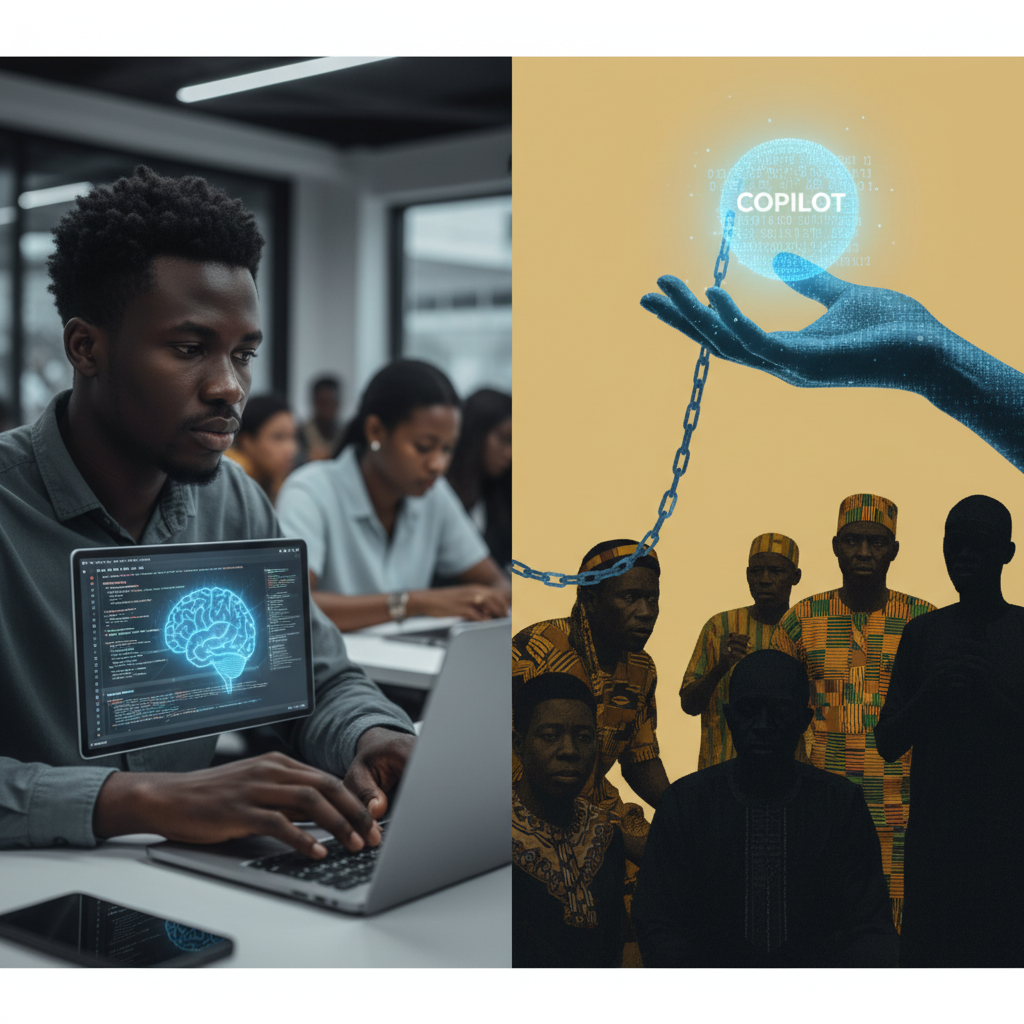

The drumbeat of technological progress often arrives in our villages with the fanfare of a new harvest, promising abundance and ease. Yet, as a journalist from Guinea, I have learned to approach such pronouncements with a healthy skepticism, much like examining the true yield of a crop after the initial boasts. The latest global sensation, Microsoft's GitHub Copilot, is no different. Heralded as an AI pair programmer, it claims to transform software development, making coding faster and more accessible. But here's the catch: for whom, and at what cost to those of us in the Global South?
Globally, the narrative is largely one of unbridled optimism. Tech giants like Microsoft, with their immense resources, position Copilot as a democratizing force, a tool that empowers developers to write code with unprecedented speed. Indeed, a recent study published in MIT Technology Review suggested that developers using Copilot completed tasks 55% faster than those without it. This efficiency gain is certainly attractive, particularly in a world where digital transformation is paramount. The allure is undeniable, especially for startups and established firms looking to cut development cycles and costs.
However, my investigations always lead me to ask: what does this mean for places like Conakry, where our tech sector is still finding its footing? We are not Silicon Valley. Our challenges are distinct, our resources often limited, and our priorities sometimes diverge from the global North's. The promise of Copilot is that it will empower developers, but I dug deeper and found something troubling. The underlying models, trained on vast datasets of public code, predominantly reflect coding paradigms and problem sets from Western contexts. While code is ostensibly universal, the application and context of that code are deeply cultural and economic.
Consider the perspective of Fatoumata Diallo, a lead developer at Guinean Innovations, a burgeoning tech hub in Kaloum. "Copilot is a powerful tool, yes," she conceded during our recent conversation, her eyes reflecting the city's vibrant energy. "But it often suggests solutions that are over-engineered for our infrastructure, or it struggles with the nuances of integrating with local payment gateways and mobile money systems, which are critical here. We spend time refactoring, not just accepting. It feels like learning a new language by speaking only to a dictionary, without understanding the local proverbs." Her point is salient: efficiency is not merely about lines of code, but about relevant, context-aware solutions.
The economic implications are also a significant concern. While Copilot might boost productivity for individual developers, what happens to the broader ecosystem of junior developers and those still learning? In Guinea, as in many African nations, the journey into tech often begins with foundational coding skills, meticulously learned and practiced. If an AI can generate boilerplate code or even complex functions, does it devalue the learning process? Does it create a dependency that stifles true innovation and problem-solving skills, particularly for those without access to premium subscriptions or robust internet connectivity?
Dr. Mamadou Bah, a prominent economist and digital policy advisor to the Guinean Ministry of Digital Economy, Telecommunications and Innovation, expressed his reservations. "We must be wary of solutions that appear to accelerate progress but inadvertently create new forms of digital dependency," he stated emphatically. "Our goal is to build sovereign technological capabilities, not just to become consumers of foreign-made tools. If our developers become overly reliant on AI for basic coding, will they truly understand the underlying logic? Will they be able to innovate independently when the AI fails, or when its terms of service change? This is not merely a technical question; it is a question of national digital sovereignty." His words echo a growing sentiment across the continent, where nations are increasingly asserting their right to define their own digital futures.
The devil is in the details, as they say, and with Copilot, those details involve intellectual property and data privacy. Microsoft assures users that their code remains private, but the very act of using a cloud-based AI tool for code generation raises questions. For Guinean companies developing proprietary solutions, especially in sensitive sectors like finance or healthcare, the thought of their intellectual assets passing through external servers, however briefly, is a non-starter. "The trust factor is paramount," explained Aminata Cissé, a cybersecurity expert based in Dakar, Senegal, whose work frequently touches upon these issues. "For many African businesses, the data governance laws of a foreign entity, even one as reputable as Microsoft, are simply not equivalent to local regulations, nor do they align with our strategic interests in data localization." This concern is not unique to Guinea; it is a continent-wide discussion.
Furthermore, the ethical considerations surrounding the training data for these large language models cannot be ignored. If Copilot was trained on code that contains biases, or even vulnerabilities, those characteristics could be propagated into newly generated code. This is a subtle but insidious form of algorithmic colonialism, where the imperfections and biases of one context are transplanted into another, often without critical examination. We have seen similar issues arise with other AI applications, and code generation is no exception.
While the global tech community celebrates the advancements brought by tools like GitHub Copilot, it is imperative that we in Guinea, and indeed across Africa, approach these innovations with a discerning eye. We must demand transparency, advocate for localized training data, and prioritize the development of our own indigenous AI capabilities. The future of software development in Guinea should be shaped by our needs, our ingenuity, and our unique challenges, not solely by the algorithms of distant tech giants. We must ensure that these powerful tools serve us, rather than inadvertently dictating our technological destiny. The path to true digital transformation in Guinea lies not in passive consumption, but in active, critical engagement and sovereign innovation. For more on how African nations are navigating the AI landscape, you might find this article on KenteCode AI [blocked] insightful.