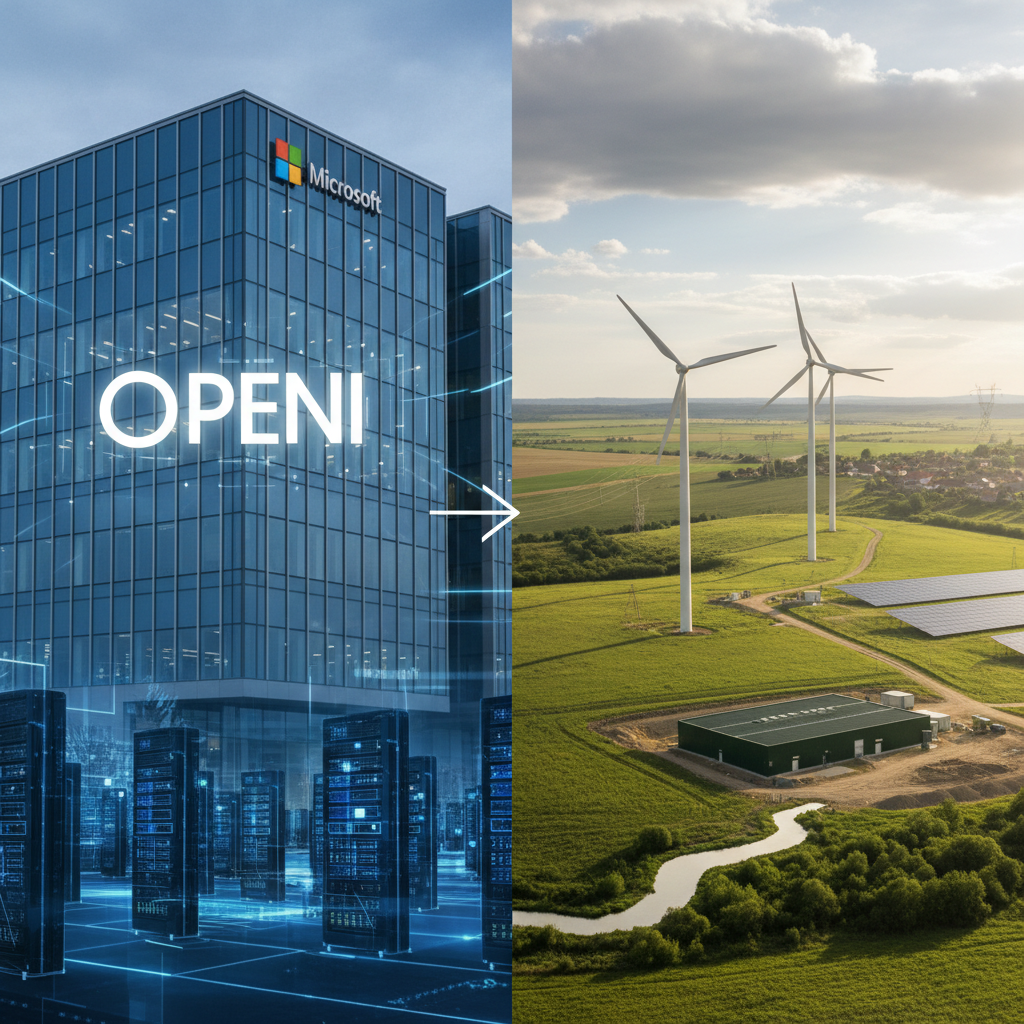

The digital whispers of artificial intelligence have grown into a deafening roar, promising to reshape industries, economies, and even the very fabric of our societies. At the epicenter of this seismic shift stands Microsoft, whose reported $13 billion investment into OpenAI has been lauded as a masterstroke, a strategic maneuver solidifying its position in the AI arms race. Yet, as a journalist from Romania, I cannot help but view these grand pronouncements through a lens of skepticism, particularly when considering the tangible, often overlooked, consequences for nations striving for sustainable development. Is this colossal bet truly paying off for the planet, or are we merely witnessing a new form of digital colonialism, demanding ever more resources from the periphery?
The narrative spun by the tech giants often focuses on the transformative power of AI for climate solutions, from optimizing energy grids to designing more efficient materials. Indeed, Microsoft itself has pledged to be carbon negative by 2030, a commendable goal. However, the energy appetite of large language models, the very core of OpenAI's offerings, is staggering. Training and running models like GPT 4 demand immense computational power, which translates directly into vast electricity consumption. This is where the story becomes less about innovation and more about infrastructure, particularly in regions like Eastern Europe.
Romania, with its burgeoning tech sector and a strategic push towards renewable energy, finds itself at a critical juncture. The Romanian tech boom hides a darker story, one where the rapid expansion of data centers, often fueled by the promise of AI development and cloud services, places immense pressure on an aging energy grid. While the country has made significant strides in solar and wind power, with renewables accounting for a substantial portion of its energy mix, the sheer, unyielding demand from AI operations threatens to outpace these efforts. According to a recent report by the International Energy Agency, global data center electricity consumption is projected to double by 2030, a trajectory heavily influenced by AI workloads. This is not a distant problem; it is a present reality.
My investigation uncovered a concerning trend: the push for AI adoption in Europe, often spearheaded by initiatives leveraging Microsoft's cloud infrastructure and OpenAI's tools, rarely comes with a transparent accounting of its energy footprint at the local level. "We are seeing an unprecedented demand for data center capacity across Europe, driven largely by AI," stated Dr. Elena Petrova, a leading energy policy analyst at the European Commission, during a recent conference in Brussels. "While AI offers immense potential for climate action, we must address its own substantial energy requirements with robust, region specific strategies. The current trajectory is simply unsustainable without significant grid modernization and a faster transition to truly green energy sources." Her words echo a growing concern among European policymakers.
Consider the practical implications for a country like Romania. The government, through its National Recovery and Resilience Plan, has allocated substantial EU funding towards digital transformation and green energy projects. Follow the EU funding trail, and you will find millions directed towards upgrading digital infrastructure, including data centers. But are these investments truly aligning with our climate goals if the underlying AI technologies are consuming energy at an exponential rate, potentially forcing reliance on less sustainable sources during peak demand? This is a question that demands an answer, not just from Bucharest, but from Redmond.
Microsoft's partnership with OpenAI is not merely a financial transaction; it is a deep technological integration. OpenAI's models are deployed on Microsoft's Azure cloud platform, meaning that the energy consumption of these powerful AI systems is directly tied to Azure's operations. While Microsoft has invested heavily in renewable energy procurement globally, including significant power purchase agreements, the localized impact in regions hosting these data centers can be profound. The energy required to cool massive server farms, for instance, adds another layer of complexity and consumption.
I spoke with Professor Mircea Popescu, a computational physicist at the Politehnica University of Bucharest, who has been vocal about the environmental costs of unchecked AI growth. "The allure of AI is powerful, almost hypnotic, but we must not ignore the physical reality of its existence," Professor Popescu explained. "Each query to a large language model, each training cycle, translates into electrons flowing through circuits, generating heat, and ultimately, demanding energy. For countries like ours, where energy security and decarbonization are paramount, this is not an abstract concept. It is a direct challenge to our national strategy." His perspective highlights the tension between technological advancement and environmental responsibility.
Furthermore, the promise of AI for climate tech itself needs scrutiny. While AI can optimize wind turbine placement or predict weather patterns for agriculture, the deployment and maintenance of these solutions also require energy. It is a complex feedback loop. Are the energy savings generated by AI climate solutions truly outweighing the energy consumed by the AI infrastructure itself? This is a critical metric that is often absent from the glossy corporate reports. The European Union, through its AI Act, has begun to address some of the ethical and regulatory challenges of AI, but the environmental footprint remains an area requiring far more stringent oversight and transparency.
For Romania, the situation is particularly acute. We are not merely consumers of global tech trends; we are also a hub for IT outsourcing and a growing destination for data center investments. This means we are both beneficiaries and, potentially, victims of AI's voracious appetite. The opportunity to leverage AI for our own green transition is undeniable, from optimizing our agricultural sector to enhancing the efficiency of our industrial processes. However, this must be done with a clear understanding of the energy trade-offs. The notion that AI is a magic bullet for climate change, without acknowledging its own resource demands, is a dangerous delusion.
Ultimately, the question of whether Microsoft's $13 billion OpenAI investment is paying off cannot be answered solely by looking at market capitalization or quarterly earnings. It must be evaluated through the lens of its broader societal and environmental impact. For countries like Romania, the true measure of success will be whether this investment accelerates our path to a sustainable, energy-independent future, or if it merely exacerbates our reliance on carbon-intensive energy sources to power the next generation of algorithms. The evidence, as it stands, suggests a precarious balance, one that demands far greater transparency and accountability from the tech giants shaping our digital destiny. We must ensure that the digital transformation does not come at the cost of our planet's future, particularly for those nations striving to build a greener tomorrow. The time for a thorough, independent audit of AI's environmental cost is now, before the digital revolution consumes more than it creates. For more on the intersection of AI and climate, see MIT Technology Review. For broader tech news, TechCrunch offers frequent updates. The environmental impact of data centers is a global concern, and Reuters often covers these developments. You can also read about the broader implications of AI regulation in Europe in our article on global AI transparency laws [blocked].