The scent of freshly baked non, warm and inviting, often reminds me of the simple yet profound power of shared resources. Just as a good recipe passed down through generations enriches our tables, the open sharing of knowledge can transform societies. Today, a similar spirit is brewing in the world of artificial intelligence, a movement that promises to bring unprecedented change to places like my home, Uzbekistan, and indeed, all of Central Asia.
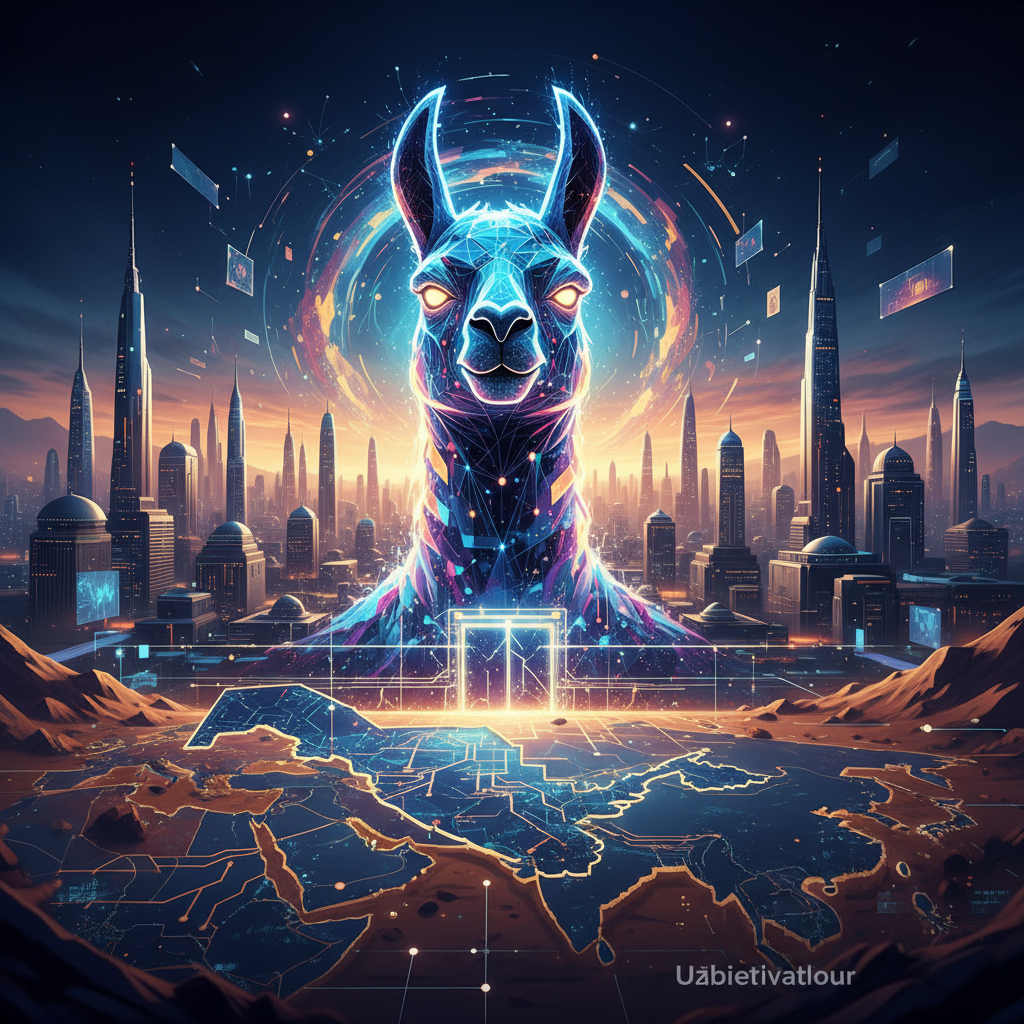
For too long, the cutting edge of AI felt like a distant peak, guarded by giants in Silicon Valley. Companies like OpenAI and Google, with their formidable closed models such as GPT and Gemini, held the keys to immense computational power and sophisticated algorithms. Their innovations were breathtaking, certainly, but often felt like a one-way street, where we consumed rather than created. Now, Meta, with its Llama series of models, is changing that narrative, throwing open the gates to a treasure trove of AI capabilities. This isn't just about code; it's about empowerment, about shifting the balance of power, and about fostering a digital renaissance in regions often overlooked.
Imagine a future, perhaps just five to ten years from now, where a young woman in Samarkand, inspired by the intricate patterns of her grandmother's suzani, uses a locally trained, open-source AI model to design textiles that blend ancient motifs with modern aesthetics. This AI, built upon a foundation like Llama, understands the nuances of Uzbek culture, speaks the Uzbek language fluently, and can even generate new patterns with a distinctly regional flair. This isn't a far-fetched dream; it is the logical progression of an open AI ecosystem.
How do we get to this vibrant future from where we stand today? The journey begins with access. When Meta decided to release its Llama models to the public, it was a pivotal moment. Unlike the proprietary black boxes of competitors, Llama's architecture and weights became available for researchers, developers, and even small startups to download, modify, and build upon. This act of generosity, or perhaps strategic foresight, has ignited a Cambrian explosion of innovation globally. In Uzbekistan, this means our burgeoning tech community no longer needs to wait for permission or pay exorbitant fees to experiment with state-of-the-art AI.
Key milestones on this path will be numerous and exciting. First, we will see the rise of specialized, localized Llama derivatives. Instead of a general-purpose AI trained primarily on English internet data, we will have models fine-tuned on vast datasets of Uzbek, Kazakh, Kyrgyz, Tajik, and Turkmen languages and cultural contexts. This will enable AI assistants that truly understand our proverbs, our humor, and our historical narratives. Consider the impact on education: imagine an AI tutor, fluent in Karakalpak, explaining complex physics concepts to a student in Nukus, adapting its teaching style to local pedagogical traditions. This is a powerful vision, and it is within reach.
Second, the cost barrier will dramatically lower. Running and developing on closed, proprietary models often involves significant API usage fees. With open models, while hardware costs remain, the intellectual property is free, allowing for more experimentation and deployment, especially for cash-strapped startups and academic institutions. This democratizes AI development, shifting it from being the exclusive domain of well-funded corporations to a tool accessible to anyone with a laptop and an idea. As Mark Zuckerberg, Meta's CEO, stated when discussing the company's AI strategy,