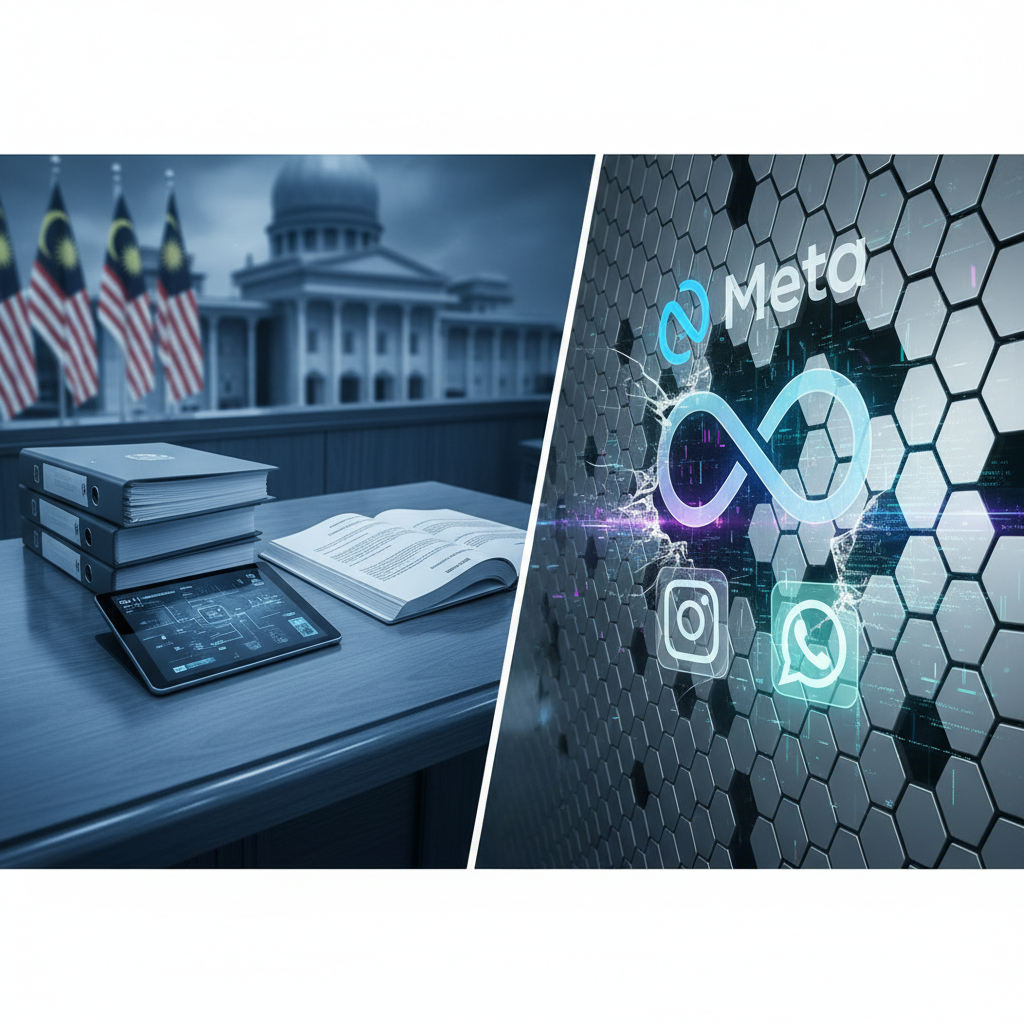

The digital landscape, much like the bustling pasar malam near my home in Shah Alam, is always evolving, always introducing something new and sometimes, a little overwhelming. Lately, the buzz isn't just about the latest durian season or a new hawker stall, but about Meta's ambitious push to integrate advanced AI chatbots directly into its ubiquitous platforms: WhatsApp, Instagram, and Messenger. This isn't a small experiment; it is a fundamental reshaping of how billions, including millions across Malaysia, interact online.
For many, these AI companions, powered by Meta's Llama models, are already a part of daily life. They can answer questions, summarize chats, generate images, and even help draft messages. It feels like having a personal assistant inside your phone, always ready to help. But beneath the surface of convenience and clever algorithms, a significant policy question looms large, particularly for nations like Malaysia: how do we govern these powerful, data-hungry AI entities that are now embedded in our most intimate communication channels?
The Policy Move: A Call for Digital Sovereignty
The policy move stirring discussions across Southeast Asia is not a single, grand piece of legislation, but rather a growing chorus of regulatory bodies and government agencies examining the implications of these AI integrations. In Malaysia, the Malaysian Communications and Multimedia Commission, or Mcmc, has been particularly vocal. Their concern centers on data privacy, content moderation, and the potential for algorithmic bias to impact our diverse society. The Mcmc, much like a meticulous mak cik preparing a traditional dish, wants to ensure every ingredient is safe and properly handled, especially when it comes to personal data.
Who is behind this scrutiny, and why? It is a combination of factors. Firstly, there is the sheer scale. WhatsApp alone boasts over two billion users globally, and Instagram is not far behind. When AI is embedded into platforms of this magnitude, its impact is amplified exponentially. Secondly, the nature of the data involved is deeply personal. Our chats, our photos, our interactions, these are the digital threads of our lives. The concern is that Meta's AI, designed to learn and improve, will inevitably process this data, raising questions about consent, data residency, and potential misuse.
“We recognize the immense potential of AI to enhance user experience,” stated Dr. Fadhlullah Suhaimi Abdul Malek, Chairman of the Mcmc, in a recent press conference. “However, this cannot come at the expense of our citizens' privacy and digital safety. We must ensure that AI models operating within our borders adhere to our data protection laws, such as the Personal Data Protection Act 2010, and respect our cultural sensitivities.” His words resonate with a broader regional sentiment for digital self-determination.
What It Means in Practice: Navigating a New Digital Frontier
In practice, this means that while Meta pushes its AI features globally, countries like Malaysia are scrutinizing the fine print. For users, it translates to questions about whether their conversations, even if processed by AI for internal improvements, remain truly private. For businesses, particularly small and medium enterprises (SMEs) that heavily rely on WhatsApp Business for customer interactions, it raises concerns about data security and compliance. Imagine a local batik seller using WhatsApp to discuss custom orders; how is that sensitive customer information handled by an AI that learns from every interaction?
Furthermore, the content generated by these AIs is another area of focus. Can an AI chatbot inadvertently spread misinformation or generate content that is culturally inappropriate or even offensive in Malaysia's multicultural, multi-religious context? The architecture is fascinating, but the societal implications are profound. Meta's Llama 3, for instance, has been trained on vast datasets, but these datasets may not fully capture the nuances of Bahasa Melayu slang, the subtleties of Chinese New Year greetings, or the specific etiquette of Hari Raya Aidilfitri. An AI that misunderstands a cultural reference could cause significant friction.
Industry Reaction: Balancing Innovation with Regulation
From the industry's perspective, Meta, like any tech giant, wants to innovate rapidly. They see AI as the next frontier for user engagement and monetization. Their public statements emphasize their commitment to responsible AI development, privacy safeguards, and user control. “We are building these AI experiences with privacy by design,” said Nick Clegg, Meta’s President of Global Affairs, in a recent interview with Reuters. “Users have control over their data and can choose whether or not to interact with our AI. We are also working closely with regulators worldwide to address their concerns.”
However, the pace of innovation often outstrips the pace of regulation. Local tech companies and startups in Malaysia are watching closely. Many are eager to integrate AI into their own services but are also wary of setting precedents that could lead to overly restrictive regulations. They understand that a balance must be struck. “We need clear guidelines that foster innovation without stifling it,” commented Dr. David Ng, CEO of a Malaysian AI startup specializing in natural language processing. “The goal should be to create a safe digital environment, not to build digital walls that isolate us from global advancements.”
Civil Society Perspective: Protecting the Vulnerable
Civil society organizations in Malaysia, particularly those focused on digital rights and consumer protection, view these developments with a healthy dose of skepticism. They are concerned about algorithmic bias, the potential for increased surveillance, and the impact on vulnerable populations. Groups like the Centre for Independent Journalism (CIJ) have highlighted the need for transparency and accountability from tech companies.
“The integration of powerful AI into platforms used by almost everyone in Malaysia demands robust oversight,” said WZ. Mukhriz, Executive Director of CIJ Malaysia. “We need independent audits of these AI systems to ensure they are not perpetuating biases, are not being used for mass surveillance, and that users, especially children, are adequately protected. This is not just about data points; it is about human rights in the digital age.” Their perspective is that of a watchful guardian, ensuring that the promise of technology does not overshadow its potential pitfalls.
Will It Work? Malaysia's Path Forward
So, will Malaysia's efforts to govern Meta's AI features work? It is a complex question, much like trying to predict the weather during monsoon season. The answer likely lies in a multi-pronged approach. Firstly, there needs to be continued dialogue between regulators, tech companies, and civil society. This isn't a battle to be won, but a landscape to be collaboratively shaped. Secondly, strengthening local data governance frameworks, perhaps even introducing an AI-specific regulatory sandbox, could provide a structured environment for testing and adapting policies.
Malaysia is positioning itself perfectly to be a leader in this space, especially given our focus on developing a robust digital economy and our commitment to Islamic fintech, which inherently demands ethical data handling. We have the opportunity to develop nuanced policies that respect our cultural values while embracing technological progress. This could involve mandating local data residency for certain types of AI processing, requiring clear consent mechanisms for AI interaction data, and investing in local AI talent to build culturally aware models.
Ultimately, the success of governing Meta's AI features, and indeed all future AI integrations, will depend on our collective ability to be proactive, adaptable, and firm. We must ensure that these powerful tools serve humanity, not the other way around. Just as we ensure our food is halal and safe, we must ensure our digital interactions are ethical and secure. The digital world is our kampung now, and we must ensure it is a safe and thriving one for all its inhabitants. For more insights into the broader implications of AI on society, I often find myself reading articles on MIT Technology Review. The discussions there often highlight the global challenges we face, which resonate deeply with our local concerns. This is not merely a technical challenge; it is a societal one, requiring wisdom, foresight, and a commitment to our shared values.