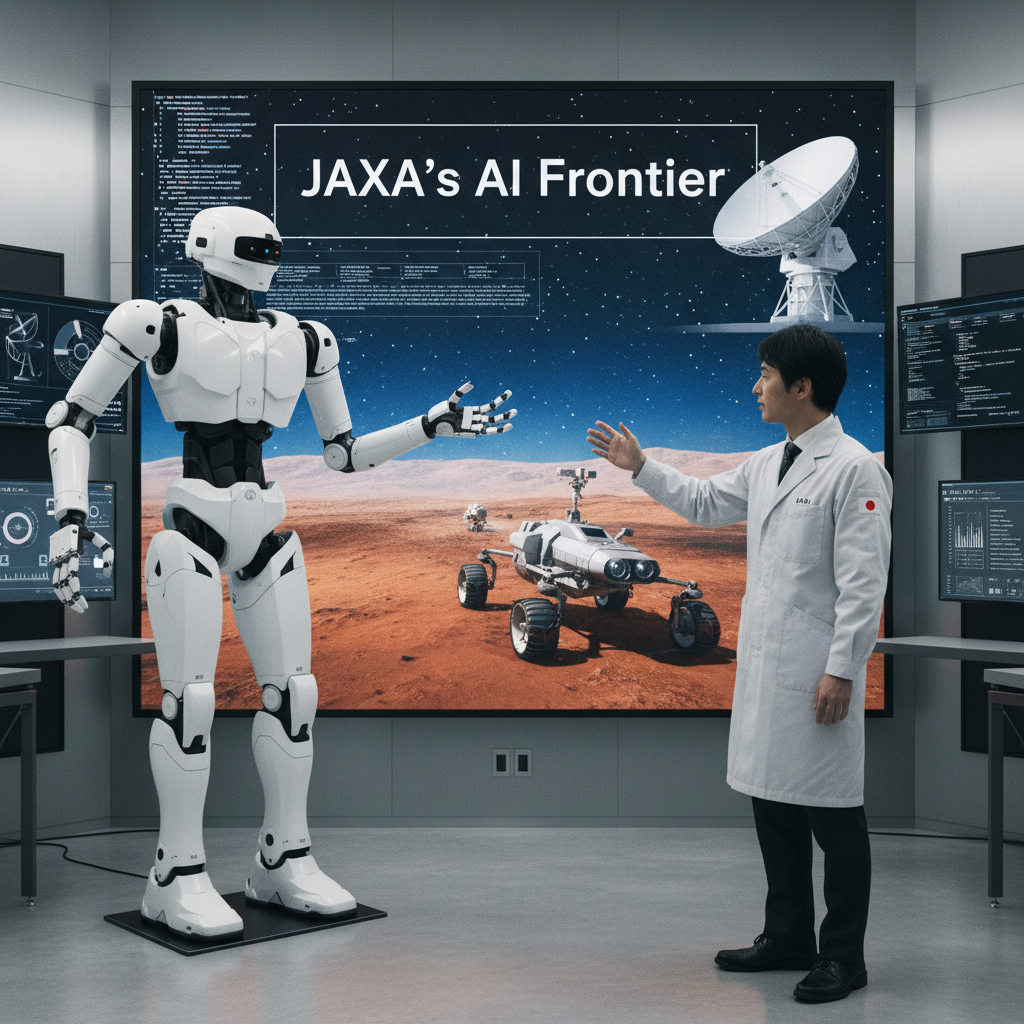

The cosmos, an expanse of unimaginable scale and complexity, has long captivated humanity. For centuries, our exploration has been limited by the frailties and finite capacities of human presence. However, a new era is dawning, one where artificial intelligence, guided by human ingenuity, is becoming our most formidable explorer. In Asia, and particularly in Japan, the integration of AI into space exploration is not merely an academic exercise, it is a strategic imperative, a natural extension of a national ethos that values precision and long-term vision.
Japan's space agency, Jaxa, a quiet but potent force in global space endeavors, has been quietly building a formidable AI capability, leveraging its deep heritage in robotics and automation. This is not a sudden pivot, but a logical progression from decades of meticulous engineering. Consider the intricate dance of a rover on the Martian surface, navigating treacherous terrain millions of kilometers from Earth. The time delay in communication renders direct human teleoperation impractical, demanding an unprecedented level of autonomy. This is where AI becomes not just helpful, but absolutely essential.
For Mars missions, AI is transforming every facet, from mission planning and autonomous navigation to scientific data analysis. JAXA's proposed Martian Moon eXploration, or MMX, mission, targeting Phobos and Deimos, exemplifies this. While the primary goal is sample return, the mission design incorporates advanced AI for autonomous decision-making during critical phases, such as landing and sample collection. The engineering is remarkable, allowing the spacecraft to assess its environment, identify optimal landing sites, and even detect anomalies without constant human intervention. This level of autonomy is a direct descendant of Japan's pioneering work in industrial robotics, where machines have long operated with sophisticated independence on factory floors.
Dr. Hiroshi Yamakawa, President of Jaxa, recently articulated this vision, stating, "Our approach to space exploration is deeply rooted in our national character: meticulous, patient, and driven by technological excellence. AI allows us to extend our reach, to conduct missions that would be impossible with human operators alone, ensuring the safety and success of our endeavors in the harsh environment of space." This sentiment underscores a pragmatic yet ambitious outlook, where AI is a tool to enhance, not replace, human exploration.
Beyond planetary exploration, satellite AI is revolutionizing Earth observation and communication. Swarms of small satellites, increasingly common in low Earth orbit, generate colossal amounts of data. Manually sifting through petabytes of imagery for environmental changes, disaster assessment, or even illegal fishing activities is a Sisyphean task. AI algorithms, particularly those leveraging deep learning, excel at pattern recognition and anomaly detection, transforming raw data into actionable intelligence. Companies like Synspective, a Japanese startup, are deploying AI-powered synthetic aperture radar, or SAR, satellites to provide high-resolution data for infrastructure monitoring and disaster response, demonstrating a clear commercial application of space AI. Their systems can detect millimeter-scale ground deformations, providing early warnings for potential landslides or structural failures.
The sheer volume of data from these constellations necessitates intelligent onboard processing. Instead of transmitting all raw data back to Earth, which is bandwidth-intensive and slow, AI can perform initial analysis, filtering out irrelevant information and prioritizing critical observations. This 'edge computing' in space is a game-changer, making satellite data more timely and efficient. The global market for AI in space applications is projected to grow significantly, with analysts at Reuters estimating it could reach tens of billions of dollars within the next decade, driven by both government and commercial ventures.
Perhaps the most profound, and certainly the most speculative, application of AI in space exploration lies in the search for extraterrestrial intelligence, or Seti. For decades, radio telescopes have passively listened to the cosmic static, hoping to detect a deliberate signal. The challenge is akin to finding a specific grain of sand on all the beaches of Earth, while simultaneously trying to understand what that grain of sand might mean. The data streams from observatories like the Allen Telescope Array or the Square Kilometre Array are immense, far exceeding human analytical capacity. This is where AI, particularly machine learning algorithms trained on vast datasets of natural and artificial signals, can shine.
Researchers at institutions globally, including the Breakthrough Listen initiative, are employing AI to sift through these signals, looking for patterns that deviate from known astrophysical phenomena. The goal is to identify technosignatures, indicators of technology from an alien civilization. While no definitive signal has yet been identified, the application of AI significantly increases the probability of detection by automating the laborious process of signal classification and anomaly detection. This is a monumental task, requiring algorithms capable of distinguishing between terrestrial interference, natural cosmic phenomena, and potentially, the faint whispers of an alien civilization. Precision matters immensely in this field, where false positives can lead to widespread speculation and false hope.
In Japan, the National Astronomical Observatory of Japan, Naoj, contributes to global astronomical research, and while their direct involvement in AI-driven Seti is nascent compared to some Western counterparts, the underlying technological expertise in signal processing and supercomputing is robust. The philosophical implications of AI assisting in Seti are also profound. If a signal is detected, how would an AI interpret it? Would its 'understanding' be limited by its human-programmed parameters, or could it offer a truly alien perspective? These are questions that will undoubtedly shape the future of our cosmic quest.
The challenges, however, are not insignificant. The development of robust, fault-tolerant AI for space applications requires rigorous testing and validation, far beyond what is typically required for terrestrial systems. A bug in a Martian rover's navigation system could mean mission failure, a costly setback measured in billions of dollars and years of effort. Ethical considerations also arise, especially as AI systems become more autonomous. Who is responsible when an AI makes a critical decision in space? These are not merely technical questions but societal ones that require careful deliberation.
Looking ahead, the synergy between AI and space exploration will only deepen. From the next generation of lunar landers and orbital habitats to ambitious interstellar probes, AI will be the silent partner, the tireless analyst, and the vigilant guardian. Japan's commitment to this future is evident in its continuous investment in robotics, materials science, and AI research, ensuring its place at the forefront of this cosmic endeavor. As we gaze towards the stars, it is increasingly clear that our journey will be guided not just by human dreams, but by the intelligent machines we create to help us realize them. The universe is vast, and with AI, our capacity to explore it grows exponentially. For more insights into how AI is shaping our technological future, you might explore articles on MIT Technology Review. The journey has truly just begun.