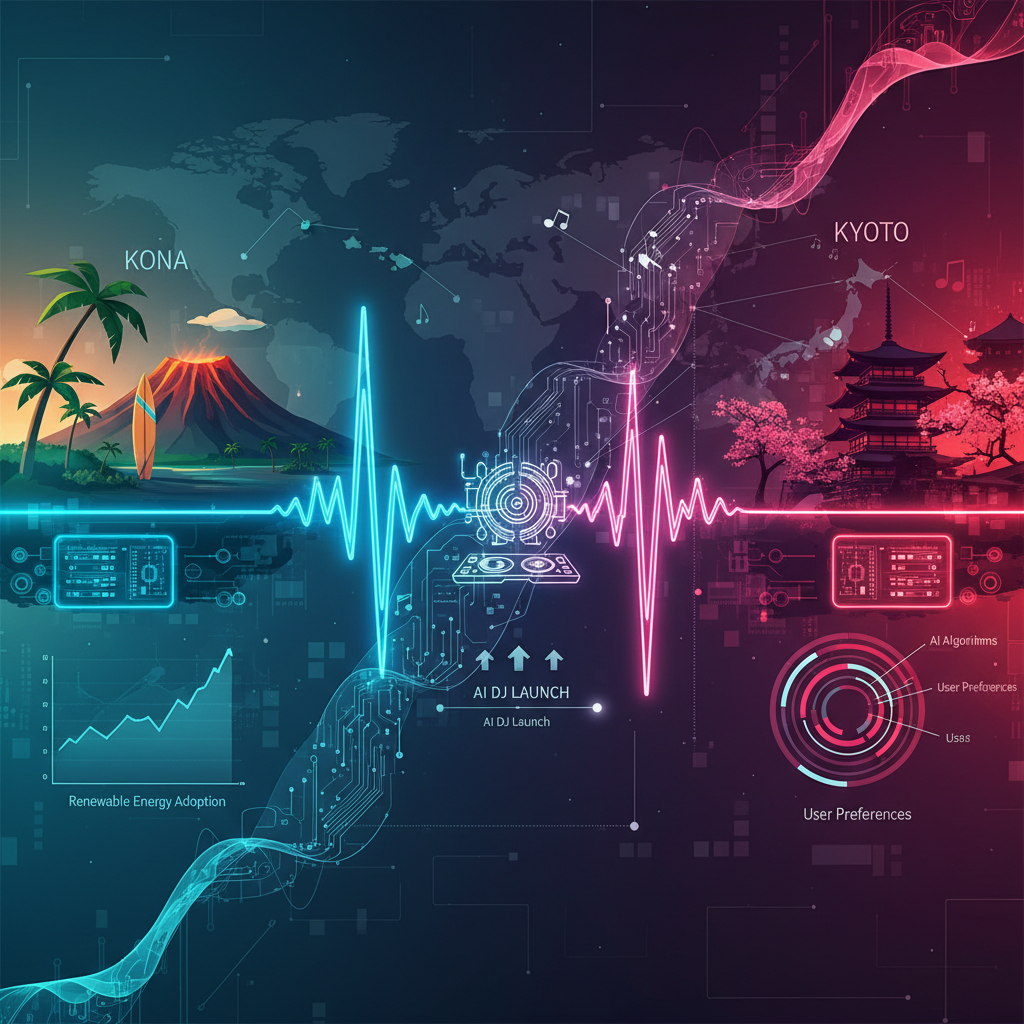

The sun dips below the horizon here in Kona, painting the sky in hues of orange and purple, and as I listen to the gentle lapping of waves, I often wonder about the soundtracks of our lives. For many, that soundtrack is now curated by an invisible hand, a digital disc jockey residing deep within Spotify's servers. Spotify's AI DJ, launched with much fanfare, promised to be more than just another algorithm; it was meant to be a companion, a musical guide who understands your mood, your history, and even your future tastes. But is this personalized soundscape a genuine evolution in music discovery, or is it merely a sophisticated algorithm playing to our existing biases? I think it is both, and the implications stretch far beyond our playlists.
For decades, music discovery was a serendipitous affair. We relied on radio DJs, friends' recommendations, record store clerks, or even the liner notes of an album. The internet changed that, ushering in an era of digital libraries. Then came algorithms, first simple, then increasingly complex, like those powering Pandora's Music Genome Project or early Spotify recommendations. These systems analyzed what we listened to, what we skipped, and what we liked, creating a feedback loop that shaped our musical journeys. Spotify, with its vast trove of user data, has been at the forefront of this algorithmic evolution. Its personalization engine, which underpins everything from Discover Weekly to Daily Mixes, has become a benchmark for the industry. It's a testament to how deeply AI has integrated into our daily lives, often without us even realizing it.
The introduction of the AI DJ in early 2023, initially rolled out to premium subscribers, marked a significant leap. Instead of just a playlist, it offered a voiced, conversational AI that introduced songs and artists, occasionally throwing in tidbits of information about them. It was designed to feel more human, more like a radio host, but one who knew your musical soul intimately. This move was not just about better recommendations; it was about creating a more engaging, interactive experience. According to Spotify's Q4 2023 earnings report, premium subscriber growth continued to be strong, partly attributed to enhanced personalization features. While specific numbers for the AI DJ's direct impact are not publicly detailed, the company consistently highlights personalization as a key driver of engagement and retention. Analysts at Bloomberg Technology have noted that Spotify's investment in AI, including its acquisition of companies like Sonantic for voice AI, underscores a long-term strategy to deepen user interaction.
However, the question remains: Is this the new normal, or just a clever, albeit temporary, gimmick? My perspective, shaped by living at the crossroads of Pacific and Silicon Valley, is that the future is being built on volcanic rock, slowly but surely. This isn't a fad; it's an inevitable progression. The human element, the desire for connection and guidance, is being re-integrated into the algorithmic experience. It's not just about what songs to play, but how they are presented, the narrative woven around them.
Experts are divided on the long-term implications. Dr. Ethan Zuckerman, a prominent scholar on internet culture and digital media, has often warned about the dangers of filter bubbles and echo chambers. He might argue that while the AI DJ feels personal, it could inadvertently narrow our musical tastes by constantly feeding us variations of what we already like. “The promise of AI is often expansion, but the reality can be contraction if not designed with true diversity in mind,” Zuckerman has reportedly stated in various forums, emphasizing the need for algorithms to actively challenge our preferences, not just cater to them. This concern resonates deeply here in Hawaii, where cultural preservation and the promotion of diverse voices, including indigenous Hawaiian music, are paramount. If an AI DJ primarily serves up mainstream hits, it could further marginalize less commercially viable, but culturally rich, genres.
On the other hand, industry leaders see this as a necessary evolution. Daniel Ek, Spotify's CEO, has consistently championed the role of AI in enhancing the user experience and connecting artists with wider audiences. While he hasn't commented directly on the AI DJ's specific impact on discovery versus reinforcement, his vision for Spotify involves leveraging technology to create deeply personal and engaging audio experiences. "We believe that AI will unlock new levels of creativity and connection, not just for listeners, but for artists too," Ek commented in a recent investor call, hinting at AI's potential to help artists find their niche audiences globally. This is a powerful idea, particularly for artists from smaller markets or unique cultural traditions, like those found across Oceania. Imagine an AI DJ that actively seeks out and promotes contemporary Hawaiian reggae or traditional Polynesian chants to listeners who have shown an open mind to world music, rather than just pop.
My concern, and perhaps my hope, is that these systems will evolve to truly embrace diversity. Aloha means more than hello because it's a framework for ethical AI, one that prioritizes connection, respect, and mutual flourishing. An AI DJ, if truly aloha-driven, would not just play what you like, but gently introduce you to new sounds, new cultures, and new perspectives. It would understand the nuance of context, perhaps knowing that on a quiet Sunday morning, you might appreciate slack-key guitar, even if your usual playlist is heavy metal. This is the kind of intelligence that moves beyond simple pattern matching to genuine cultural understanding.
Consider the potential impact on local artists here in Hawaii and across the Pacific. While global hits dominate, there's a vibrant, ever-evolving music scene that often struggles for broader recognition. Could an AI DJ, tuned correctly, become a champion for these voices? Imagine a scenario where a listener in Berlin, who enjoys ambient music, is gently introduced to the ethereal sounds of a contemporary Hawaiian artist, not because they explicitly searched for it, but because the AI recognized a shared emotional resonance. This could be transformative, creating new avenues for cultural exchange and economic opportunity for artists who might otherwise remain unheard on a global stage. The challenge, of course, is programming that aloha, that intentionality, into the algorithms.
In April 2026, the AI DJ is still in its relatively early stages, but its trajectory is clear. It's not just about music; it's about the future of personalized media. We're seeing similar trends in news aggregation, video streaming, and even educational content. The question isn't whether AI will continue to curate our experiences, but how intelligently, how ethically, and how expansively it will do so. Will it broaden our horizons or narrow them? Will it foster genuine discovery or merely reinforce our existing preferences? The answer lies in the design, the data, and the values we embed in these powerful systems.
For now, the AI DJ is a fascinating experiment, a conversational interface to the vast ocean of music. Its success will ultimately be measured not just by engagement metrics, but by its ability to surprise us, to challenge us, and to connect us to sounds we never knew we needed. As we navigate this future, we must demand that these intelligent systems reflect the diversity and richness of human experience, much like the diverse currents that meet in our vast Pacific. The potential for an AI that truly understands and celebrates the breadth of human creativity is immense, and it’s a future worth striving for, one song at a time. The conversation around ethical AI and its impact on culture is only just beginning, and you can read more about these broader implications on Wired.
Ultimately, Spotify's AI DJ is more than a fleeting tune; it's a significant chord in the symphony of our digital future. It represents a pivot towards more immersive, conversational AI experiences. While the immediate impact might feel like a subtle enhancement to our daily playlists, its long-term implications for how we consume, discover, and even create culture are profound. It's a trend that will shape not just our listening habits, but perhaps even our understanding of ourselves and each other, for decades to come. The future of personalized media, much like the ocean, is vast and full of uncharted depths, and the AI DJ is just one of the many vessels exploring it. For more on how AI is transforming various industries, you might find this article on Figure AI's humanoid robots [blocked] an interesting read, showcasing the breadth of AI's reach.