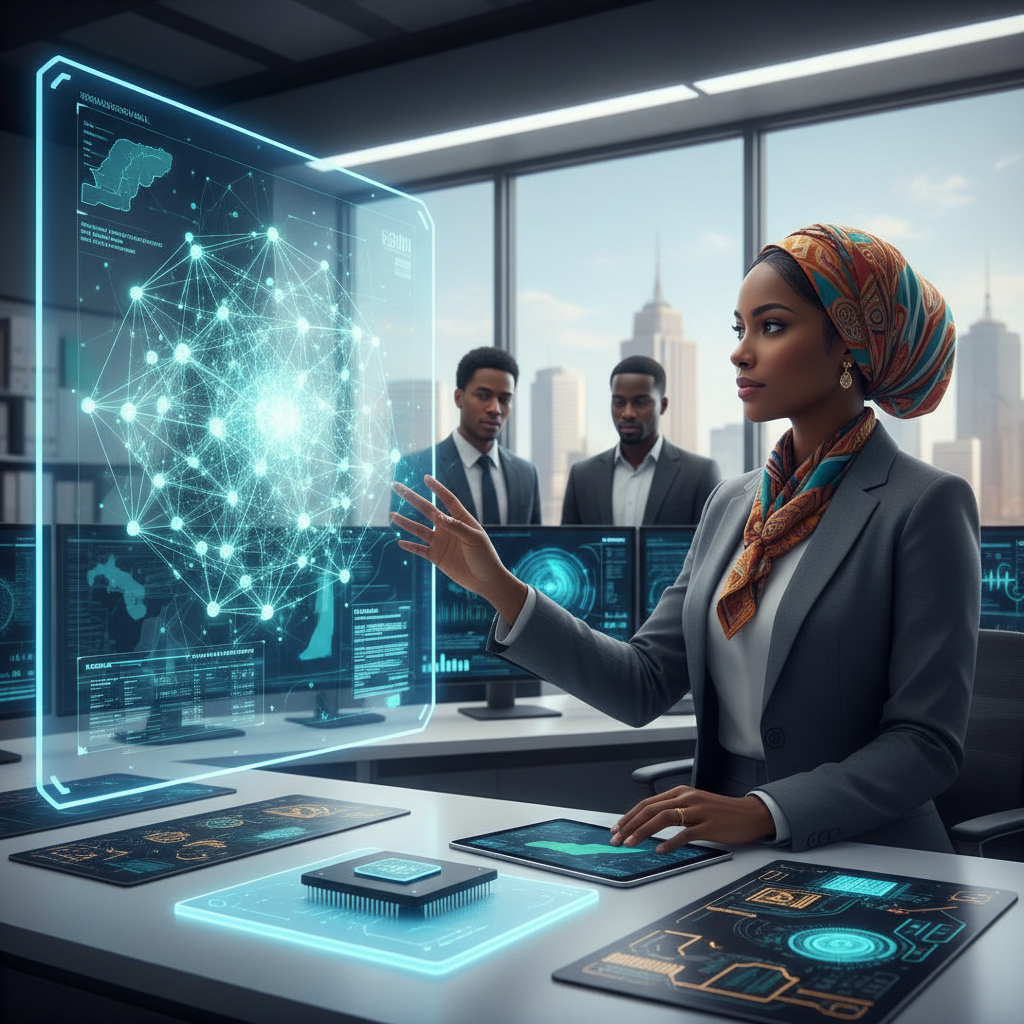
My friends, let me tell you, the air here in Accra is absolutely buzzing. You can feel it, a palpable energy, a sense of purpose that's almost electric. Everywhere you look, from the bustling tech hubs of East Legon to the innovative startups sprouting in Tema, there's a conversation happening. It is all about AI, and it is not just talk, it is action. But lately, I have been hearing whispers, echoes from the West, about an 'AI bubble.' Is this just another dot-com era in the making, destined to burst and leave a trail of digital debris? Or is what we are building here in Ghana, and across Africa, fundamentally different, more robust, and deeply rooted in real-world impact?
The Strategic Move: Ghana's Deliberate AI Integration
Ghana's approach to AI is not about speculative valuations or chasing the next big hype cycle. It is a calculated, strategic integration into our core economic sectors. Our government, alongside a vibrant private sector, has been quietly, yet effectively, laying the groundwork. Consider the National Artificial Intelligence Strategy, launched in late 2023, which outlines a clear roadmap for AI adoption in agriculture, healthcare, education, and finance. This is not some abstract policy document; it is a living blueprint guiding tangible investments and partnerships. We are seeing initiatives like the 'AI for Agriculture' program, which leverages machine learning to predict crop yields, optimize irrigation, and detect plant diseases, directly addressing food security and farmer livelihoods. This is not about building the next viral app; it is about feeding our people and empowering our farmers.
Context and Motivation: Beyond the Hype Cycle
The motivation behind Ghana's AI push is deeply pragmatic. We are a young, dynamic nation with immense potential, but also with pressing challenges that AI can help solve. Our population is growing, urbanization is accelerating, and we need sustainable solutions. The average age in Ghana is around 21 years old, a demographic dividend hungry for opportunity and innovation. This youthful energy is a powerful engine. We are not just consuming AI, we are creating it, adapting it, and applying it to our unique contexts. The government's motivation is clear: use AI to leapfrog traditional development hurdles, create high-value jobs, and position Ghana as a leader in African technological innovation. This is about economic sovereignty and building a resilient future, not just riding a wave.
Competitive Analysis: A Different Kind of Race
When you talk about an 'AI bubble' in the global context, you are often looking at the fierce competition among the tech giants in Silicon Valley: OpenAI, Google DeepMind, Anthropic, and their race for ever-larger models and ever-more sophisticated general intelligence. Their valuations are astronomical, and yes, some of that might be speculative. But here in Ghana, our competitive landscape is different. We are not directly competing with them on foundational model development, at least not yet. Instead, we are focusing on application and localization. Our competitive edge comes from our deep understanding of local needs, our agile startup ecosystem, and our ability to build solutions that are culturally relevant and economically viable for our markets.
Take, for instance, the burgeoning fintech sector in Accra. Companies are using AI for credit scoring in unbanked populations, fraud detection in mobile money transactions, and personalized financial advice for small businesses. These are not 'nice-to-haves,' they are essential services. While global players like Microsoft and Google are certainly present and investing, their primary focus remains on their global product lines. Our local innovators are filling critical gaps, often with leaner budgets and a more direct path to market. As Dr. Lucy Agyepong, Director of the AI Center at Ashesi University, recently stated, "Africa's AI journey is defined by its problem-solving imperative. We are not just chasing innovation; we are chasing solutions to real, immediate challenges, and that makes our investment in AI inherently more grounded." Her words resonate deeply with the spirit I see every day.
Strengths and Weaknesses: Ghana's AI Equation
Our strengths are formidable. We have a rapidly growing pool of young, tech-savvy talent. Universities like Kwame Nkrumah University of Science and Technology (knust) and the University of Ghana are producing brilliant graduates who are eager to apply their skills. The government's commitment to digital infrastructure, including expanded internet access, provides a crucial backbone. Furthermore, the cost of living and doing business in Ghana, compared to major tech hubs, makes it an attractive location for startups and R&D centers. Just look at the influx of venture capital into African tech, which hit a record high of over $5 billion in 2022, with Ghana being a significant recipient. TechCrunch regularly highlights the vibrant startup scene across the continent.
However, we also face challenges. Access to high-performance computing resources, like the advanced GPUs from NVIDIA, can be limited and expensive. Data privacy and ethical AI considerations, while being addressed in our national strategy, require continuous vigilance and robust regulatory frameworks. We also need more localized datasets to train AI models effectively for our diverse languages and cultural nuances. This is where collaboration with global partners becomes vital, not just for funding, but for knowledge transfer and infrastructure development. We are building our own capacity, but we are also open to learning from the best. The conversation around ethical AI, for example, is one where global collaboration is key, as highlighted by discussions on platforms like MIT Technology Review.
Verdict and Predictions: This is Bigger Than Anyone Realizes
So, is the global AI market in a bubble? Perhaps some segments are inflated by speculative investment, particularly those far removed from tangible applications. But here in Ghana, and indeed across much of Africa, the AI narrative is fundamentally different. We are building an AI ecosystem based on necessity, utility, and sustainable impact. This is not a fleeting trend; it is a foundational shift. Our investments are in areas that yield direct societal and economic returns, from improving healthcare diagnostics to optimizing logistics and enhancing educational outcomes. The focus is on value creation, not just valuation.
I predict that Ghana, with its strategic vision and youthful dynamism, will continue to attract significant investment and talent in the AI space. We will see more localized AI solutions emerge, tailored to African challenges, and eventually, these solutions will find global markets. The 'AI bubble' conversation, while valid for some parts of the world, misses the crucial point about Africa's unique trajectory. We are not just participating in the AI revolution; we are shaping it in our own image, one that is practical, inclusive, and deeply impactful. This is bigger than anyone realizes, and Ghana is proving the skeptics wrong, not with hype, but with tangible progress and a relentless spirit of innovation. The future, my friends, is being built right here, right now, with Black Star energy. We are not just dreaming of the future; we are coding it into existence. Our journey is a testament to the power of local ingenuity meeting global technology, creating something truly transformative for our people and for the world. For more insights into how AI is transforming various sectors, you might find this article on healthcare AI in Mexico [blocked] an interesting parallel.