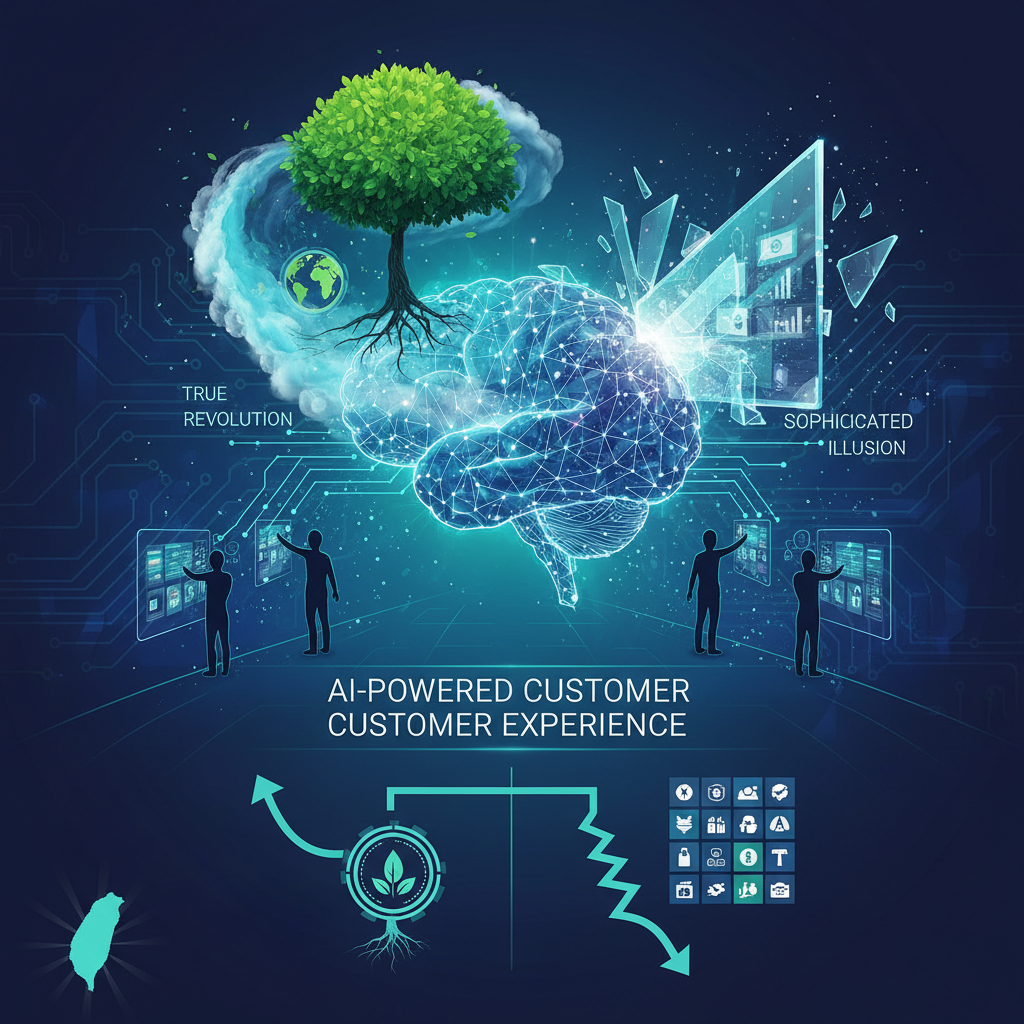

The digital landscape is awash with proclamations of AI's transformative power, particularly in the realm of customer experience. From automated chatbots handling routine queries to predictive analytics anticipating consumer needs, the narrative suggests a paradigm shift. But is this widespread adoption of AI-powered customer experience a genuine revolution, or merely a sophisticated illusion, a new coat of paint on familiar challenges?
Let's separate fact from narrative. For years, companies have grappled with the twin demands of efficiency and personalization. The rise of the internet brought self-service portals, then live chat, and now, the omnipresent AI assistant. Historically, the evolution of customer service has been a relentless pursuit of cost reduction, often at the expense of genuine human connection. Early automated phone systems, with their labyrinthine menus and frustrating loops, serve as a stark reminder of technology's potential to alienate rather than assist. The current wave of AI promises to rectify these past missteps, offering intelligent, empathetic, and always-available support. However, the critical question remains: does it deliver on this promise consistently, or are we witnessing another cycle of hype outpacing reality?
Consider the current state, particularly from a data-driven perspective. A recent report by Gartner projects that by 2027, conversational AI will be the primary customer service channel for a quarter of organizations worldwide, up from less than 10 percent in 2023. This rapid acceleration is fueled by the allure of reduced operational costs, with some companies reporting savings of up to 30 percent on customer service expenditures after AI implementation. For instance, a major telecommunications provider in Southeast Asia, which prefers to remain unnamed, claimed a 25 percent reduction in call center volume within six months of deploying an advanced AI chatbot system. These figures, while impressive on paper, often gloss over the nuances of customer satisfaction.
Here in Taiwan, where service quality is often a cultural hallmark, the adoption of AI in customer experience presents a particularly interesting case study. Taiwanese consumers, accustomed to meticulous attention to detail and a high degree of personal interaction, might find purely automated solutions lacking. "Our customers value efficiency, yes, but they also value the human touch, the ability to resolve complex issues with a knowledgeable person," states Dr. Chen Li-Hua, Professor of Service Management at National Chengchi University. "While AI can handle basic inquiries, the moment a problem deviates from a pre-programmed script, the system often falters, leading to frustration and a return to human agents, negating some of the initial efficiency gains." This sentiment resonates deeply within a society that prides itself on its hospitality and the meticulousness of its service industries, from the smallest night market stall to the largest financial institutions.
Indeed, the data tells a more nuanced story. While AI excels at processing high volumes of simple, repetitive tasks, its performance on complex or emotionally charged interactions is often suboptimal. A survey conducted by DataGlobal Hub in late 2025 indicated that while 70 percent of consumers appreciate the speed of AI chatbots for quick answers, only 35 percent felt their complex issues were adequately resolved without human intervention. Furthermore, 60 percent expressed a preference for speaking with a human agent when dealing with sensitive topics or product failures. This disparity highlights a significant gap between the perceived capabilities of AI by companies and the actual experience of their customers.
Mr. Lin Po-Chieh, Chief Technology Officer at a prominent Taiwanese e-commerce platform, offers a pragmatic view. "We've invested heavily in AI to streamline our customer service, but we view it as an augmentation, not a replacement. Our AI handles the first layer of inquiries, filtering and directing, freeing our human agents to focus on high-value, complex cases. The goal is to make our human agents more effective, not to eliminate them entirely." This hybrid approach, often termed 'augmented intelligence,' appears to be the most promising path forward, leveraging AI's speed and scalability while preserving the irreplaceable empathy and problem-solving skills of human professionals.
However, the implementation is not without its challenges. The quality of AI-powered customer experience is directly tied to the quality and volume of data used for its training. Bias in training data, insufficient contextual understanding, and the inability to interpret subtle human cues, such as tone or implied meaning, remain significant hurdles. "The 'intelligence' of these systems is often limited by the data they consume," explains Ms. Chang Mei-Ling, a data ethics researcher at Academia Sinica. "If the training data does not accurately reflect the diversity of customer queries or the nuances of human communication, the AI will inevitably produce unsatisfactory or even biased responses. This is a critical ethical consideration, particularly when dealing with vulnerable populations or sensitive personal information." Taiwan's position, as a hub for both technological innovation and a society with high service expectations, makes these considerations particularly acute.
The future of AI in customer experience, therefore, is more complex than headlines suggest. It is not simply a matter of deploying the latest large language model. It requires a strategic integration that understands the limitations of AI as much as its strengths. Companies must move beyond the simplistic goal of cost cutting and focus on enhancing the overall customer journey. This means designing systems where AI and human agents collaborate seamlessly, where the transition between automated and human support is fluid and efficient, and where customer data is used to personalize interactions, not just automate them.
My verdict is this: AI-powered customer experience is undoubtedly here to stay, but its true revolutionary potential lies not in replacing human interaction, but in intelligently augmenting it. The current trend is less about a complete overthrow of traditional service models and more about a sophisticated evolution. Companies that succeed will be those that recognize AI as a tool to empower their human teams and enrich customer relationships, rather than merely a means to cut costs. Those that fail will likely find their customers migrating to competitors who understand that genuine connection, even in a digital age, remains paramount. The illusion of effortless AI is tempting, but the reality demands a more thoughtful, human-centric approach to technology deployment. The real revolution will occur when AI enables more meaningful human interactions, not fewer.