
Namaste, my friends! Rajèsh Krishnàn here, buzzing with more energy than a Bangalore startup on its funding round, and let me tell you, the cosmos is getting a serious AI upgrade! We are talking about AI in space exploration and astronomy, and honestly, it is a topic that fills me with both boundless excitement and a healthy dose of introspection. It is like watching a T20 match where every ball is a six, but you also wonder if the bowler is playing fair, you know?
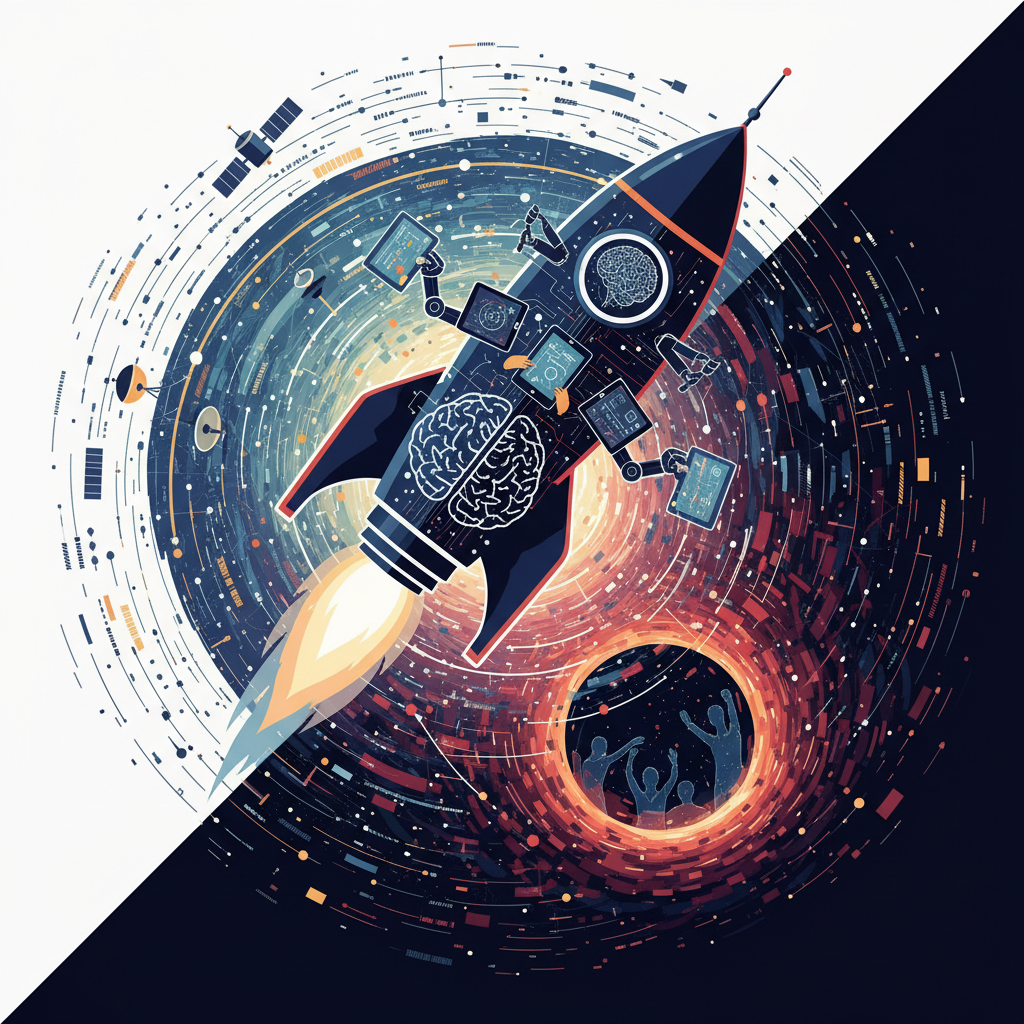
For years, the vastness of space has humbled us, a cosmic canvas painted with mysteries. Now, with artificial intelligence, we are not just observing that canvas, we are actively interpreting it, predicting its brushstrokes, and even dreaming of adding our own. From sifting through mountains of telescope data to guiding autonomous probes on distant planets, AI is becoming the co-pilot, the analyst, and sometimes, even the decision maker in our interstellar adventures. But here is my provocative take, the one that might make some of you spill your chai: while AI promises to unlock the universe's deepest secrets, we are dangerously close to creating a data black hole, an ethical void where human intuition and oversight might just disappear, leaving us with a universe understood by machines, not by us.
Think about it. The Square Kilometre Array, a truly mind boggling international project, will generate exabytes of data every single day. That is more data than the entire internet generates in a week! No human, not even a team of a thousand human astronomers, could ever process that. AI is not just helpful there, it is absolutely essential. It is like having Virat Kohli and Jasprit Bumrah on your team, but also having a supercomputer coaching them on every single move. AI algorithms are already identifying exoplanets, classifying galaxies, and even detecting gravitational waves with a speed and accuracy that would make our heads spin. Dr. Anjali Sharma, Head of Astro-informatics at the Indian Space Research Organisation, Isro, recently told me, "AI is not just an aid, it is the lens through which we will truly see the universe. Without it, we are essentially blind to the subtle patterns and anomalies hidden within the cosmic noise." And she is right, the scale is mind boggling.
But here is where my journalistic antennae start twitching. When AI becomes the primary interpreter of cosmic phenomena, what happens to human bias, or rather, the lack of it? Algorithms are trained on existing data, data often collected and curated by humans with their own theories and assumptions. If an AI is trained on a dataset that, perhaps inadvertently, prioritizes certain types of stellar events or ignores others, could it miss something truly revolutionary? Could it perpetuate our own terrestrial biases onto the cosmos? Imagine an AI designed to detect life, trained only on Earth-like conditions. It might completely overlook a silicon based life form or a consciousness residing in a gas giant, simply because it does not fit its programmed parameters. We are not just building tools, we are building digital philosophies of the universe.
Some might argue, and quite rightly so, that AI is merely a tool, an extension of human intellect, not a replacement. They would say that human astronomers will always be in the loop, guiding the AI, validating its findings, and making the final scientific interpretations. "Rajèsh, you are being overly dramatic," I can almost hear Professor Vikram Singh, a leading astrophysicist at the Tata Institute of Fundamental Research, saying. "AI frees us from the mundane, allowing us to focus on the truly creative and conceptual aspects of discovery. It is like having a super-efficient research assistant, not a boss." And yes, there is immense truth in that. AI can automate the tedious tasks, allowing brilliant minds to ponder the deeper questions. It accelerates discovery, pushing the boundaries of what is possible.
However, my concern is about the degree of reliance. As AI systems become more complex, more autonomous, and more black box in their operations, understanding why they made a certain classification or how they arrived at a particular conclusion becomes increasingly difficult. We are already seeing this in other fields. If an AI identifies a potential asteroid collision threat, but its reasoning is opaque, do we trust it implicitly? Do we launch a multi billion dollar deflection mission based on an algorithm we do not fully comprehend? The ethical implications are immense. What if an AI, designed to optimize resource allocation for a Mars colony, decides that certain human activities are inefficient, or even detrimental, to the mission's success? These are not far fetched sci-fi scenarios anymore; they are questions we need to grapple with now.
Furthermore, there is the question of access and equity. Who controls these powerful AI systems? Will the benefits of AI driven space exploration be shared globally, or will they exacerbate existing technological divides? India is having its moment in space, with ISRO's incredible achievements like Chandrayaan and Mangalyaan, and our burgeoning private space sector. We have a massive pool of AI talent, and our engineers are contributing significantly to global space projects. It is crucial that we ensure this AI revolution in space is inclusive, not exclusive. We must advocate for open source AI models, collaborative international frameworks, and equitable access to the data and discoveries. Otherwise, the universe might become the exclusive playground of a few technologically advanced nations or corporations, leaving the rest of humanity gazing at the stars through a digital fence.
My rebuttal to the "AI is just a tool" argument is this: a tool can shape its user as much as the user shapes the tool. If we delegate too much of our understanding and decision making to AI, we risk losing our own capacity for intuition, for serendipitous discovery, for the very human act of wondering and questioning the universe. The magic of astronomy often lies in the unexpected, the anomaly that breaks the model. If our AI is too good at fitting data into existing models, will it miss the next paradigm shifting anomaly? Will we become passive recipients of AI generated knowledge, rather than active participants in cosmic discovery?
This is not a call to halt progress, not at all. My heart beats for innovation, for pushing boundaries. But it is a fervent plea for conscious, ethical development. We need robust AI ethics guidelines specifically for space exploration, developed through international collaboration, involving philosophers, ethicists, and social scientists, not just engineers. We need explainable AI, systems that can articulate their reasoning in a way humans can understand and scrutinize. We need to invest in training the next generation of astronomers and space scientists to not just use AI, but to critically evaluate it, to understand its limitations, and to retain that vital human spark of curiosity and skepticism.
India, with its ancient philosophical traditions and its modern technological prowess, has a unique perspective to offer this global conversation. We understand the balance between technological advancement and human values. Let us ensure that as we reach for the stars with AI, we do not lose sight of what makes us human. Because ultimately, the universe is not just about data points and algorithms; it is about wonder, about our place in the cosmos, and about the stories we tell ourselves about it. And those stories, my friends, must always be told by us, for us. This is just the beginning, and the choices we make now will echo across light years. What kind of universe do we want to discover, and who will truly be doing the discovering?