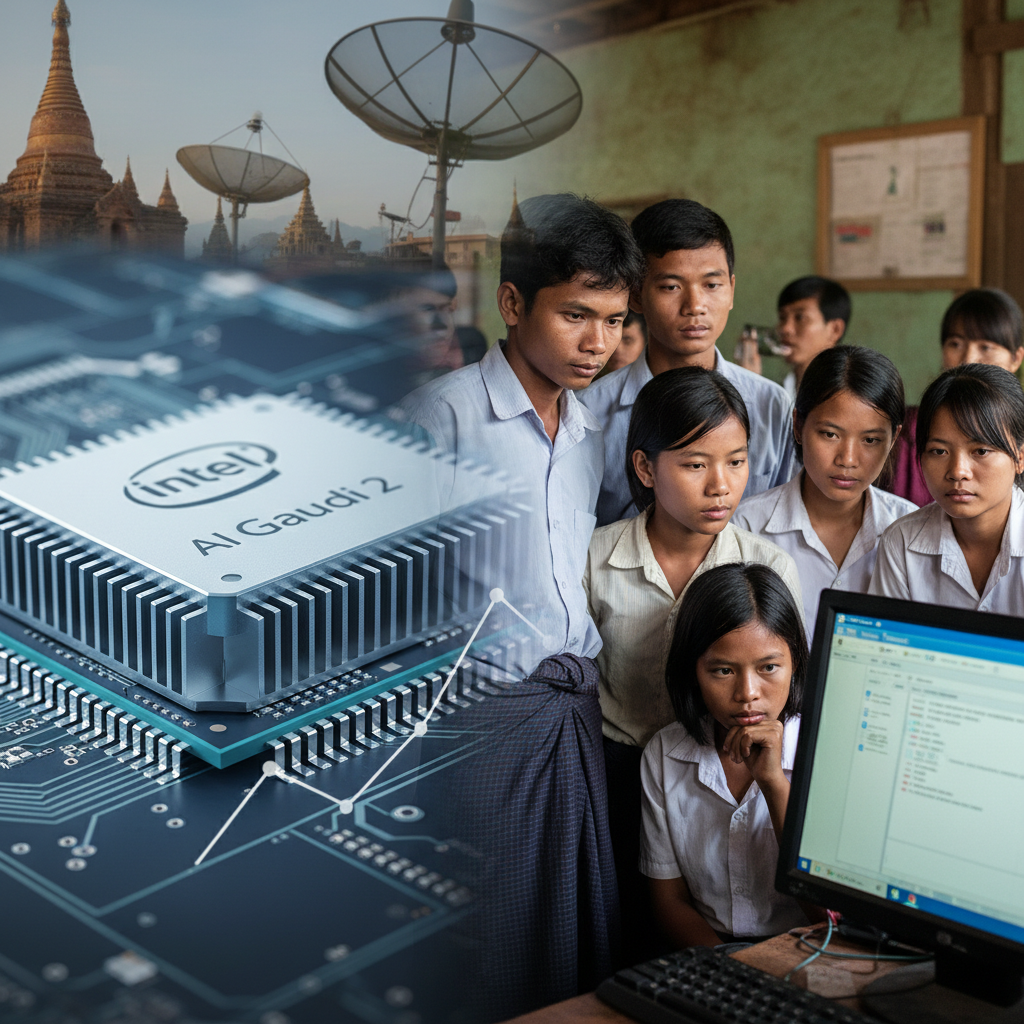

The global race for AI dominance feels like a distant thunder here in Myanmar, yet its tremors are felt in every corner of our lives. From the internet shutdowns that plunge us into digital darkness to the constant struggle for reliable infrastructure, the promise of advanced technology often feels like a cruel jest. But then, a story emerges, like Intel's renewed push into AI accelerator chips, and I find myself wondering: could this be a turning point, not just for a tech giant, but for nations like ours?
For years, NVIDIA has been the undisputed king of AI hardware, their GPUs powering everything from massive language models to complex scientific simulations. Jensen Huang, NVIDIA's CEO, has become a household name in tech circles, his company's valuation soaring as demand for their H100 and A100 chips exploded. This dominance has created a bottleneck, a chokepoint where access to cutting-edge AI is largely dictated by who can afford NVIDIA's premium hardware and who has the political clout to secure it. This is a reality that hits hard in places like Myanmar, where resources are scarce and geopolitical complexities abound.
Intel, a name synonymous with computing for decades, has been playing catch-up. Their latest weapon in this high-stakes game is the Gaudi series of AI accelerators, particularly the Gaudi 3. Announced with much fanfare, these chips are designed to offer a competitive alternative, promising significant performance gains over their predecessors and, crucially, a more cost-effective solution compared to NVIDIA's top-tier offerings. For a company like Intel, this isn't just about reclaiming market share, it’s about staying relevant in an industry that moves at breakneck speed. For us, in the Global South, it could mean something far more profound.
Imagine the potential. If Intel can truly democratize access to powerful AI compute, even slightly, it opens doors. Doors for local researchers to train models on locally relevant data, for humanitarian organizations to deploy more sophisticated aid distribution systems, or for activists to develop more resilient communication tools. In Myanmar, the stakes are different. We are not talking about optimizing ad revenue or creating more engaging social media filters. We are talking about basic needs, about health, education, and the fundamental right to information.
Intel's strategy appears to be multi-pronged. They are not just building chips; they are building an ecosystem. They are emphasizing open standards and software compatibility, aiming to make it easier for developers to migrate their existing AI workloads. This approach is critical. As Dr. Lisa Su, CEO of AMD, another significant player in the chip market, often emphasizes, “It is not just about the hardware, it is about the entire software stack and the developer community.” This sentiment resonates deeply, because hardware without accessible software is like a powerful engine without fuel.
The Gaudi 3, according to Intel's own benchmarks, reportedly offers a 50% improvement in inference throughput and a 40% improvement in training efficiency compared to the Gaudi 2. While these numbers are impressive, the real test will be in adoption. Early reports from companies like Stability AI, which has been experimenting with Gaudi accelerators for their image generation models, suggest promising results. Stability AI’s CEO, Emad Mostaque, has often spoken about the need for diverse hardware options to prevent a single vendor lock-in, a perspective that aligns with the broader goal of democratizing AI. He stated in a recent interview, “We need more options in the AI hardware space to foster true innovation and prevent monopolies. Competition benefits everyone.”
The challenge for Intel, however, remains formidable. NVIDIA’s Cuda platform has a decade-long head start, an entrenched developer base, and a reputation for unparalleled performance. Breaking that grip requires more than just competitive chips; it requires a sustained commitment to ecosystem development, developer outreach, and aggressive pricing strategies. Analysts at IDC recently projected that the AI accelerator market will exceed $100 billion by 2027, with NVIDIA currently holding an estimated 80% market share. Intel’s ambition is to capture a significant portion of the remaining 20% and grow it further.
From our vantage point in Southeast Asia, the implications of this global chip war extend beyond corporate balance sheets. For a nation grappling with ongoing crises, reliable and affordable access to advanced technology can be a lifeline. Consider the potential for AI in disaster prediction and response, an urgent need in a region prone to natural calamities. Or in developing localized educational tools that can function even with limited connectivity. The digital divide is not just about internet access; it is increasingly about access to the compute power that drives the most transformative technologies. Reuters often reports on the geopolitical implications of chip manufacturing and supply chains, highlighting how critical these components are to national security and economic development.
I recall a conversation with a local tech enthusiast in Yangon, a young woman named Daw Aye Thuzar, who runs a small community coding workshop. She spoke passionately about the need for tools that are not just powerful, but also accessible and sustainable. “We cannot always rely on imported solutions built for different contexts,” she told me, her voice firm. “We need the foundational technology to build our own, to solve our own problems. If Intel can genuinely lower the barrier to entry for AI compute, it would empower so many here.” Her words echo the sentiment of many who believe in the transformative power of technology, provided it is placed in the right hands.
The push for open-source AI models, championed by companies like Meta with their Llama series, further amplifies the need for diverse hardware. If models are freely available, but only a select few can afford the hardware to run or fine-tune them, then true democratization remains elusive. This is where Intel’s Gaudi chips could carve out a crucial niche, providing a more accessible path to leveraging these powerful open models. The synergy between open software and more competitive hardware could unlock unprecedented innovation in regions traditionally left behind.
Ultimately, Intel’s fight to stay relevant in the AI accelerator market is more than just a corporate saga. It’s a narrative that intertwines with the aspirations of countless individuals and communities striving for a better future, often against immense odds. For us, here in Myanmar, where every technological advancement is scrutinized for its potential impact on our daily struggles, the prospect of more diverse and affordable AI compute is not merely an economic footnote. It is a beacon of possibility, a hint that the tools needed for self-determination might just become a little more within reach. MIT Technology Review has extensively covered the ethical and access issues surrounding AI development, emphasizing the need for equitable distribution of its benefits.
This is about survival, not convenience. It is about ensuring that the future of AI is not solely shaped by the priorities of Silicon Valley, but also by the urgent needs of the world’s most vulnerable populations. Whether Intel succeeds in reshaping the AI hardware landscape remains to be seen, but their efforts offer a much-needed glimmer of hope for a more inclusive technological future. The world watches, and so do we, with a specific kind of hope that only those who have faced true adversity can understand. Perhaps, just perhaps, the next wave of AI innovation will not just be faster, but fairer, too. For more on the broader implications of AI in developing nations, one might look at this article [blocked] exploring AI's role in global security, which touches on access and ethical concerns.