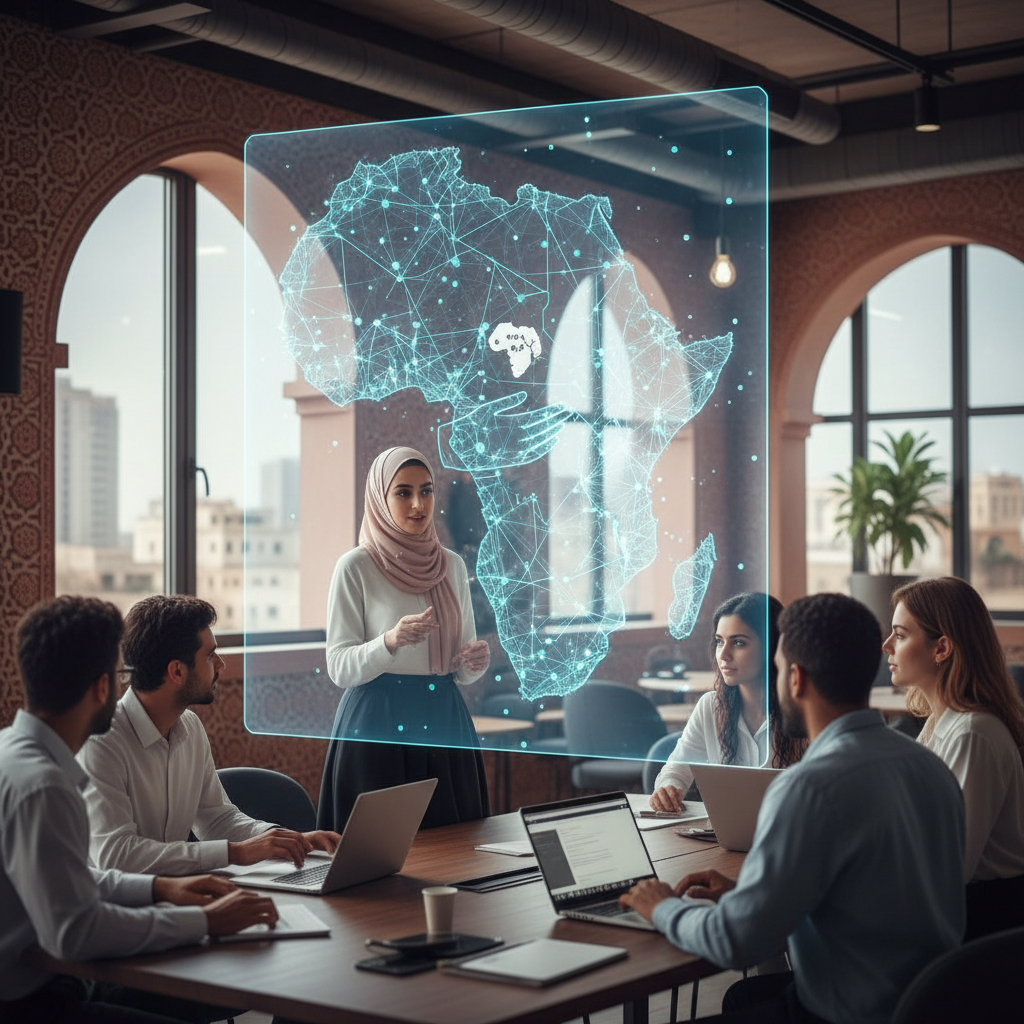
The scent of mint tea still lingers in the air of Casablanca's burgeoning tech districts, a familiar comfort amidst the relentless pace of innovation. Yet, beneath this timeless facade, something profoundly new is taking root, something that promises to reshape not just Morocco, but the entire continent. We are witnessing a quiet, yet powerful, democratization of artificial intelligence, largely driven by the open source ethos championed by platforms like Hugging Face.
For decades, the cutting edge of AI felt like a distant, exclusive club, its doors guarded by a few colossal tech giants in Silicon Valley. Their proprietary models, vast computing resources, and deep pockets created an almost insurmountable barrier for smaller players, especially those in emerging markets. But the tide is turning. Hugging Face, with its expansive repository of pre trained models, datasets, and tools, has effectively handed the keys to the AI kingdom to anyone with an internet connection and a spark of ingenuity. This is not merely a technological shift, it is a geopolitical one, and Morocco sits at the crossroads of Africa, Europe, and the Arab world and that's our AI superpower, perfectly positioned to capitalize on it.
Consider the numbers. Hugging Face's platform now hosts over 500,000 models and 100,000 datasets, a veritable library of AI knowledge that grows exponentially every day. This isn't just a collection of algorithms, it is a shared global brain, accessible to researchers and developers from Rabat to Rio. According to a recent report by TechCrunch, the adoption of open source AI frameworks has surged by over 60 percent in the past two years, with significant growth observed in regions previously underserved by traditional tech ecosystems. This proliferation means that a startup in Marrakech can now leverage the same foundational models as a multi billion dollar corporation, adapting them for local languages, cultural nuances, and specific African challenges.
I spoke with Dr. Fatima Zahra Alaoui, a leading AI researcher at Mohammed V University in Rabat. She emphasized the transformative power of this accessibility. "Before Hugging Face, developing sophisticated natural language processing models for Darija, our Moroccan Arabic dialect, was a monumental task. We lacked the vast datasets and the computational power," she explained. "Now, we can fine tune existing models, often with surprisingly little data, to understand and generate text in our local languages. This isn't just about convenience, it's about cultural preservation and economic empowerment. It means we can build AI tools that truly speak to our people, in their own voices." Her words echo a sentiment I've heard repeatedly across the continent: open source AI is enabling a new wave of localized innovation.
The impact is already visible in several sectors. In agriculture, Moroccan startups are utilizing open source computer vision models to monitor crop health and predict yields, adapting them for local plant species and weather patterns. In healthcare, researchers are fine tuning medical imaging models to detect diseases prevalent in the region, often with limited access to specialized equipment. The automotive sector, a cornerstone of Morocco's industrial strategy, is also feeling the ripple effect. Companies are experimenting with open source reinforcement learning frameworks to develop autonomous driving components tailored for diverse African road conditions, a task far more complex than navigating the pristine highways of Europe or North America. Casablanca is becoming the AI capital nobody expected, fueled by this open collaboration.
This shift isn't without its challenges, of course. While the models are open, the compute infrastructure required to train and deploy them at scale still demands significant investment. "The Sahara is vast, but the data flowing across it is vaster, and processing it requires energy and hardware," noted Karim El-Mourabit, CEO of a promising AI startup in Agadir focusing on smart city solutions. "Access to affordable cloud computing and high performance GPUs remains a bottleneck for many African startups. However, the open source community often provides optimized models that can run efficiently on more modest hardware, bridging some of that gap." This pragmatism is characteristic of the Moroccan tech scene, always seeking innovative solutions to practical problems.
The global AI landscape is also evolving rapidly, with players like OpenAI and Anthropic pushing the boundaries of proprietary large language models. Yet, the open source movement, exemplified by Hugging Face and projects like Meta's Llama series or Mistral AI's models, continues to gain momentum. The recent release of more powerful, commercially viable open models has intensified the debate between open and closed AI. This competition is healthy, driving both innovation and accessibility. It forces the giants to consider the broader ecosystem, knowing that a vibrant open source community can often out innovate a closed one in sheer breadth and speed of application.
From a policy perspective, Morocco's government and educational institutions are increasingly recognizing the strategic importance of fostering an open AI ecosystem. Initiatives to integrate AI education into university curricula, provide grants for AI research, and establish data centers are gaining traction. The goal is not just to consume AI, but to produce it, to become a net contributor to the global AI knowledge base. This aligns perfectly with the spirit of open source, where contributions from anywhere can benefit everyone.
As Sam Altman of OpenAI once remarked, "The future of AI is going to be built by a lot of people, not just a few." While his company champions a more controlled approach, the sentiment about widespread participation resonates deeply with the open source movement. Hugging Face is making that widespread participation a reality, particularly for regions like North Africa that are hungry for technological self determination. The platform has become a crucial bridge, connecting global AI research with local needs and talents. It is fostering a generation of AI developers who are not just users, but creators, innovators, and problem solvers, building an AI future that is truly inclusive and reflective of the world's diverse cultures and languages.
The journey ahead will undoubtedly be complex, fraught with technical hurdles, ethical considerations, and the constant need for investment. Yet, the foundations are being laid, brick by digital brick, by a community united by the belief that AI should be a tool for all, not just for the privileged few. The open source movement, spearheaded by platforms like Hugging Face, is not just democratizing machine learning, it is democratizing the future itself, and Morocco is ready to lead the charge. This is a story that will unfold not in quarters, but in decades, shaping the very fabric of our societies. For more insights into the broader implications of open source AI, you might find this analysis from MIT Technology Review particularly illuminating.