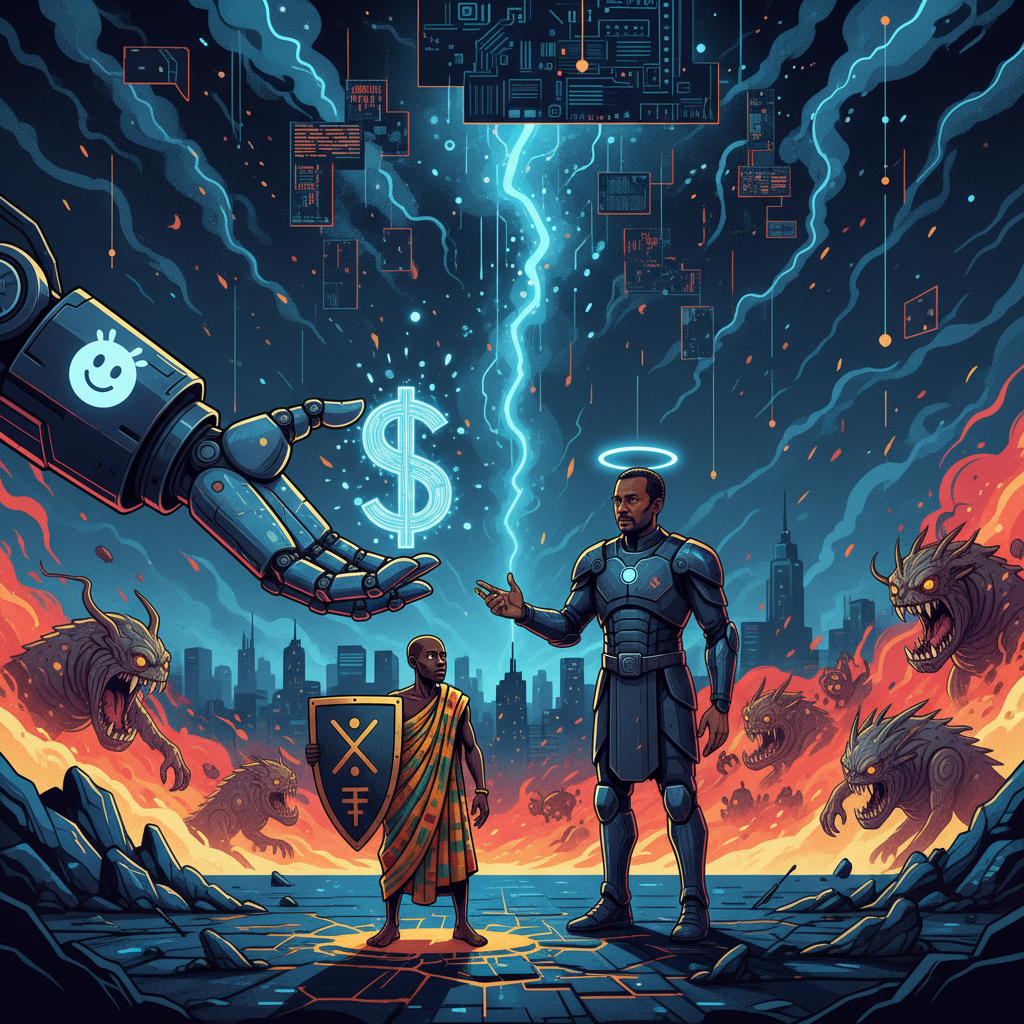

Akwaaba, my friends, and welcome back to DataGlobal Hub, where the future isn't just arriving, it's already here and buzzing with an energy that makes my heart sing! Today, we're diving deep into a phenomenon that is reshaping the very fabric of artificial intelligence, a development so profound it demands our immediate attention, especially here in Africa: Hugging Face.
Can you believe it? Hugging Face, the open-source AI platform that has become a digital marketplace for models, datasets, and demos, recently hit a staggering $4.5 billion valuation. And get this: they are now hosting over a million AI models. A million! That's not just a number, it's a digital explosion, a supernova of innovation that is democratizing AI at an unprecedented pace. The numbers don't lie, this is bigger than anyone realizes. But with such immense power comes a responsibility to understand the risks, not just the rewards, especially for nations like Ghana that are rapidly integrating AI into every sector.
The Unseen Shadows in the Open-Source Sunlight
While the open-source movement is a beacon of collaboration and accessibility, Hugging Face's rapid ascent also ushers in a new era of AI safety and security concerns. Think of it like this: Accra's bustling Kejetia market is a marvel of commerce and community, but without proper regulations and oversight, it could also become a place where counterfeit goods or even dangerous items circulate. The digital realm of AI models is no different. With over a million models readily available, the potential for malicious actors to exploit or weaponize these powerful tools grows exponentially.
The Risk Scenario: Malicious Model Injection and Supply Chain Attacks
Imagine a scenario where a seemingly benign, open-source language model downloaded from Hugging Face is subtly poisoned. It might perform perfectly for most tasks, but when prompted with specific keywords or contexts related to, say, national security, critical infrastructure, or even financial markets, it could generate disinformation, reveal vulnerabilities, or trigger harmful actions. This isn't science fiction, it's a very real threat known as a 'model poisoning attack' or 'AI supply chain attack.'
The technical explanation is rather chilling. Researchers have demonstrated that even a small percentage of maliciously crafted data injected into a training dataset can cause a model to behave unpredictably or maliciously under specific trigger conditions, while appearing normal otherwise. When these models are then uploaded to platforms like Hugging Face, they become accessible to millions. A developer in Accra, eager to build an innovative agricultural AI solution, might download such a model, integrate it, and unknowingly deploy a compromised system. The implications for Ghana's burgeoning digital economy, our food security, or even our democratic processes are profound.
The Expert Debate: Openness Versus Control
This rapid proliferation of open-source AI has ignited a fierce debate among experts globally. On one side, proponents argue that open access fosters innovation, democratizes technology, and allows for collective scrutiny, which ultimately enhances security. "The more eyes on the code, the faster vulnerabilities are found and fixed," argues Dr. Aisha Mensah, a leading AI ethicist at Ashesi University in Ghana. "Restricting access would only centralize power and slow down progress, leaving developing nations further behind. We need transparency, not secrecy."
On the other side, a growing chorus of voices, including some from major tech companies, express serious reservations. They point to the dual-use nature of advanced AI models. "A powerful language model that can generate persuasive text can be used for education, or it can be used to craft highly effective phishing campaigns and propaganda at scale," stated Mr. Satya Nadella, CEO of Microsoft, in a recent interview. "The challenge is ensuring responsible deployment without stifling the incredible innovation open source brings." His concerns are echoed by others who highlight the potential for state-sponsored actors or organized crime to leverage these models for cyber warfare, surveillance, or large-scale fraud.
Professor Kwesi Boateng, head of the AI for Development lab at the University of Ghana, offers a nuanced perspective. "We cannot afford to be alarmist, but neither can we be naive. The open-source movement has been a godsend for African tech. It allows our startups to build world-class solutions without the prohibitive costs of proprietary models. However, we must develop robust internal frameworks for vetting and validating these models. Relying solely on the goodwill of the global community is not a strategy." He advocates for national AI safety labs, perhaps modeled after similar initiatives in Europe or the US, to scrutinize open-source models for potential risks before widespread adoption.
Real-World Implications for Ghana and Beyond
The implications for Ghana are particularly acute given our rapid digital transformation. Our government is investing heavily in AI for public services, from healthcare diagnostics to traffic management. Our vibrant startup ecosystem, especially in places like Accra's Silicon Accra, is leveraging open-source tools to build solutions for agriculture, finance, and education. We are a nation of builders, and these tools are our digital cement.
Consider the agricultural sector, a cornerstone of Ghana's economy. AI models are being developed to predict crop yields, detect plant diseases, and optimize irrigation. If a compromised model were to be deployed in a nationwide agricultural program, the economic fallout could be devastating. Similarly, in the financial technology space, where Ghana is a regional leader, a malicious model could facilitate sophisticated fraud or destabilize markets. The potential for misinformation campaigns, especially during election cycles, is another critical concern that could undermine our democratic institutions.
According to a recent report by the African Union, AI adoption in Africa is projected to grow by 35% annually over the next five years, with open-source models driving a significant portion of this growth. This rapid acceleration means that the window for establishing robust safety protocols is closing fast. We need to be proactive, not reactive, in safeguarding our digital future.
What Should Be Done: A Ghanaian Blueprint for AI Safety
So, what's the path forward? For Ghana, and indeed for all nations embracing this open-source AI revolution, a multi-pronged approach is essential:
- Invest in Local AI Safety Expertise: We need to train a new generation of Ghanaian AI safety researchers and engineers who can understand, audit, and secure open-source models. Collaborations between universities, government, and industry are crucial here. Programs like the African Institute for Mathematical Sciences (aims) could expand their curriculum to include specialized AI safety modules.
- Develop National Model Vetting Frameworks: Ghana needs a national body or a consortium of experts dedicated to evaluating the safety and security of widely used open-source AI models. This body could issue certifications or warnings, much like how we regulate food and drug safety. This would provide a layer of trust for developers and organizations. This is where we can truly show that Ghana is proving the skeptics wrong, by leading with responsible innovation.
- Promote Responsible AI Development Practices: Education is key. Developers must be aware of the risks of model poisoning and supply chain attacks. Platforms like Hugging Face could implement stricter vetting processes for models, perhaps using AI to detect anomalies or malicious code patterns. The community itself, through peer review and reporting mechanisms, also plays a vital role.
- Foster International Collaboration: AI safety is a global challenge that requires global solutions. Ghana should actively participate in international forums and initiatives focused on AI governance and safety, sharing our unique perspectives and learning from others. Organizations like the United Nations and the African Union are already working on frameworks, and our voice must be heard.
- Embrace Explainable AI (XAI): We need models that don't just give us answers, but also explain how they arrived at those answers. This transparency is crucial for detecting malicious behavior or unintended biases. Research into XAI should be prioritized.
The rise of Hugging Face is a testament to the incredible power of collective human ingenuity. It's a goldmine of innovation waiting to be tapped, and Ghana stands ready to leverage its potential. But like any powerful tool, it demands respect, vigilance, and a clear understanding of its double-edged nature. Let us embrace this future with our characteristic Ghanaian optimism, but also with our eyes wide open and our minds focused on building a secure, equitable, and prosperous digital tomorrow. The stakes are too high for anything less. For more insights into the evolving AI landscape, you can always check out what's happening over at TechCrunch's AI section or dive into the deeper research at MIT Technology Review. The conversation is just beginning.