
The air in Tokyo, even in the bustling districts, often carries a quiet hum, a subtle rhythm that speaks of tradition meeting relentless innovation. It is a city where ancient shrines stand beside neon-lit skyscrapers, a place that understands the delicate balance between past and future. This balance, I believe, is now being tested in the most profound way by the swirling currents of artificial intelligence, particularly in the realm of visual storytelling.
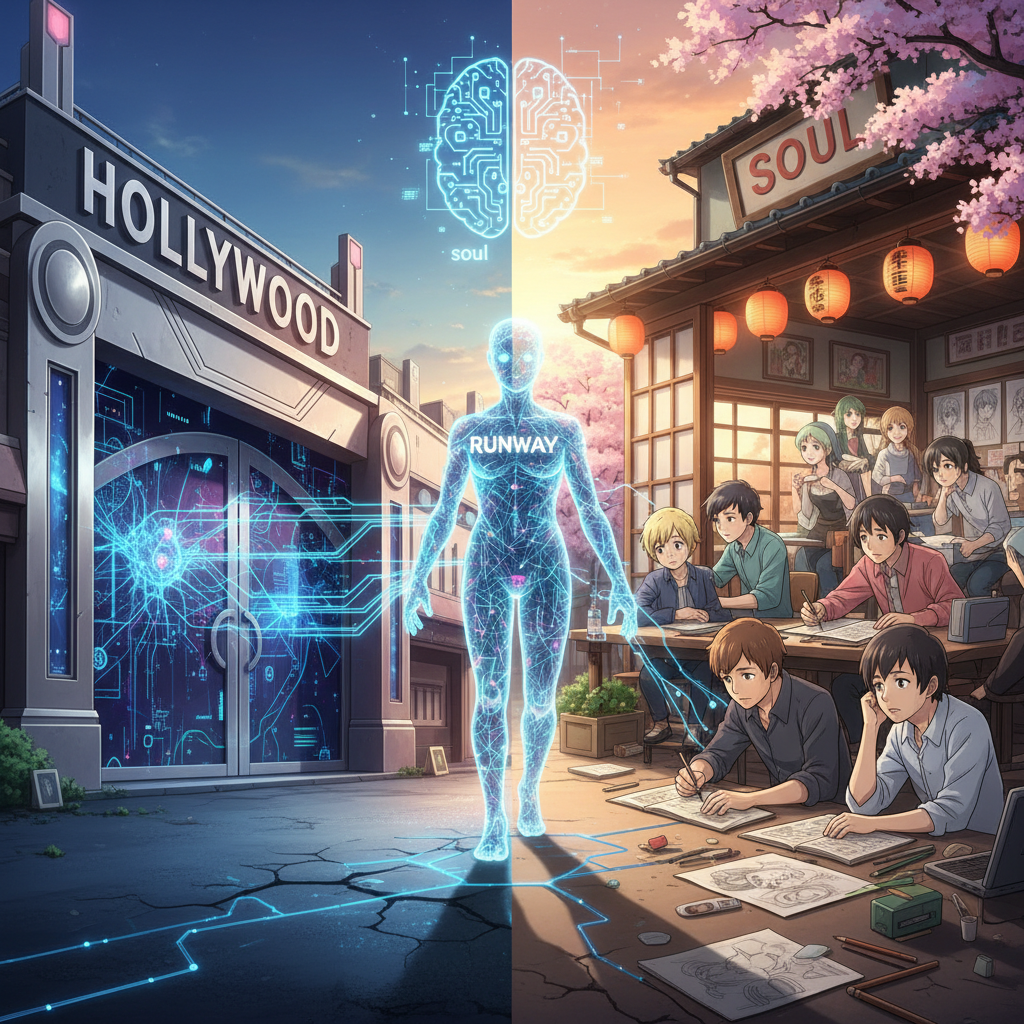
In the West, Hollywood is buzzing with a new kind of magic, one conjured not by special effects artists alone, but by algorithms. Companies like Runway ML have emerged as pioneers, offering tools that promise to transform text into stunning video, to animate static images, and to manipulate footage with unprecedented ease. Their Gen-1 and Gen-2 models, and now even more advanced iterations, are not just incremental improvements; they represent a seismic shift. Directors and producers, ever eager for efficiency and creative liberation, are experimenting with these tools, envisioning a future where entire scenes, perhaps even entire films, could be born from a few lines of text and a click of a button. The excitement is palpable, a mixture of awe and apprehension.
But what does this revolution, largely centered in Hollywood, mean for Japan, a nation that has given the world some of its most iconic and beloved visual narratives? I think of the meticulous hand-drawn frames of Studio Ghibli, the vibrant, dynamic action sequences of shonen anime, the subtle emotional nuances captured by generations of animators. This is not just an industry here; it is a cultural cornerstone, a source of national pride and a global phenomenon. The human side of the machine, as I often ponder, is never more evident than when technology threatens to redefine an art form so deeply rooted in human craft.
I recently spoke with Kenji Tanaka, a veteran animator in his late 50s, who has spent over three decades perfecting his craft in a small, bustling studio in Suginami. His hands, though slightly calloused, still move with the grace of a dancer as he sketches. "AI can generate images, yes," he told me, his voice soft but firm, "but can it understand the ma? The space between the notes, the pause before a crucial line, the unspoken emotion in a character's eyes? That comes from life, from experience, from the human heart. It is not just about drawing; it is about feeling." His words resonated deeply, a reminder that art is often found in the subtle, the intangible.
Indeed, the initial reactions from Japan have been a mix of curiosity and cautious skepticism. While some smaller studios and independent creators are exploring AI tools for pre-visualization, concept art, and even background generation, the broader sentiment in the established anime industry remains watchful. The Japan Animation Creators Association (JAniCA), for instance, has been actively discussing the implications of AI on artistic integrity and employment. Their stance, as articulated by a spokesperson last year, emphasizes the need for ethical guidelines and the protection of artists' livelihoods. "We must embrace technological progress," the spokesperson stated, "but not at the expense of the human spirit that defines our animation. Education and adaptation will be key, but so too will be safeguarding the unique contributions of our artists."
Consider the sheer scale of Japan's animation industry. It is a multi-billion dollar enterprise, employing tens of thousands of artists, directors, writers, and production staff. From the iconic Toei Animation to the innovative mappa and Kyoto Animation, these studios are powerhouses of creativity. The concern is not just about job displacement, though that is a very real worry for many young animators entering the field. It is also about the potential homogenization of artistic styles, the loss of unique voices, and the erosion of the painstaking craftsmanship that has long been a hallmark of Japanese animation.
Yet, there are also voices of optimism, particularly among younger creators who see AI as a powerful assistant rather than a replacement. Haruka Sato, a freelance digital artist in her early twenties, shared her perspective with me. "For independent creators like me, AI tools can be a game-changer," she explained. "They can help with repetitive tasks, generate variations quickly, and even suggest new creative directions. It allows me to focus more on the storytelling and less on the grunt work." She whispered something that changed my perspective: "It's not about replacing us, but empowering us to do more, to dream bigger, if we learn how to wield it." Her vision is of a symbiotic relationship, where human creativity guides the machine.
This sentiment is echoed by some forward-thinking production houses. In a quiet Tokyo lab, I learned about a small team at a mid-sized anime studio experimenting with Runway ML's capabilities to generate initial character poses and environmental elements, significantly reducing the time spent on early-stage production. They view it as a tool for accelerating the pre-production phase, freeing up human animators to focus on the intricate, expressive keyframes and character acting that truly bring a story to life. This approach suggests a future where AI handles the heavy lifting of repetitive tasks, allowing human artists to concentrate on the truly creative and emotionally resonant aspects of their work. For more on how AI is impacting creative industries globally, Wired has extensive coverage.
The economic implications are also profound. If Hollywood can produce high-quality video content with fewer human artists and shorter timelines, it could put immense pressure on traditional animation pipelines worldwide. Japan, with its relatively high labor costs compared to some other Asian animation hubs, might find itself at a crossroads. Will it double down on its unique artistic integrity, positioning itself as a bastion of human-crafted animation, or will it strategically integrate AI to remain competitive on a global stage? The answer, I suspect, will be a nuanced blend of both.
This is not merely a technological debate; it is a philosophical one. What defines art? Is it the outcome, or the process? Is the human touch irreplaceable, or can machines learn to emulate it so perfectly that the distinction becomes meaningless? These are questions that Japan, with its deep appreciation for craftsmanship and its rich artistic heritage, is uniquely positioned to explore. The Agency for Cultural Affairs and various industry bodies are keenly observing these developments, understanding that the future of a significant cultural export is at stake.
As I left Kenji Tanaka's studio, the scent of ink and paper still lingering in the air, I thought about the monozukuri spirit, the Japanese philosophy of craftsmanship and continuous improvement. This spirit, I believe, will guide Japan through this new era. It is not about resisting change entirely, but about thoughtfully integrating new tools while preserving the essence of what makes Japanese animation so special. The revolution in AI video generation is here, and while Hollywood embraces its shiny new toys, Japan is quietly, thoughtfully, considering how to keep the soul in its art. For further insights into the business side of AI, Reuters provides excellent reporting. The conversation is just beginning, and the canvas of the future is still being drawn, one human stroke, and perhaps one AI-generated pixel, at a time.