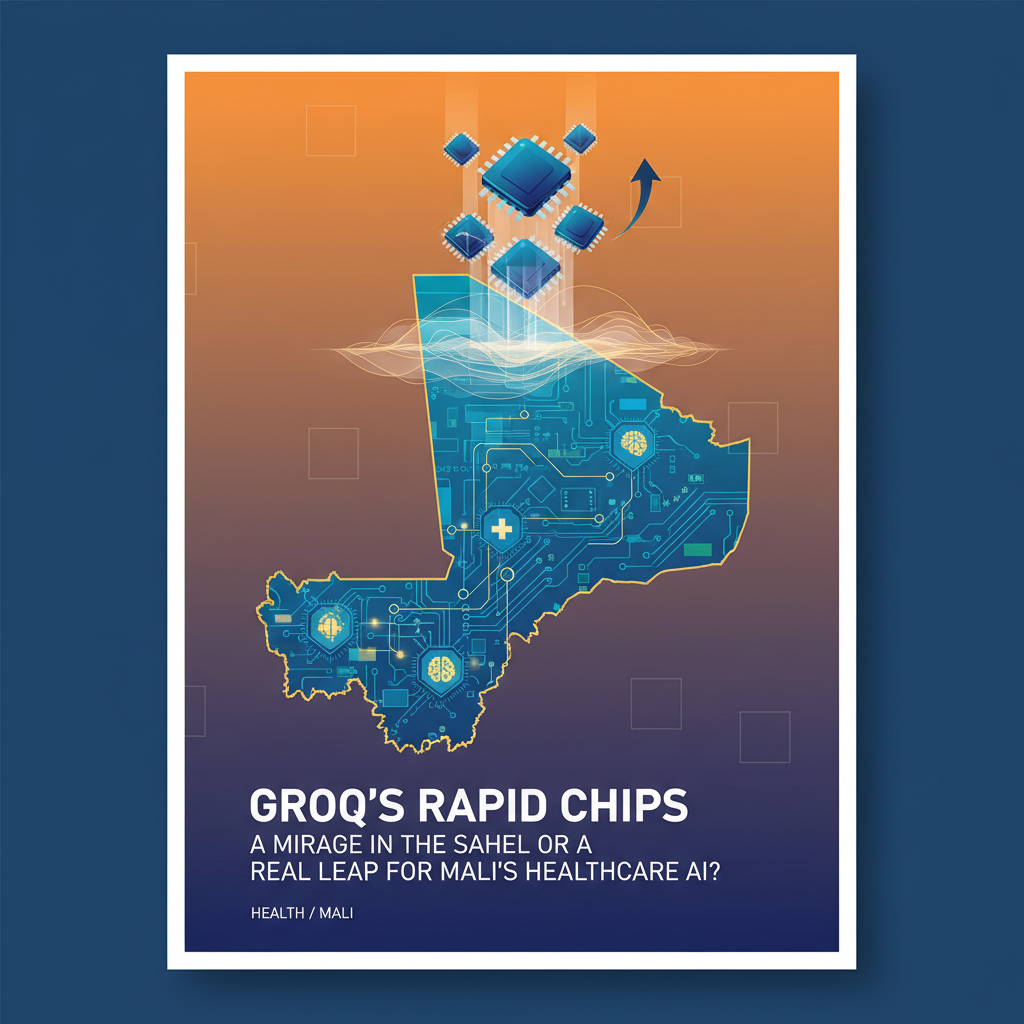

The global discourse around artificial intelligence often feels like a distant drumbeat in Bamako, a symphony of promises played out in Silicon Valley boardrooms, far removed from the immediate concerns of our communities. Yet, when a company like Groq emerges, claiming a tenfold increase in speed and a significant reduction in cost for large language model inference, even the most seasoned observers, myself included, must pause. Is this a genuine technological breakthrough poised to democratize advanced AI, or merely another iteration of Silicon Valley hyperbole that will bypass the practical needs of places like Mali?
For decades, the narrative surrounding new computing paradigms has followed a predictable arc. From the mainframe era to the personal computer revolution, and subsequently the cloud computing surge, each wave promised unprecedented efficiency and accessibility. The underlying hardware, however, has always been the silent arbiter of these promises. We saw this with the rise of NVIDIA's GPUs, which transformed AI training from a theoretical exercise into a practical endeavor, albeit an expensive one. The sheer computational power required for modern AI models, particularly large language models, has created a bottleneck, limiting their deployment and increasing operational costs. This is where Groq, with its Language Processing Units or LPUs, enters the fray, asserting a fundamental architectural advantage over traditional GPUs for inference workloads.
Historically, Mali and many other African nations have been late adopters of these technological waves, not due to a lack of innovation or desire, but due to fundamental infrastructure deficits. The digital divide is not merely about internet access, it is about reliable electricity, robust data centers, and the technical expertise to deploy and maintain complex systems. In 2023, for instance, Mali's internet penetration stood at approximately 28 percent, and access to stable, affordable electricity remains a significant hurdle for both urban and rural populations. How can we leverage faster AI chips when the very foundation they require is still under construction?
Groq's claims are compelling on paper. Their architecture, designed specifically for sequential inference operations, reportedly achieves latencies measured in milliseconds, not seconds, for complex LLM queries. This translates to more responsive AI applications, potentially enabling real-time conversational AI or instantaneous medical diagnostics. For example, a recent demonstration showed Groq's LPU systems processing 65-billion-parameter models at hundreds of tokens per second, a figure that far outstrips many GPU-based solutions. The company has secured significant investment, and its technology is being adopted by various enterprises in North America and Europe, seeking to reduce their operational expenditure on AI inference. According to TechCrunch, the company's valuation has soared, reflecting investor confidence in its disruptive potential.
However, the path from a laboratory benchmark to a practical, scalable solution in a Malian context is fraught with challenges. Let's be realistic. The cost of deploying a single Groq system, while potentially lower in the long run for inference compared to an equivalent GPU cluster, still represents a substantial capital outlay. Furthermore, these systems require consistent power and cooling, resources that are often scarce and expensive here. Our healthcare system, for instance, struggles with basic equipment maintenance, let alone the sophisticated upkeep required for cutting-edge AI hardware.
I recently spoke with Dr. Aminata Diallo, Head of Digital Health Initiatives at the Malian Ministry of Health and Social Development. She expressed a cautious optimism. "The idea of faster, cheaper AI for diagnostics or patient management is incredibly appealing," Dr. Diallo stated. "Imagine an AI assistant that can instantly analyze medical images or provide real-time support to rural health workers, overcoming language barriers with local dialects. However, the data tells a different story when we look at our current capacity. We are still working to digitize patient records across all major hospitals, let alone deploying advanced inference engines. The focus for us remains on foundational digital literacy and reliable connectivity first." Her perspective underscores a critical point: advanced AI hardware is only as useful as the ecosystem it operates within.
Mr. Oumar Konaré, a telecommunications engineer and founder of a local data center startup in Bamako, offered a more technical view. "Groq's LPUs are impressive, no doubt," Konaré explained. "But they are not a magic bullet. They optimize for a specific workload: LLM inference. What about the training phase, which still largely relies on NVIDIA GPUs? And what about the sheer volume of data needed to fine-tune these models for local languages and medical contexts? We need robust, low-latency networks and secure, energy-efficient data centers. Without these, even a 10x speedup is like having a Ferrari on a dirt road during the rainy season." He highlighted the need for practical solutions, not moonshots that ignore the ground realities of developing infrastructure.
Even in the academic sphere, there is a healthy skepticism. Professor Fatoumata Traoré, a computer science lecturer at the University of Bamako, emphasized the need for local talent development. "These technologies require skilled engineers to deploy, manage, and integrate them into existing systems," Professor Traoré noted. "Our curriculum is evolving, but we cannot produce experts overnight. We need partnerships, knowledge transfer, and investment in human capital alongside hardware. Without our own people understanding and adapting these tools, they remain foreign objects, no matter how fast they are." Her point is crucial: technology transfer is not just about shipping boxes, it is about building local capacity.
My verdict is clear: Groq's custom AI inference chips represent a significant technical advancement in the global AI landscape. Their promise of faster, cheaper LLM responses is not a fad in the technical sense; it is a genuine engineering achievement that will likely become a new normal for high-volume AI inference in well-resourced environments. For Mali, however, it remains a distant aspiration rather than an immediate game-changer. The fundamental challenges of power infrastructure, internet connectivity, data availability, and skilled human resources must be addressed first. Investing in a single, ultra-fast chip without the robust ecosystem to support it is akin to buying a sophisticated surgical robot for a hospital that lacks sterile operating theaters or trained surgeons. The potential is undeniable, but its realization in our context requires a phased, pragmatic approach.
We must prioritize building the digital foundations that can truly leverage such innovations. This means investing in renewable energy solutions for stable power, expanding fiber optic networks across the country, and fostering local talent through education and training. Only then can we genuinely harness the power of advanced AI, whether from Groq, NVIDIA, or any other innovator, to address critical issues in healthcare, education, and economic development. Until then, the focus must remain on practical, incremental steps that build resilience and capability from the ground up. The future of AI in Mali will be built on solid infrastructure, not just silicon speed, and that is a reality we cannot afford to ignore.