
The scent of freshly brewed hojicha always brings me back to my grandmother’s small, tidy home in Setagaya. Her hands, gnarled by years of tending to her garden and family, would carefully pour the tea as she listened to my stories from the city. Sometimes, I would ask her about a forgotten custom, a traditional recipe, or the meaning behind an old proverb. She would not give me an instant answer. Instead, she would often pause, her eyes distant as she searched her memories, sometimes even pulling out an old, worn book from a dusty shelf. The answer, when it came, was always rich with context, personal anecdotes, and the wisdom of a life lived. It was a journey, not a destination.
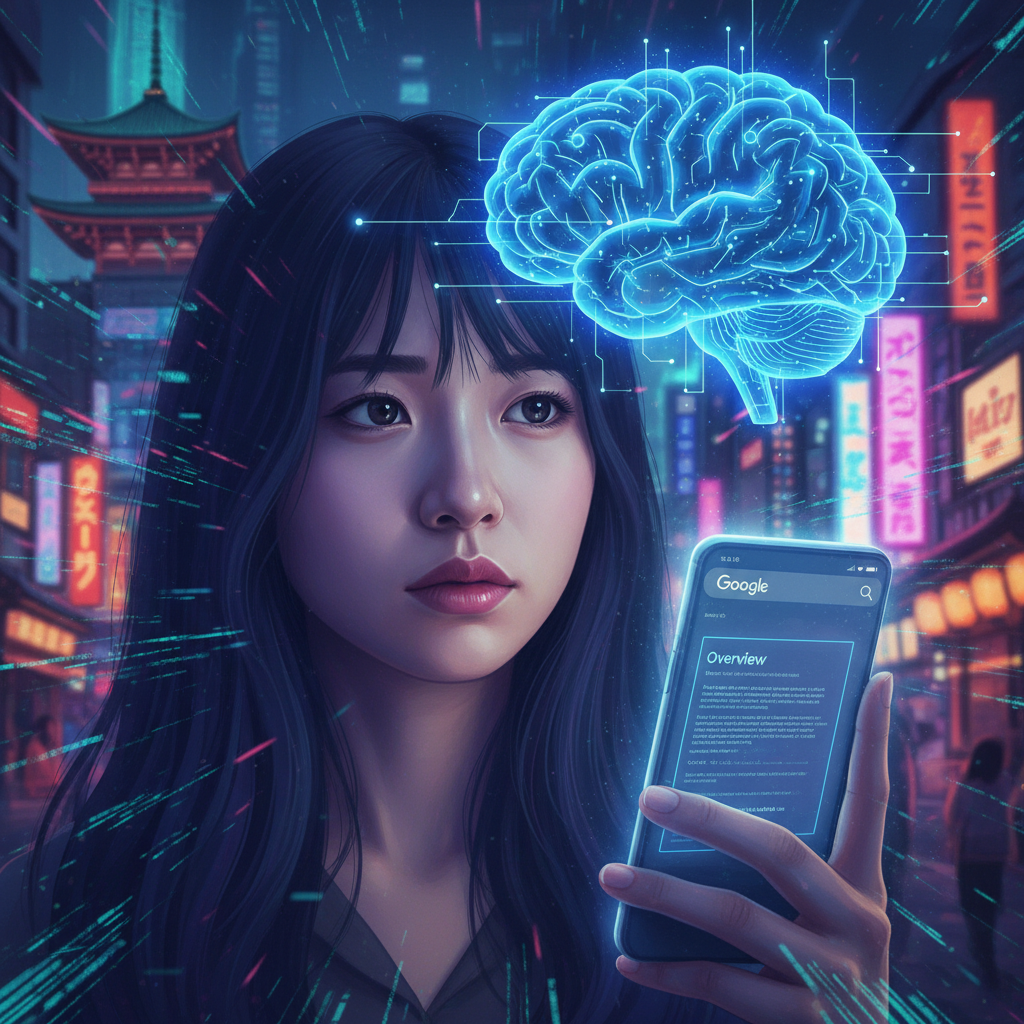
Today, the digital world offers us a different kind of journey, or perhaps, no journey at all. Google's AI Overviews, a feature now increasingly prominent in our search results, promise to distill the vastness of the internet into concise, AI-generated summaries. It is like having a digital sage, always ready with an answer, but one that perhaps lacks the warmth and depth of my grandmother’s stories. This shift, while seemingly benign, is beginning to stir questions in the quiet corners of Japanese psychology labs and among everyday users, about its subtle yet profound impact on our cognition, behavior, and even our relationships.
Consider Mr. Tanaka, a retired schoolteacher in Kyoto, who used to spend hours researching historical facts for his local community group. He would delve into various websites, cross-reference sources, and often stumble upon fascinating tangential information that enriched his understanding. Now, he finds himself relying heavily on the AI Overviews. “It is so quick, so efficient,” he told me recently, his voice tinged with a mix of gratitude and a subtle unease. “But sometimes, I feel… less engaged. The joy of finding something unexpected, that is gone.” His experience echoes a growing concern: are we trading depth for speed, and what is the psychological cost?
Recent research from institutions like the University of Tokyo’s Department of Cognitive Psychology suggests that constant exposure to pre-digested information might be altering our information-seeking behaviors. Dr. Kenjiro Sato, a leading cognitive scientist, explains, “When an AI provides a summary, it bypasses the active process of critical evaluation and synthesis that a human brain typically undertakes. This could lead to what we call 'cognitive offloading,' where our brains become less adept at complex information processing over time.” He pointed to preliminary studies indicating a potential decrease in long-term retention of information when it is consumed via AI summaries versus traditional, multi-source research. “The human side of the machine,” he mused, “is not just about how we build AI, but how AI rebuilds us.”
The implications extend beyond individual cognition. In a society like Japan, where nuance, context, and the unspoken are deeply valued, the blunt efficiency of AI Overviews can feel jarring. Our culture often emphasizes the process, the journey, as much as the outcome. The art of tea ceremony, the meticulous preparation of sushi, the careful arrangement of a ikebana flower display, these are all testaments to the beauty found in deliberate effort. When Google’s AI offers a direct answer, it strips away the layers of discovery that often lead to deeper understanding and appreciation.
Dr. Akiko Nakamura, a sociologist specializing in digital culture at Waseda University, shared her perspective. “In Japan, we often learn through shuhari, a concept of learning through imitation, then breaking from tradition, and finally innovating. The AI overview gives you the 'ri' without the 'shu' or 'ha.' It presents the conclusion without the journey of mastery. This could subtly undermine our cultural emphasis on learning through experience and deep engagement.” She whispered something that changed my perspective: “True wisdom often comes from asking the right questions, not just getting the fastest answers.”
Moreover, the rise of AI Overviews raises significant questions about the future of the open web itself. If users are increasingly satisfied with AI-generated summaries, will they still click through to the original sources? This could severely impact content creators, independent journalists, and smaller websites that rely on traffic to sustain their work. As TechCrunch has reported, many publishers are already expressing concerns about declining referral traffic. If the diverse voices of the internet are silenced by a single, synthesized AI voice, what becomes of the rich tapestry of information and perspectives that the open web was designed to foster? It is not just about business models, it is about the plurality of thought and the democratic access to varied viewpoints.
The psychological impact also touches on our relationship with truth and authority. When an AI presents information as a definitive answer, it can inadvertently imbue that information with an unquestionable authority, even if the underlying sources are flawed or biased. This phenomenon, sometimes called the “automation bias,” means we are more likely to accept information from an automated system without critical scrutiny. In a world grappling with misinformation, this could be a dangerous precedent. We saw glimpses of this during the early days of generative AI, where users struggled to discern factual accuracy from confidently hallucinated responses. While Google has implemented safeguards and improved accuracy, the inherent psychological tendency to trust automated systems remains a concern.
So, what can we do? How do we navigate this new landscape without losing the precious human qualities of curiosity, critical thinking, and the joy of discovery? The answer, I believe, lies not in rejecting AI, but in cultivating a conscious relationship with it. For individuals, it means practicing what I call “mindful searching.” Instead of passively accepting the AI Overview, take a moment to question it. Ask yourself: Where did this information come from? What are the alternative perspectives? Can I dig deeper? Use the AI as a starting point, not an endpoint. Embrace the journey, even if the AI tries to shortcut it.
Educators, too, have a crucial role. Schools in Japan, known for their rigorous approach to learning, could integrate digital literacy programs that specifically address AI interaction. Teaching students how to critically evaluate AI-generated content, how to trace sources, and how to formulate complex queries that go beyond simple facts will be essential. As MIT Technology Review often highlights, the future of education must adapt to the realities of AI.
For technology companies like Google, the responsibility is immense. Designing AI Overviews that encourage exploration, perhaps by prominently displaying diverse sources or prompting users to consider different viewpoints, could mitigate some of these cognitive risks. Transparency about the AI’s limitations and potential biases is also paramount. It is a delicate balance, between providing convenience and preserving the intellectual vitality of users and the health of the open web. Perhaps a future iteration could offer a “deep dive” button, encouraging users to explore the rabbit hole of information that my grandmother cherished.
The convenience of instant answers is undeniably appealing, especially in our fast-paced lives. But as I reflect on Mr. Tanaka’s quiet unease and Dr. Nakamura’s insightful words, I am reminded that some things are too valuable to be streamlined. The journey of learning, the act of questioning, the slow accumulation of wisdom through thoughtful engagement, these are the treasures that make us human. We must ensure that in our pursuit of efficiency, we do not inadvertently diminish the very qualities that define our intellect and our spirit. The future of the open web, and indeed, the future of our minds, depends on how wisely we choose to interact with these powerful new tools. For more on the broader implications of AI on information consumption, you might find this article on AI ethics and societal impact [blocked] insightful.