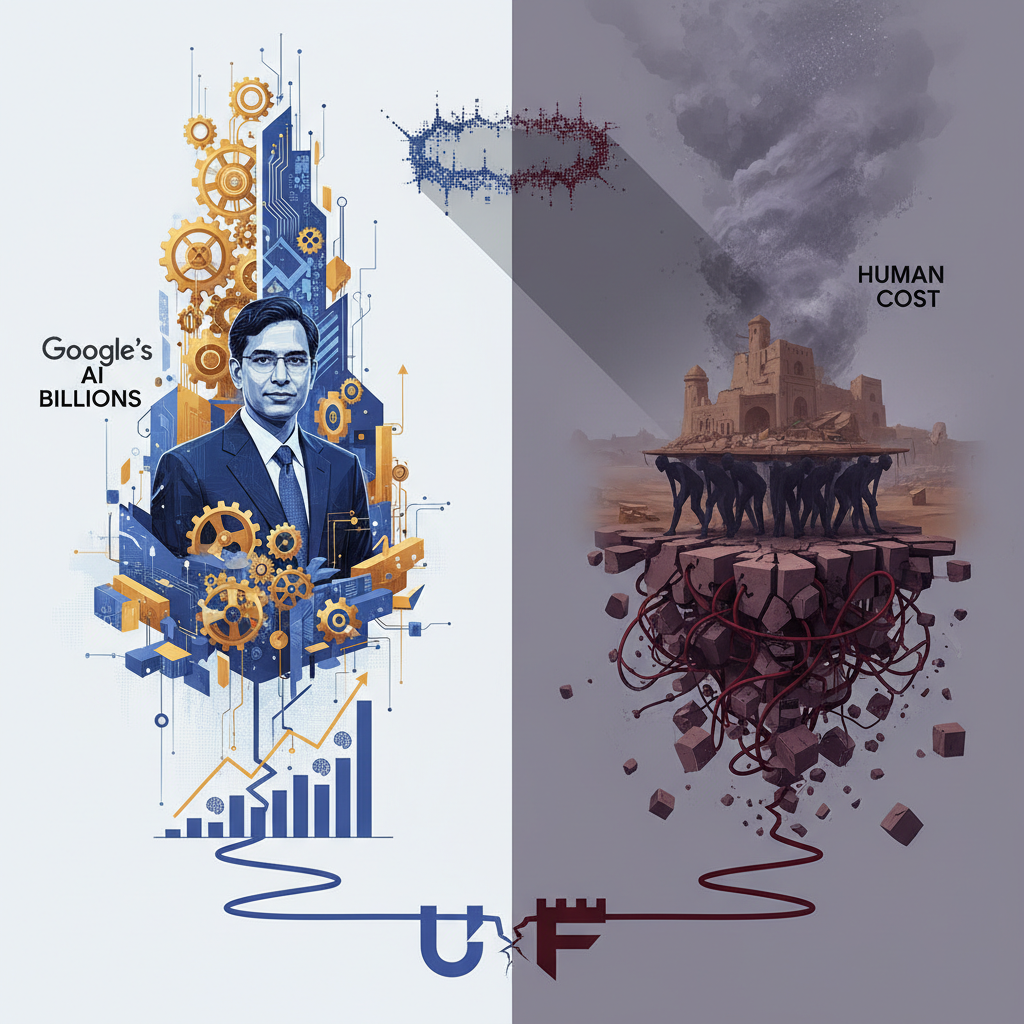

Does the relentless pursuit of artificial intelligence, marked by colossal investments in data centers and simultaneous workforce reductions, signal a new era of corporate strategy or merely a familiar cycle of technological disruption? This question looms large, not only in Silicon Valley boardrooms but also in places like Dushanbe, where the ripples of global tech decisions are increasingly felt.
For years, the narrative around technological advancement, particularly from the West, has been one of boundless opportunity and job creation. We were told that innovation would uplift, empower, and expand the human endeavor. Yet, the recent actions of tech giants, most notably Google under Sundar Pichai, present a more complex, and frankly, more unsettling picture. The company has announced billions of dollars in new AI data center investments, while simultaneously conducting multiple rounds of layoffs affecting thousands of employees globally. In 2023 and early 2024, Google parent Alphabet reported over 12,000 job cuts, followed by further reductions in areas like hardware, engineering, and advertising sales, even as its capital expenditures soared, largely driven by AI infrastructure. This juxtaposition demands scrutiny.
Historically, technological shifts have always brought about changes in the labor market. The Industrial Revolution, the advent of computing, and the rise of the internet each displaced certain types of work while creating others. However, the current wave, driven by generative AI, appears to be accelerating this process with unprecedented speed and scale. In the past, companies often reinvested profits into expanding human capital alongside technological upgrades. Today, the emphasis seems to be almost exclusively on the latter, with a clear intent to automate tasks traditionally performed by humans.
Consider the data: Alphabet's capital expenditures, primarily for technical infrastructure including servers and data centers, reached approximately 32.3 billion dollars in 2023, a significant portion earmarked for AI capabilities. For 2024, projections indicate continued, if not accelerated, spending in this domain. Simultaneously, reports from various news outlets, including TechCrunch, confirm ongoing layoffs across various Google divisions. This is not merely a reallocation of resources; it is a fundamental redefinition of what constitutes valuable capital within these organizations. Human labor, once a primary asset, is increasingly viewed as a cost center to be optimized away by intelligent algorithms and robust computing power.
"The pattern is clear," states Dr. Gulnara Karimova, an economic analyst at the Tajik National University. "Companies are betting on AI to deliver exponential returns, and they are willing to shed human workers to fund that bet. The efficiency gains are undeniable, but the social contract is eroding. We are seeing a shift from a labor-intensive growth model to a capital-intensive, AI-driven one." Her perspective resonates deeply in a region like Central Asia, where labor stability is often a cornerstone of economic development.
From the perspective of Silicon Valley, this strategy is often framed as a necessary evolution. "To remain competitive in the global AI race, we must invest aggressively in the foundational infrastructure," explained a former Google executive, who requested anonymity due to ongoing non-disclosure agreements. "The scale of computation required for advanced models like Gemini is immense. These data centers are not just buildings; they are the factories of the future, producing intelligence." This sentiment is echoed by many industry leaders who view AI as the next frontier, a transformative technology that justifies radical operational changes.
However, this narrative often overlooks the human element. The thousands of individuals laid off are not abstract data points; they are professionals with families, mortgages, and aspirations. Their skills, often honed over years, are being deemed redundant by algorithms that can perform tasks faster or cheaper. "It is a brutal calculus," observes Mr. Rustam Safarov, head of the Tajikistan Union of IT Workers. "While we understand the need for progress, the speed and scale of these layoffs, particularly from companies that once championed employee welfare, are alarming. It sends a message that human loyalty is secondary to algorithmic efficiency." The reality in Central Asia is different from the headlines; here, job security holds a profound weight, and such seismic shifts in employment strategy are viewed with apprehension.
Expert opinions vary on whether this trend is a temporary adjustment or a permanent fixture of the new economic landscape. Dr. Elena Petrova, a labor economist at the Moscow School of Management Skolkovo, suggests that "we are witnessing a structural change, not merely a cyclical downturn. The nature of work itself is being redefined. Companies are moving towards a leaner, more automated operational model. This is the new normal, and governments and educational institutions must adapt rapidly to retrain workforces for roles that complement, rather than compete with, AI systems." Her analysis, often featured in publications like MIT Technology Review, points to a future where human-AI collaboration becomes paramount, but the path to that future is fraught with displacement.
Conversely, some analysts argue that the current wave of layoffs might be an overcorrection, a speculative bubble driven by investor enthusiasm for AI. "While AI is powerful, its true economic impact and job displacement potential are still being assessed," says Professor David Lee, a technology policy expert at Stanford University. "There's a risk that companies are cutting too deep, too fast, underestimating the value of human intuition, creativity, and complex problem-solving that current AI still struggles with. We might see a rebound in certain human-centric roles once the initial AI hype cycle moderates." This perspective suggests that while AI will undoubtedly reshape industries, the wholesale replacement of human labor might be overstated in the short to medium term.
My verdict, grounded in the practicalities observed from our vantage point in Tajikistan, leans towards a cautious acceptance of this as a new normal, albeit one with significant caveats. The sheer scale of investment into AI infrastructure, coupled with the strategic focus of companies like Google, indicates a long-term commitment to an AI-first future. This is not a passing fad. The economic incentives for efficiency and competitive advantage are too strong to ignore. However, the human cost is substantial and cannot be dismissed as mere collateral damage. Tajikistan's challenges require Tajik solutions, and ignoring the social impact of global tech trends would be a grave error.
The implications for developing economies, particularly those reliant on human capital, are profound. As AI systems become more capable, the demand for certain types of labor, even in outsourcing hubs, may diminish. This necessitates a proactive approach to education and skill development, focusing on areas where human capabilities remain indispensable: critical thinking, emotional intelligence, creativity, and complex inter-personal communication. Let's talk about what actually works: investing in our people's adaptability, fostering innovation that creates new forms of work, and building robust social safety nets to cushion the inevitable transitions. The future of work, shaped by AI, will require more than just technological prowess; it will demand a renewed commitment to human dignity and societal resilience. The billions Google spends on data centers are building a powerful new world, but we must ensure it is a world where humanity still finds its place, not just its replacement. For further reading on the broader implications of AI in the workforce, consider articles found on Reuters Technology.