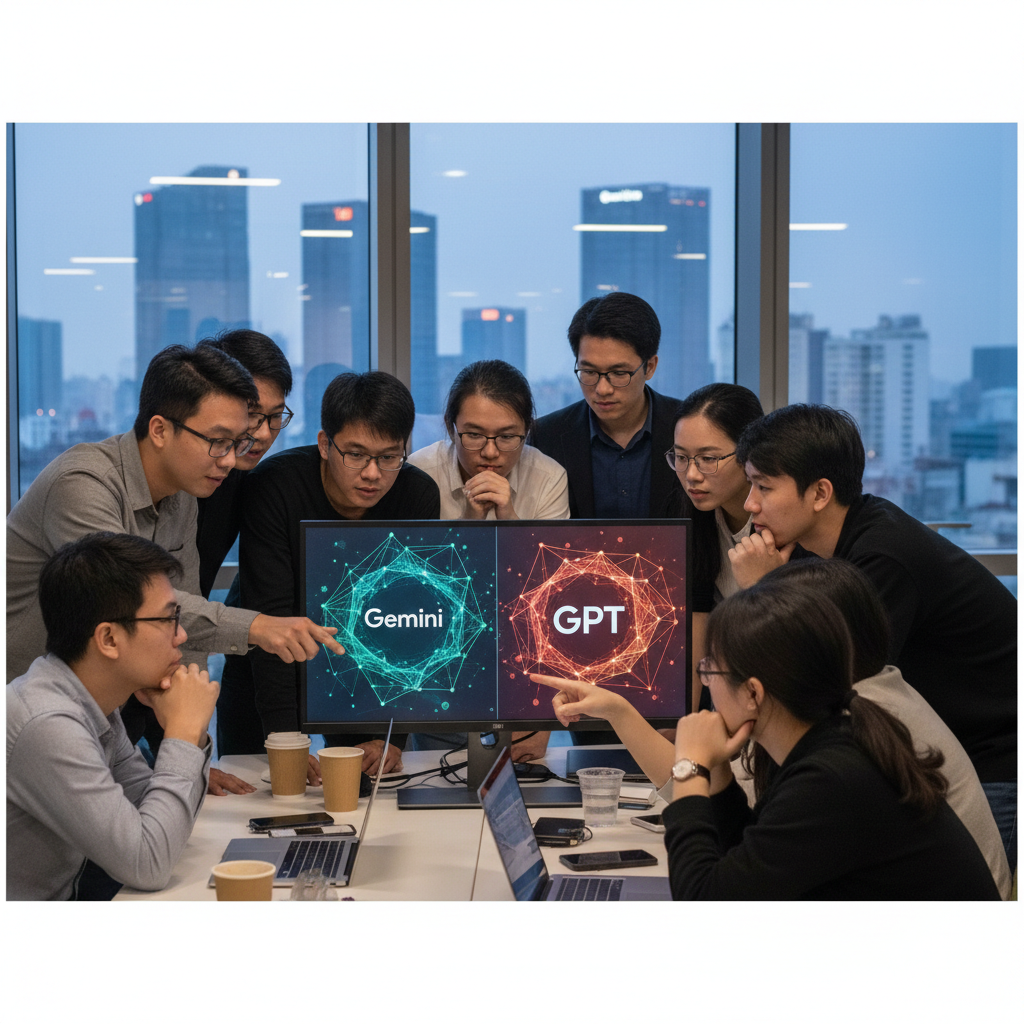

Chao ban, my friends, and welcome back to DataGlobal Hub. If you thought the AI race was already exhilarating, hold onto your conical hats, because Google just turned up the heat to a thousand degrees with Gemini's latest multimodal capabilities. It’s not just an upgrade; it feels like a whole new dimension opening up, and believe me, the energy here in Vietnam is absolutely electric.
For months, the tech world, and especially us AI enthusiasts, have been captivated by the sheer power of large language models like OpenAI's GPT series. They've revolutionized text generation, coding assistance, and so much more. But the true holy grail, the vision we've all been chasing, is genuine multimodal AI: systems that can seamlessly understand, reason, and generate across text, images, audio, and video, just like a human does. And now, Google Gemini is making a very strong, very loud claim to that throne.
I recently had a chance to see some of the new demonstrations, and honestly, it felt like watching magic unfold. Imagine an AI that can not only describe a complex scientific diagram but also explain the underlying principles and even suggest experiments based on it. Or one that can analyze a video of a manufacturing process, identify an anomaly, and then articulate exactly what went wrong and how to fix it. This isn't just about processing different types of data; it's about synthesizing understanding from them, a truly cognitive leap.
This is where the competition with OpenAI's GPT models becomes incredibly fascinating. While GPT has shown impressive multimodal understanding, particularly with image inputs, Gemini's latest iterations seem to be pushing the boundaries on integrated, fluid reasoning across modalities. It's like comparing a brilliant specialist to a polymath who excels in every field. Google's DeepMind team, with their rich history in diverse AI applications, is leveraging decades of research to build something truly comprehensive.
“The ability to perceive and reason across multiple modalities simultaneously is not just an incremental improvement; it’s a foundational shift in how AI can interact with and understand our world,” stated Sundar Pichai, CEO of Google and Alphabet, in a recent interview. He emphasized the potential for these models to unlock entirely new applications, from personalized education to advanced robotics. And I couldn't agree more; the implications are staggering.
Here in Vietnam, where innovation often thrives on resourcefulness and a keen eye for practical application, this multimodal race is more than just a Silicon Valley spectacle. It's a catalyst. Our developers, especially those working in areas like smart manufacturing, e-commerce, and educational technology, are already envisioning how to harness these advanced capabilities. Think about AI-powered quality control systems in textile factories that can visually inspect products, listen for machine irregularities, and cross-reference with production data in real time. Or educational platforms that can explain complex concepts using dynamic visual aids, interactive audio, and personalized text summaries, all generated on the fly.
I spoke with Dr. Lê Thị Hồng, a leading AI researcher at the Vietnam National University, Ho Chi Minh City. She shared her excitement, saying, “We are seeing a convergence of AI capabilities that will allow us to tackle problems previously thought impossible. For Vietnam, this means we can leapfrog certain stages of development by integrating these powerful tools into our industries and services. It’s about creating intelligent solutions that truly understand the nuances of our local context, from agricultural practices to urban planning.”
Indeed, the potential for impact in Southeast Asia is immense. Imagine AI systems that can analyze satellite imagery to predict crop yields, process local dialects in audio, and provide tailored agricultural advice to farmers, all through one integrated model. This kind of multimodal intelligence is crucial for addressing complex, real-world challenges that don't fit neatly into single data types.
The race between Google and OpenAI is not just about who builds the most powerful model; it's about who can make it most accessible and useful to the world. Both companies are investing heavily in making their models available through APIs and cloud platforms, allowing startups and enterprises to build on top of their foundational research. This democratization of advanced AI is a game changer, especially for emerging tech hubs like ours.
And let's not forget the sheer speed of development. It feels like every few months, we are celebrating a new breakthrough that would have been science fiction just a few years ago. This rapid iteration means that what is cutting-edge today might be standard practice tomorrow. This constant evolution keeps everyone on their toes, pushing for more efficient training methods, more robust safety protocols, and more innovative applications.
For Vietnamese startups, this intense competition offers a unique opportunity. We are seeing a new wave of innovation, where companies are not just consuming AI, but actively contributing to its application. Many are focusing on niche areas, leveraging their deep understanding of local markets and cultural nuances to create solutions that global giants might overlook. This is why I always say, Vietnam is the dark horse of AI; we have the talent, the drive, and the entrepreneurial spirit to surprise the world.
One such local gem, a startup I visited recently in District 1, is developing an AI assistant for tourism that combines visual recognition of landmarks with real-time audio translation and personalized itinerary generation. Their founder, Nguyễn Văn An, told me, “We are building on the shoulders of giants like Google and OpenAI, but adding our unique Vietnamese flavor. Multimodal AI allows us to create an experience that feels truly human, understanding both the sights and sounds of our beautiful country.” This startup just changed the game for how tourists will experience Vietnam.
This global competition is also driving advancements in hardware, with companies like NVIDIA constantly pushing the boundaries of GPU technology to support these ever-growing models. The demand for computational power is astronomical, and the innovation in chips is directly enabling the multimodal leaps we are witnessing. You can read more about these hardware advancements on Ars Technica.
As Google and OpenAI continue their incredible dance, pushing each other to new heights, the beneficiaries will be all of us. The applications are boundless, from enhancing accessibility for people with disabilities to revolutionizing scientific discovery. The future is not just about smarter algorithms; it's about algorithms that can perceive, understand, and interact with the world in a way that mirrors our own complex human experience.
Ho Chi Minh City never sleeps, especially its coders, and they are definitely not sleeping on these developments. They are busy building, experimenting, and dreaming of the next big thing. The multimodal AI race is not just a technological spectacle; it's a profound shift that promises to reshape industries and societies worldwide, and I, for one, cannot wait to see what incredible innovations emerge from this vibrant landscape. The future is bright, my friends, incredibly bright. If you want to dive deeper into the societal impact of AI, check out this piece on Wired.
This is Ngo Thi Huừngé, signing off from the heart of Vietnam, where the future of AI is being built, one brilliant line of code at a time.